Showing posts with label Mary Mother of God. Show all posts

Sunday, January 1, 2012

Eureka

It must have been an illumination vouchsafed by the Paraclete, I say in all humility: on New Year's Eve at the parish vigil Mass, I finally understood why, at O.F. Mass, the first reading on the Solemnity of Mary Mother of God, Maria Mater Dei, is from Numbers 6:22-27, specifying the manner in which to impart the Aaronic benediction.

I had been trying to fathom the intended connexion between that pericope and the Gospel passage from St Luke 2:16-21, when it struck me: in Christ, God unveils and reveals His Face to us, as we gaze in spirit upon the Babe of Bethehem, just as the shepherds did in the flesh, having heard the angelic hymn of glory to God and peace to men of good will; and this was promised by the Aaronic blessing "May the Lord uncover his face to you and bring you peace" (Num. 6:26, J.B.).  For as Truth tells us, "He that hath seen Me hath seen the Father" (St John 14:9).

The Aaronic blessing is therefore a promise and prophecy of Him Who is to come.  Now, having looked up the readings of the solemnity in my old new missal, I turn to the Neo-Vulgate (which hasn't been lifted off the bottom middle bookshelf in quite a while), and transcribe this text:
22 Locutusque est Dominus ad Moysen dicens:
23 «Loquere Aaron et filiis ejus: Sic benedicetis filiis Israël et dicetis eis:
24 "Benedicat tibi Dominus et custodiat te!
25 Illuminet Dominus faciem suam super te et misereatur tui!
26 Convertat Dominus vultum suum ad te et det tibi pacem!"
27 Invocabuntque nomen meum super filios Israël, et ego benedicam eis».
Thus shall the sons of Israel be blessed, by Aaron and his sons their priests down the ages; thus shall God's Name ineffable be invoked upon the sons of Israel, for He promises that He will Himself bless them when such is said, as on earth, so in heaven.  Thus was God's commandment unto Moses.

But "the Law was given through Moses, grace and truth through Jesus Christ" (St John 1:17):  this verbal blessing is fulfilled in the Incarnate Word, Whose beauteous Face was revealed to us when born of Mary the Virgin at Bethlehem of Judæa in the days of Herod the King.  He it was Who in His own Person has enlightened us by the radiance of His Face shining upon us and having mercy upon us, as He did in His ministry, as He did on the Cross.  He it was Who turned His Countenance towards us and gave us His peace, peace such as the world cannot give.

Deus misereatur nostri et benedicat nobis; illuminet vultum suum super nos...
benedicat nos Deus, Deus noster, benedicat nos Deus... (Ps 66(67):2, 7b-8a, Nova Vulgata)

May God be gracious to us and bless us, and make his face to shine upon us... 
God, our God, shall bless us. God shall bless us... (Psalm 66(67):1, 6b-7a, English Standard Version)

Not for nothing did the ancient Fathers regard this passage of the Psalms, no less than the Aaronic benediction itself, as manifestly Trinitarian; not for nothing did Luther and the Lutherans adopt both one and the other as fitting formulæ of blessing.  Strange, how Catholic he could be, old Luther.

Neale, in his great Commentary on the Psalms, says of verses 6 and 7:
The mystery of the Holy Trinity is shadowed out in the triple recitation of the Name of God.  God the Father, Unbegotten, Underived, shall bless us.  Our own God, our Brother, God the Son, made like unto us, shall bless us.  God the Holy Ghost shall bless us. And the singular verb and pronoun which follow [in "and all the ends of the world shall fear him"] express the Unity.
All glory be to God!

Saturday, January 10, 2009

Mediatrix of All Graces

After confession this morning I recited Matins and Lauds, and in so doing was reminded, it being the prayer to-day, of the Marian Collect Deus qui salutis æternæ on which I blogged earlier:

Deus, qui salutis æternæ, beatæ Mariæ virginitate fœcunda, humano generi præmia præstitisti: tribue, quæsumus; ut ipsam pro nobis intercedere sentiamus, per quam meruimus auctorem vitæ suscipere, Dominum nostrum Jesum Christum Filium tuum: Qui tecum vivit...

(God, Who didst grant unto the human race the reward of eternal salvation through the fruitful virginity of blessed Mary, grant, we beg, that we may feel her to intercede for us, through whom we have deserved to receive the Author of life, Our Lord Jesus Christ: Who with Thee liveth...)

This prayer is used on the Octave Day of Christmas, marking it out as a Marian feast - the Novus Ordo has aptly renamed it the Solemnity of Mary Mother of God - as well as the recapitulation of the Christmas mystery and the remembrance of Our Lord's Circumcision.  But it is also used on the ferias of Christmastide from the 2nd to the 5th of January; and for Saturdays when Our Lady's Office and Mass is said from the Saturday after the Octave of Christmas until the Saturday before the Purification of Our Lady (which again is now styled the Presentation of Our Lord) inclusive; last but not least, it is the oration appended to the Alma Redemptoris Mater after Compline every day from the 24th of December (Christmas Eve) until the 1st of February (Eve of the Purification) inclusive, for a total of 40 days, a tithe of the year.

What of this Collect?  It teaches the doctrine that Our Lady is the Mediatrix of All Graces.

What this doctrine?  That, as from all eternity God freely and almightily chose to bring into the world His Son Incarnate - the very Source of all grace - from the Virgin's spotless womb, she is therefore the Porta cæli, the Gate of heaven, and so is the Mediatrix of Grace, which is nothing other than to call her by her right name Mother of God; and further, as a corollary, it is entirely reasonable and religious to acknowledge that God, Who does nothing by caprice, but all things in harmony, has not changed, but likewise wills to grant all graces at her maternal intercession with her Son and God, our one Redeemer and Mediator between God and man (I Tim. ii, 5): for at the Annunciation, Our Lady stood in the place of all mankind when she graciously consented to God's plan for restoring lost creation, and in this place she stands still, just as she stood stedfast beneath the Cross, and stedfast prayed in the Upper Room for the coming of the Promised Paraclete to vivify and sanctify the nascent Church.

Does this make of her a goddess or sorceress?  By no means!  She waves not her hands as if to work lying wonders on her own like some pagan pretender, but she as every Christian most humbly supplicates that the Divine Will may be done, as in heaven, so on earth, as her Son hath taught is to be ever our rule of prayer (St Matthew vi, 9f).  This is her actual intercessory coöperation with the granting of every grace.  For surely every man knows that the saints in heaven are ever worshipping the Lord and in their undying charity a-praying for us!

Indeed, if we one and all are co-redeemers with Christ as the Apostle teaches (cf. Col. i, 24), and if one and all are to cease not from petition, supplication and intercession, are we not even here on earth mediators in the One Mediator (cf. I Tim. ii, 1-5)?  And much the more so are God's elect and chosen angels and saints; and supremely so is she who alone is Virgin Mother of the Word made flesh.  For as St Gregory the Great said, God has determined from all eternity to grant graces in response to prayer.  

Our Lord God delights to work through secondary causes, as the great chain of causality in His Creation all about us shews; likewise with things spiritual - as instanced by His care of us at the hands of ministering angels, and at the hands of our lawful pastors, and through His Revelation mediated to us "whether by letter or by word of mouth" (II Thess. ii, 15) - that is, via Scripture and Tradition - and through His Sacraments which are real contacts with the grace won for us on Calvary by His bleeding, dying Son.  It is the same with the united ceaseless intercession of all the saints, and by simple logic the preëminent prayer of the Mother of Our Lord, her special and uniquely maternal solicitude for us all, seeing that we were all given her as children in the order of grace by Christ from the Cross, in the person of St John (St John xix, 26f).


Does not Catholic piety, the sensus fidelium, the feeling of the faithful, confirm this?  Is she not styled Mother of Perpetual Succour, and a thousand other titles illustrating her office?  In every anguish and distress, every faithful Christian turns at once and says an Ave

Hail Mary, full of grace, the Lord is with thee.  Blessed art thou amongst women and blessed is the fruit of thy womb, Jesus.  Holy Mary, Mother of God, pray for us sinners, now and at the hour of our death.  Amen.

Thursday, January 1, 2009

Maria Mater Dei

To-day is the Octave Day of Christmas; the oldest sources relate that in Rome this was once held as a fast-day in detestation of idol-worship, but was soon solemnized as the eighth day of the Yuletide solemnities.  The Office for this day apparently stems from the Christmas Office as celebrated, not at St Peter's, but at St Mary Major's; as it has a more Marian orientation, while still celebrating the inexpressible joys of Our Saviour's birth, in the modern Roman Rite it has been renamed the Solemnity of Mary Mother of God, thus happily taking over the thought of the feast thereof held on the 11th October from 1931 until the postconciliar reforms.  Viewing this celebration from another angle, being the eighth day after His Birth it is also called the Feast of the Circumcision (St Luke ii, 21 - the very short Gospel read at to-day's traditional Mass), recalling how Our Lord, was born of a woman, born a subject of the Law, to redeem those subject to the Law and enable us to receive the adoption of sons (Galatians iv, 4-5).

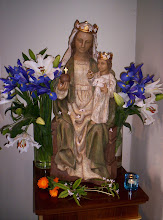
(Icon of the Mother of God, Health of the Roman People, in the Borghese chapel at St Mary Major, Rome.)

 St Elizabeth acknowledged her "the Mother of my Lord" (St Luke i, 43); how wonderful is this great title of the Blessed Virgin - to be Mater Dei, to be Theotokos

No more intimate relationship to God can be conceived.  In Suarez' immortal phrase, "She touched the hem of the Divinity". 

Hail, Mary,
full of grace,
the Lord is with thee.
(St Luke i, 28)

Blessed art thou amongst women,
and blessed is the fruit of thy womb, Jesus.
(St Luke i, 42)

Holy Mary,
Mother of God,
pray for us sinners,
now and at the hour of our death.
Amen.

The Traditional Collect of this splendid feast is also that used with the Marian anthem Alma Redemptoris Mater from Christmas until the Presentation of the Lord:

Deus, qui salutis æternæ, beatæ Mariæ virginitate fœcunda, humano generi præmia præstitisti: tribue, quæsumus; ut ipsam pro nobis intercedere sentiamus, per quam meruimus auctorem vitæ suscipere, Dominum nostrum Jesum Christum Filium tuum: Qui tecum vivit...

(God, Who didst grant unto the human race the reward of eternal salvation through the fruitful virginity of blessed Mary, grant, we beg, that we may feel her to intercede for us, through whom we have deserved to receive the Author of life, Our Lord Jesus Christ: Who with Thee liveth...)

(More about New Year, to-day's feast(s) and so forth can be found at my post for the 1st of January 2008.)

Tuesday, January 1, 2008

Another Year Over, A New One Begun

Today's Office contains most delightfully beautiful texts, especially the Lauds and Vesper antiphons drawn from the Greek Liturgy.  

In the older books it is known as the Feast of the Circumcision (when the Holy Name of Jesus was bestowed upon our Lord, in accordance with the angel's message; of course, there is a separate feast for this coming up very soon), while in the modern books it is styled the Feast of Mary the Mother of God (subsuming the fairly recent feast of the Maternity of Our Lady on the 11th of October); yet in reality there is not much difference, since even the old Breviary's texts for this feast are quite Marian (apparently the texts come in large part from the Christmas Office as chanted anciently at St Mary Major, where naturally the Feast had a Marian flavour).

The modern Martyrology best links up all aspects of today:

In octava Nativitatis Domini et die ejus Circumcisionis, sollemnitas sanctæ Dei Genetricis Mariæ, quam Patres in Concilio Ephesino Theotokon acclamaverunt, quia ex ea Verbum carnem assumpsit et inter homines habitavit Dei Filius, princeps pacis, cui Nomen super omne nomen datum est.

(The octave day of the Nativity of the Lord and the day of His Circumcision, the solemnity of holy Mary Mother of God, whom the Fathers at the Council of Ephesus acclaimed the Theotokos, for from her God's Son the Word took flesh and dwelt amongst men [cf. S. John i, 14], the prince of peace [Is ix, 6], to whom was given the Name above every name [cf. Phil. ii, 9].)

It is also the feast of St Fulgentius of Ruspe (462/7-527/33):

Ruspis in Byzacena, sancti Fulgentii, episcopi, qui, munere procuratoris Byzacenæ functus, monachus evasit; deinde episcopus effectus, tempore vandalicæ persecutionis, ab arianis multa perpessus est et in Sardiniam a rege Thrasamundo bis relegatus.  Tandem populo suo restitutus, eum per reliquos vitæ annos veritatis et gratiæ verbo fideliter nutrivit.

(At Ruspe in Byzacena, of Saint Fulgentius, bishop, who, suffering the burden of the office of procurator of Byzacena, escaped to become a monk; thereafter, being made bishop, in the time of the Vandal persecution, endured much from the Arians and was twice exiled to Sardinia by King Thrasamund.  At length restored to his people, he fed them faithfully for the remaining years of his life with words of truth and grace.)

On this day died also St Odilo, Abbot of Cluny (c.962-c.1048), who instituted the commemoration of All Souls on the 2nd of November; St Giuseppe Maria Tommasi (1649-1713; canonized in 1986), Theatine Cardinal and noted liturgical scholar; as well as many others who passed triumphant from this world to heaven – 

Et alibi aliorum plurimorum sanctorum Martyrum et Confessorum, atque sanctarum Virginum.  R/.  Deo gratias.

(And in divers places many other holy Martyrs and Confessors, and sainted Virgins.  R/.  Thanks be to God.)

– such a pity this formulaic conclusion, which just rolls off the tongue, is not included in the new Martyrology!

Curiously enough, the 2002 Roman Missal provides a Votive Mass for the beginning of the civil year, although this is of course not to be said on the 1st of January!  Here are the texts with my translations:

Aña ad introitum

Benedices coronæ anni benignitatis tuæ, et campi tui replebuntur ubertate.  Ps 64:12

[Thou shalt bless the crown of the year, of Thy goodness: and Thy fields shall be filled with plenty.]

vel

Ecce ego vobiscum sum omnibus diebus, dicit Dñs, usque ad consummationem sæculi, allelujaMt 28:20b

[Behold, I am with you all days, saith the Lord, even to the consummation of the world, alleluia.]

Collecta

Deus, qui, sine initio et sine fine, totius es principium creaturæ, da nobis ita hunc annum, cujus initia tibi dedicamus, transigere, ut et substantiis abundemus, et sanctitatis operibus fulgeamus.  Per...  

[O God, Who, without beginning and without end, art the foundation of all creatures, grant unto us so to pass this year, whose beginning we dedicate unto Thee, that we may both abound in good things, and shine forth in works of holiness.  Through...]

Super oblata

Sacrificia quæ tibi offerimus ita tuis oculis, Dñe, sint accepta, ut omnes, qui initia hujus anni cum lætitia celebramus, reliquum excursum ejus in tua mereamur transigere caritate.  Per...

[May the sacrifices which we offer, Lord, be so acceptable in Thine eyes, that all we, who celebrate the beginning of this year with joy, may deserve to pass the rest of its length in Thy love.  Through...]

Aña ad communionem

Jesus Christus heri et hodie, ipse et in sæcula.  Heb 13:8

[Jesus Christ, yesterday, and today: and the same for ever.]

Post communionem

Adesto, Dñe, populis, qui sacra mysteria contigerunt, ut in toto decursu hujus anni nullis periculis affligantur, qui in tua semper protectione confidunt.

[Be present, Lord, to the people who have received the sacred mysteries, that in the whole course of this year they may be afflicted by no perils, who ever trust in Thy protection.]

Benedictio solemnis

Deus, fons et origo totius benedictionis, gratiam vobis concedat, benedictionis suæ largitatem infundat, atque per totum annum vos salvos et incolumes protegat.

Custodiat fidei vobis integritatem, tribuat spei longanimitatem, perseverantem usque ad finem cum sancta patientia caritatem.

Dies et actus vestros in sua pace disponat, preces hic et ubique exaudiat, et ad vitam æternam feliciter vos perducat.

[God, fount and origin of all blessing, grant grace to you, pour into you the gift of his blessing, and protect you safe and secure through the whole year.

He guard for you the integrity of faith, grant long-suffering of hope, charity persevering until the end with holy patience.

He dispose your days and actions in His peace, here and everywhere hear your prayers, and felicitously bring you to life everlasting.]


The relevant Lectionary supplies the following choice of pericopes:
  • Genesis i, 14 -18 (the fourth day of creation – sun, moon, stars, day, and night, marking seasons, days and years) or
  • Numbers vi, 22-27 (the Aaronic blessing; how on earth is this relevant?!);
  • I Corinthians vii, 29-31 (the form of this world is passing away) or
  • James iv, 13-15 (life is as a passing mist);
  • Psalm 8, 0r 48, or 89 (the elegaic last being my favourite);
  • St Matthew vi, 31-34 (do not be anxious about tomorrow) or
  • St Luke xii, 35-40 ( be ready for the Master's return).
I must say, I miss in this list what the Revised Common Lectionary supplies: surely Ecclesiastes iii, 1-13 is the best of all choices?

Omnia tempus habent,

et suis spatiis transeunt universa sub cælo.

Tempus nascendi, et tempus moriendi;

tempus plantandi, et tempus evellendi quod plantatum est.

Tempus occidendi, et tempus sanandi;

tempus destruendi, et tempus ædificandi.

Tempus flendi, et tempus ridendi;

tempus plangendi, et tempus saltandi.

Tempus spargendi lapides, et tempus colligendi,

tempus amplexandi, et tempus longe fieri ab amplexibus.

Tempus acquirendi, et tempus perdendi;

tempus custodiendi, et tempus abjiciendi.

Tempus scindendi, et tempus consuendi;

tempus tacendi, et tempus loquendi.

Tempus dilectionis, et tempus odii;

tempus belli, et tempus pacis.


Quid habet amplius homo de labore suo?

Vidi afflictionem quam dedit Deus filiis hominum,

ut distendantur in ea.

Cuncta fecit bona in tempore suo,

et mundum tradidit disputationi eorum,

ut non inveniat homo opus

quod operatus est Deus ab initio usque ad finem.

Et cognovi quod non esset melius nisi lætari,

et facere bene in vita sua;

omnis enim homo qui comedit et bibit,

et videt bonum de labore suo, 

hoc donum Dei est.


Here is The Byrds' version!  

The RCL also gives Psalm 8, Rev. xxi, 1-6a (I make all things new) and S. Matthew xxv, 31-46 (the general Judgement).

While I didn't get around to singing a Te Deum in thanksgiving last night (very tired and out of sorts, please pray for me!), I will be offering up a Veni Creator Spiritus to supplicate God's blessings on this new Year of Our Lord, 2008.  As the modern Easter Vigil puts it:

Α
2 | o
—+—
0 | 8
Ω

Christ yesterday and today 
the beginning and the end 
Alpha 
and Omega 
all time belongs to Him 
and all the ages 
to Him be glory and power 
through every age for ever.  
Amen.