Showing posts with label Sarum Rite. Show all posts

Sunday, December 9, 2012

My Favourite Advent Antiphon

On my mind and lips during Advent is the Magnificat antiphon from first Vespers of this, the Second Sunday of Advent: Veni, Domine, visitare nos in pace, ut lætemur coram te corde perfecto – "Come, O Lord, and visit us in peace, that we may joy before thee with a perfect heart."


This antiphon above all others – yes, for the moment, even the O Antiphons, and the Marian anthem of the season, Alma Redemptoris Mater – is my choice, and why? because in sundry Uses it was not a Magnificat antiphon, but the Advent Nunc dimittis antiphon.  Several forms of Compline (such as the Dominican) have variant hymns, antiphons, responsories and the like to be employed at certain times and seasons; in the Sarum Rite, though not that of the Black Friars, Veni, Domine, visitare was sung during Advent in place of the usual antiphon Salva nos Domine.

Consider the wording, unfamiliar as it may seem, of the Nunc dimittis with this antiphon:

Come, O Lord, and visit us in peace, that we may joy before thee with a perfect heart. 
Lord, now lettest thou thy servant depart in peace : according to thy word.
For mine eyes have seen : thy salvation,
Which thou hast prepared : before the face of all people;
To be a light to lighten the Gentiles : and to be the glory of thy people Israel.
Glory be to the Father, and to the Son : and to the Holy Ghost.
As it was in the beginning, is now, and ever shall be : world without end. Amen. 
Come, O Lord, and visit us in peace, that we may joy before thee with a perfect heart.

I take the English wording of this from a curious little volume in my possession, The Hours of Prayer from Lauds to Compline inclusive compiled from the Sarum Breviary and other rites (3rd ed., revised), originally drawn up in 1910, but reprinted in 1946; my copy has a preface by Edward C. Trenholme, S.S.J.E., dated 1928.  This is, in other words, one of the many Sarum-ish or Roman Diurnals drawn up by Anglo-Catholics over the course of their history – Patrimony!

While many such manuals exist, I only have one other here, which also contains the "Come, O Lord": The Priest's Book of Private Devotion, originally compiled in the late 19th C. by Oldknow and Crake, revised in 1929 by Briscoe, and published in a new edition in 1952; unlike The Hours of Prayer, it contains a vast collection of prayers, meditations, and all manner of devotions – but of its 593 numbered pages, the first third, pages 3 to 221, contains "Divine Service for the Lesser Hours of the Day", that is, Prime, Terce, Sext, None, and Compline,  with full Propers of the Temporal and Sanctoral cycle, and the relevant Commons, plus Vespers of the Dead and the Penitential Psalms. These Hours are evidently meant to be said alongside daily recitation of Mattins and Evensong from the BCP.

An interesting point about both these unofficial forms of the Office is that they stick to the pre-1912 psalm cursus: Lauds has its daily Laudate psalms (Pss 148-150); during the Little Hours, each and every day, Psalm 118(119) is read through; and Compline has daily Pss 4, 30(31):1-6, 90(91) and 133(134).

Saturday, December 25, 2010

Sarum Christmas Tidings


The Sarum Missal appointed a farced Lesson for Christmas Midnight Mass – that is, a reading from the Prophet Isaias (ix, 2. 6-7) interpolated with a gloss, bringing out the Christian meaning of what he foretold.  Two clerks in copes were to chant the Lesson, first together, then alterately, then together at the end for a doxology.  An English translation follows:

I will sing praises to God for ever, Who formed me in His Right Hand, and redeemed me on the Cross with the purple Blood of His Son.

The Lesson of Esaias the Prophet,
In which is foretold the glorious Birth of Christ.
Thus saith the Lord,
Father, Son, and Holy Ghost, by Whom are created all things in Heaven and earth.
The people that walked in darkness
Whom Thou createdest: whom the enemy expelled from Paradise by subtle fraud: and led captive with him to hell.
Have seen a great light.
And at midnight strange brightness hath shone on the Shepherds,
They that dwell in the shadow of death, the light
Everlasting, and our True Redemption
Upon them hath shined.
O Stupendous Birth,
For unto us a Child is born,
Jesus the Son of God, He shall be great ,
A Son
Of the highest Father
Unto us is given.
So had it been foretold from the Throne on high.
And the government shall be upon His shoulder,
That He may rule Heaven and earth.
And His Name shall be called
Messiah, Soter, Emmanuel, Sabaoth, Adonai,
Wonderful,
The Root of David,
Counsellor,
Of God the Father,
God
Who created all things,
Mighty,
Overthrowing the hideous gates of hell.
The Everlasting Father,
King Almighty, and governing all,
The Prince of Peace
Here and for ever.
Of the increase of His government
In Jerusalem, Judea, and Samaria
And peace there shall be no end,
For ever and ever,
Upon the Throne of David, and upon his kingdom,
And there shall be no bounds to His reign
To order it,
In the bonds of the faith,
And to establish it with judgment and with justice,
When He shall come as Judge to judge the world.
From henceforth
To Him be due glory, praise, and rejoicing,
Even for ever.

From the rising of the Sun to the going down of the same, let meet praise resound to the Creator throughout all climes to the ends of the whole world. Let every thing say, Amen.

Sunday, May 16, 2010

Sarum Rite Sunday after the Ascension

To-day I attended Solemn High Mass according to the Use of Sarum... I wish!

(Instead, to-night I'll perforce attend the usual Novus Ordo Mass for Ascension-on-Sunday.)

Whatever of my liturgical fantasies, I did have cause to consult an online translation of the Sarum Missal of 1526, and for interest's sake looked up the Mass Proper for Sunday after the Ascension.  As I surmised, the texts provided are almost identical to the Traditional Roman (and likewise to the Dominican) – but for the Offertory, Secret and Postcommunion, of which the last two are quite noteworthy for their expressing the doctrine of the Session of Christ our King and Head and Priest and Intercessor at the Father's Right:

Offertory (Ps 146:1 (PBV) = 145:2 (Vulg.))
Praise the Lord, O my soul; while I live will I praise the Lord; yea, as long as I have any being, I will sing praises unto my God, alleluya.
Secret
Grant, we beseech thee, almighty God, that we may acceptably offer this sacrifice, to become the body and blood of him, whom sitting at the right hand of thy power we assuredly believe to be interceding for us, our Lord Jesus Christ, thy Son.  Who with thee...
Postcommunion
Grant, we beseech thee, almighty God, that through this most holy communion we may confidently believe that to be accomplished in the body of the whole Church, which has already been accomplished in her head.  Through [the same]...

Though I have only this English version of the Sarum to hand, I am intrigued to see that the Sarum postcommunion seems to be almost the same as the Modern Roman prayer after communion for the Sunday after the Ascension (when that Mass gets used at all):

Exaudi nos, Deus, salutaris noster, ut per haec sacrosancta mysteria in totius Ecclesiae confidamus corpore faciendum, quod eius praecessit in capite.  Per...
(Graciously hear us, God our Saviour, that by these most holy-and-sacred mysteries we may have confidence [that] may be accomplished in the body of the whole Church, which has preceded in her Head.  Through...)

By reason of the Lord's Resurrection and Ascension, all things now tend upwards...

God grant it!

Saturday, July 11, 2009

Officium Parvum Beatæ Mariæ Virginis

The Little Office is a blessing and a relief - why not try it as a fit devotion and rule of prayer suited to a traditionalist Catholic? I know that Fr Tattersall recommended it to my friend Justin for one.

I have previously posted on:
Some other useful resources:

  • the Little Office, in parallel Latin and English, according to the Use of Rome in 1599: hence the hymns are in their original state prior to Urban VIII's misguided 'correction' of them, the antiphons are not doubled - given in full before as well as after each psalm or canticle - and the items removed in the reforms of Pius X (that is, Psalms 66, 149 and 150 at Lauds) and Pius XII (the prefatory Ave of each Hour, the Kyrie before the Collect, the memorial of the saints at Lauds and Vespers, the Pater and versicle to be said at the end of the Hours one has said, and the Pater, Ave and Credo after the Marian anthem at Compline) are still there;
  • the Little Office according to the Ambrosian Rite as of 1957;
  • the Little Office as put on someone's blog, apparently in the pre-1950's form (with all the above-named items removed under Pius XII still included).

Saturday, January 31, 2009

The Little Office after the Use of Sarum


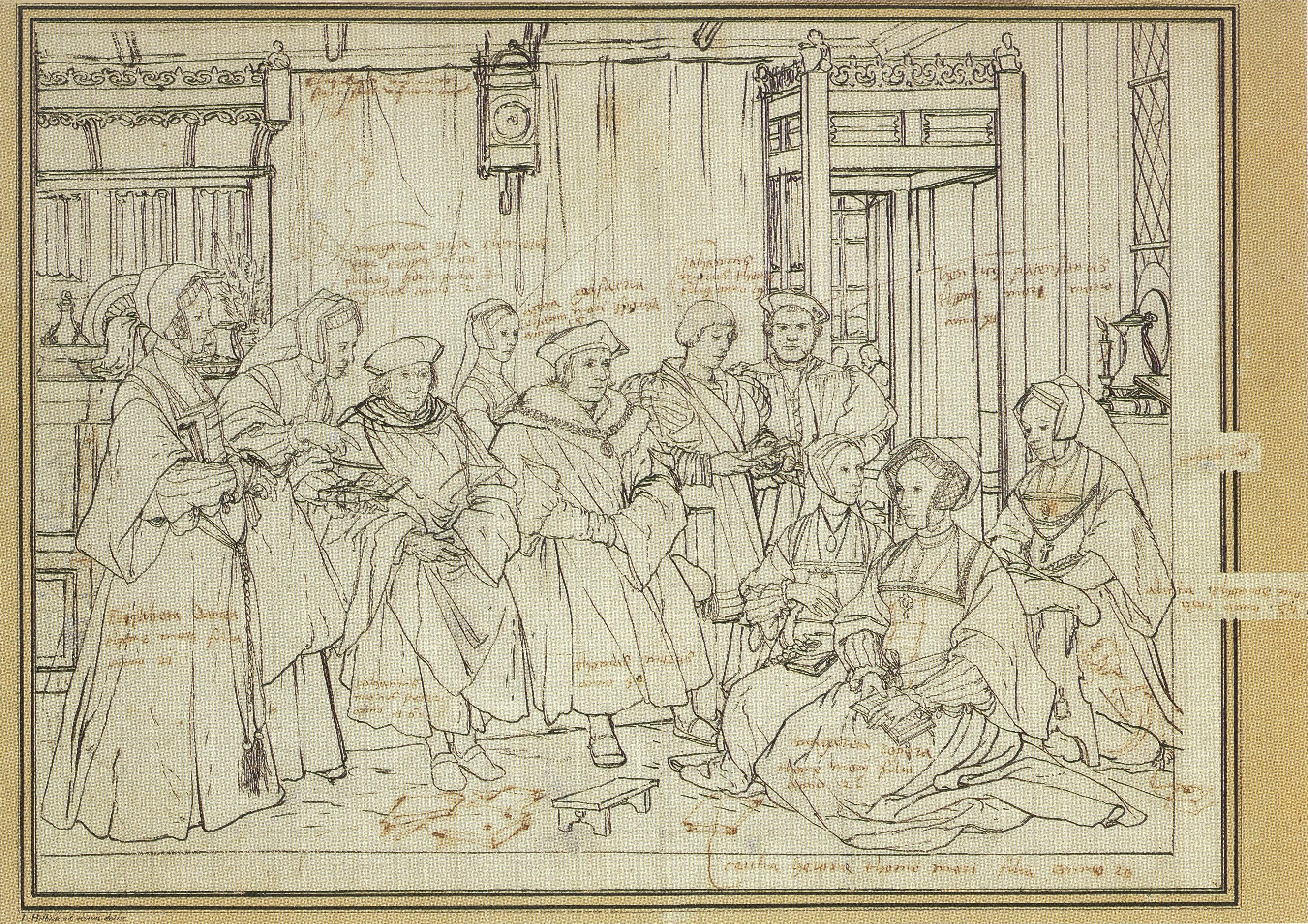
In the famous Holbein sketch of St Thomas More and his extended family, all are shewn with a book - but this is not so much, as it has been misinterpreted to demonstrate, that they are all Renaissance men to a man (and woman), but to manifest their piety as all good Englishmen would have wished in the days before the Reformation struck: for evidently the volume they are each holding is a copy of the Primer, or Book of Hours; led by the head of the family, they are about to pray, not the family Rosary more familiar to Catholics in later times, but an Hour from the Little Office (probably Vespers).

Now the Little Office according to the Use of Sarum (which was that used in England for the most part, until in time of persecution the Roman Use was adopted for Mass, Office and most things else) was more or less like the modern, but probably a little closer to the Dominican Use (and closer still to the Carmelite) in point of fact - at Matins, appointing always the same three Psalms (8, 18, 23) under one antiphon, Benedicta tu, appended to them only, and having the three usual prayers to Our Lady as Lessons, and with no Absolution, but a versicle after the Te Deum. (It can be followed via this link to the Burnet Psalter; note such gloriously mediæval spellings as Ympnus for Hymnus.)

At Lauds, the eight pre-Pius X psalms and canticle are given with only one antiphon, the first of the Christmastide ones in the Roman Little Office, and the little chapter is also non-Scriptural (oddly, but as commonly in mediæval books): Maria virgo semper letare que meruisti Christum portare celi et terre conditorem quia de tuo utero protulisti mundi salvatorem ("Mary Virgin rejoice alway who deservedst Christ to carry, of heaven and earth the Maker, for from thy womb came forth the world's Saviour). The Benedictus antiphon is the same as the Dominican. As was also common, the Collect at all the Hours was Concede nos famulos; and as also common in mediæval times, after it and Benedicamus Domino came very many commemorations (each an anthem, verse and collect): of
  1. the Holy Ghost,
  2. the Holy Trinity,
  3. the Holy Cross,
  4. St Michael Archangel,
  5. St John Baptist,
  6. St Peter,
  7. St Paul,
  8. St Andrew,
  9. St John the Evangelist,
  10. St James,
  11. St Bartholomew,
  12. All the Apostles,
  13. St Stephen,
  14. St Lawrence,
  15. St Thomas à Becket,
  16. St Blaise,
  17. St Christopher,
  18. St Edmund King & Martyr,
  19. St George,
  20. All Martyrs,
  21. St Germanus of Auxerre,
  22. St Nicholas,
  23. St Martin,
  24. St John of Beverley,
  25. St William,
  26. St Leonard,
  27. All Confessors,
  28. St Anne,
  29. St Mary Magdalen,
  30. St Catherine,
  31. St Margaret,
  32. St Etheldreda,
  33. St Faith,
  34. All Virgins,
  35. All Saints, and
  36. for Peace.
(Note that the exact saints commemorated tended to vary from Little Office to Little Office - recalling that all these were manuscript, handwritten copies until the late 15th century - according to the personal devotion of the user, who even added in favourite saints or, one suspects, didn't read all of the commemorations each and every day.)

(For the same reason, very often short Hours, really just larger commemorations, were inserted after each Hour of the Blessed Virgin - in the Burnet Psalter, these are the Hours of the Holy Cross and of the Compassion of the Virgin.)

As in the Carmelite Use, Prime of Our Lady has Psalms 53, 116 and 117 (not 84 as in the Roman) - the first being that always used at the start of Prime, the last, that great Psalm of the Exodus sung on Sundays in celebration of the still greater and more perfect redemption wrought for us through the Paschal Mystery of Christ. The hymn - used at all the Little Hours - in its older version as here reading Memento salutis auctor &c., begins, as I suggested in an earlier post, with the first stanza of Veni Creator Spiritus - for through the agency of the Holy Ghost (first stanza), Christ took flesh (second stanza) in His Mother Mary (third stanza), to the glory of the whole Trinity (fourth and last stanza). The psalm antiphon is again the same as that in the Roman Little Office for Christmastide, and the lesson is from Ecclesiasticus; but there is a short responsory as well as a versicle, and the Collect is Concede. Terce, Sext and None have successively Pss 119-121, 122-124, 125-127 as in the Roman Use, again with Christmastide antiphons, capituli from Ecclesiasticus, short responsories, versicles and the same Collect.

Sarum Vespers of Our Lady are quite different to begin with from what the Roman and Dominican have: for the psalmody consists of Pss 121-125, under one antiphon, and with a non-Scriptural little chapter that is in fact elsewhere used as an antiphon: Beata es virgo Maria que dominum portasti creatorem mundi genuisti eum qui te fecit et in eternum permanes virgo ("Blessed art thou, Virgin Mary, who didst carry the Lord the Creator of the world: thou didst give birth to Him Who made thee, and in eternity thou abidest a virgin"). It is evident then that the psalms of Vespers are repeats of those used earlier during Terce, Sext and None; in the Sarum Breviary, as in the Roman before 1912, these five psalms were those read on ferias on Tuesdays, and were perhaps chosen for their brevity and beauty, the Gradual Psalms being favourites for use at prayer.

Again as in the Carmelite Little Office, there are four psalms appointed for use at Compline de Beata according to the Sarum Rite: Pss 12, 42, 128 and 130. The anthem for these psalms is familiar to me from Marian feasts at Compline according to the Dominican Breviary - an instance of how texts were interchanged, or rather how there existed a great fund of items for liturgical use. Likewise, the hymn appointed is the second half of the Vesper hymn Ave maris stella; strangely, there is no short responsory. As was also a common mediæval custom, the Collect for Compline is not Concede, but Gratiam tuam quæsumus, familiar to moderns as the concluding prayer of the Angelus. After the intercalated Hours mentioned above comes the Salve Regina, with its last exclamations farced, as was the Sarum custom, with stanzas of a hymn, then a versicle and the usual collect afterward.

Interesting...