Showing posts with label Holy Machabees. Show all posts

Saturday, November 14, 2009

A Lesson

After Confession this morning, I read Mattins from my B.D.W. (hoping by this quixotic devotion to express my prayerful support for corporate reunion of Anglicans), and was struck by the end of the first Lesson:

The Mattathias cried out in the city with a loud voice, saying: "Let every one who is zealous for the law and supports the covenant come out with me!" And he and his sons fled to the hills and left all that they had in the city.
I Maccabees 2:27-28

Surely this may be applied to those wetting their toes on Tiber's banks, having finally spurned the glamours and witchery of that false strumpet, the C of E? For in the days of the Maccabees, Israel had capitulated to the pressure of the pagan world, changing from faith in God to worship of demons, and from adhesion to the Law to the crass expediency that marked Gentile morals. All that was left to do was to fight and flee to a place of refuge...

And I recall what happens a bit further into the tale of the Maccabean revolt, in chapter eight of the first book of the Maccabees:

Now Judas [Maccabeus] heard of the fame of the Romans, that they were very strong and were well-disposed toward all who made an alliance with them, that the pledged friendship to those who came to them...

So Judas chose Eupolemus the son of John, son of Accos, and Jason the son of Eleazar, and sent them to Rome to establish friendship and alliance, and to free themselves from the yoke; for they saw that the kingdom of the Greeks was completely enslaving Israel. They went to Rome, a very long journey...
I Maccabees 8:1, 17-18a


It is and has been a very long journey to Rome: please God, journey's end is now at last in sight.

To escape the slavery of modernism - that is, complete surrender to the world - and to cast off its yoke, paradoxically it remains for Anglicans to seek Gospel liberty in the embrace of the Roman Pontiff: who, far from being the tyrant of Protestant legend or of the scoffing mob's derision, is as Christ's faithful Vicar, the true heir of SS Peter and Paul, attending to preaching the Good News to all, ever concerned for all the churches, and striving to guarantee the Lord's promises of a light burden, Christian service in perfect freedom, the tranquillity of order, and a peace that the world cannot deliver.

Saturday, August 1, 2009

Lammas - II

Anciently this feast was kept as a harvest festival in England - whence its name Lammas, from hlaf-mæsse (loaf-mass). But until the late pre-Conciliar reforms, or rather prunings, to-day was the feast of the Chains of St Peter (S. Petrus ad Vincula), the celebration of the hallowed fetters that held the Prince of the Apostles in his Roman prison (as earlier Herod had vainly enchained him), or rather, the celebration of his holding fast to Christ until death, death on an upside-down cross. This day is the anniversary of the consecration of the church of St Peter ad Vincula, called the Eudoxian Basilica after Princess Eudoxia who had it rebuilt in the fifth century.

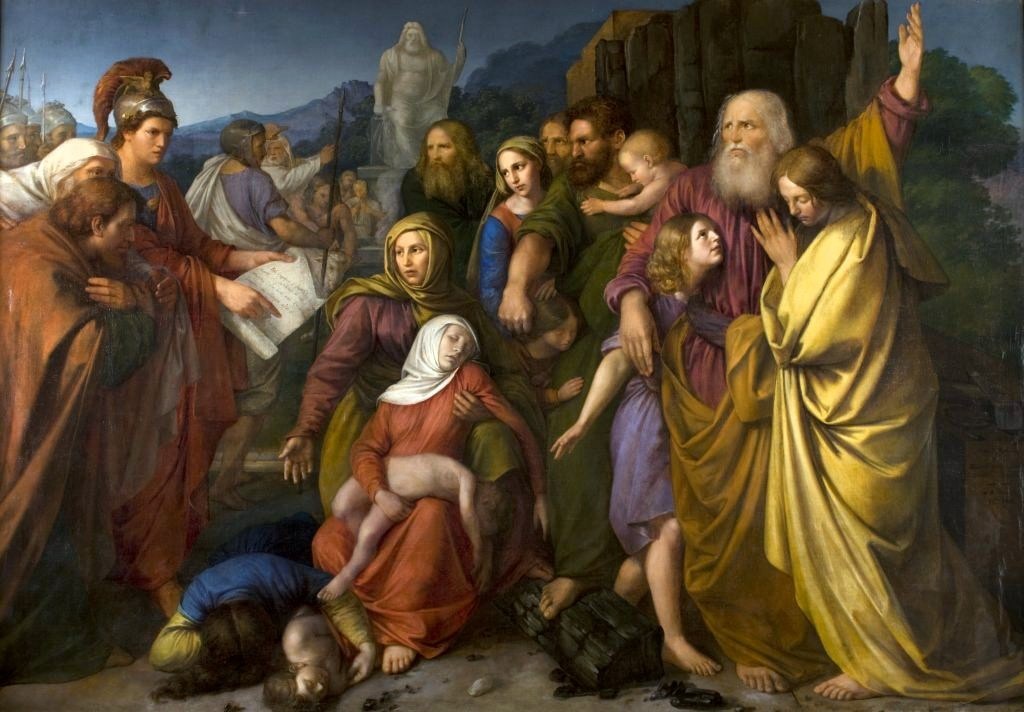
But to-day is also the commemoration of the Holy Machabæan Martyrs, seven brothers and their mother put to death by Antiochus Epiphanes a century and a half before Christ: their great constancy under torture, their stedfast refusal to betray God and His Law, their belief in a future resurrection, all these make them great forerunners and models of Christian martyrs, and so the Fathers frequently preached. (Apparently their commemoration is held to-day because relics believed to be theirs were kept at the Church of St Peter in Chains.)

May the prayers of St Peter and these Martyrs unchain the bonds of sin that bind us: see my comments and the Collect and so forth that I quoted last year.

Saturday, August 2, 2008

The Holy Machabees

While they were commemorated at Mass yesterday, today I'll post something at least about those sterling Jewish Martyrs, the seven brothers and their mother.

Firstly, their history is given in II Machabees, chapter 7, while that of St Eleazar is in chapter 6; while in the Apocryphal IV Machabees, the majority of the book (i, 7-12, and all of chapters viii-xviii) deal with their sufferings; chapters 5 to 7 deal with St Eleazar.

The Byzantine Rite fêtes all these saints on the 1st of August, and traditionally names the mother St Solomoni; the extremely useful Anastasis website gives a fine translation of the liturgical texts of their feast.

These are the proper orations for the Holy Machabees in the Traditional Roman Rite:

Fratérna nos, Dómine, Mártyrum tuórum corona lætíficet: quæ et fídei nostræ præbeat increménta virtútum; et multíplici nos suffrágio consolétur. Per...

May the fraternal crown of Thy martyrs, O Lord, rejoice us, both to afford our faith increase of virtues and to console us with their manifold prayers. Through...

Mystéria tua, Dómine, pro sanctorum Martyrum tuórum honóre, devota mente tractémus: quibus et, præsidium nobis crescat, et gaudium. Per...

With a devout mind may we deal with Thy mysteries, O Lord, for the honor of Thy holy martyrs, and by them may both protection and joy be increased unto us. Through...

Praesta, quæsumus, Omnipotens Deus: ut, quorum memóriam sacramenti participatione recolimus, fidem quoque proficiéndo sectémur. Per...

Grant, we beseech Thee, Almighty God, that we may more and more closely follow the faith of those whose memory we revere by partaking of the sacrament. Through...

Lammas

Mass at the Pro. this evening (after the First Friday Holy Hour) was of the Chains of St Peter. While still subsisting as an option (!) in the 1962 Missal, Bugnini & co. had removed it from the Breviary. Today is in fact a triple feast: in England of yore, it was the harvest festival (Lammas derives from hlæf-masse, "loaf Mass"); it is the feast of St Peter ad vincula; and today we commemorate the Holy Machabees, famous Martyrs of Old Testament times.

In any case, the Alleluia verse and Collect sum up the principal mystery represented very well, as does the extract from St Augustine formerly read at Matins as Lessons vii and viii:

Alleluja, alleluja. V/. Solve, jubénte Deo, terrárum, Petre, caténas, qui facis ut páteant cæléstia regna beátis. Alleluja.

(Loosen, at the command of God, the chains of the earth, Peter, who openest the heavenly kingdom to the blessed.)

Deus, qui beátum Petrum Apóstolum, a vínculis absolútum, illæsum abíre fecísti: nostrórum, quæsumus, absólve víncula peccatórum ; et ómnia mala a nobis propitiátus exclúde. Per...

(O God, Who didst loose blessed Peter Apostle from his chains and didst make him to go forth unharmed: loose, we beseech thee, the chains of our sins, and in thy mercy keep us from all evil. Through...)

Peter was the only one of the Apostles who was worthy to hear the words: Verily, I say unto thee that thou art Peter, and upon this rock I will build my Church. Worthy indeed must he be, who, when the nations are to be built up into a Temple of God, is chosen as the ground-stone whereon the building is to stand: the pillar whereby it is to be held up, and the key wherethrough entrance is to be made into the kingdom. Concerning him the Word of God saith: That they brought forth the sick into the streets, and laid them on beds and counches, that at the least the shadow of Peter passing by might overshadow some of them. If the shadow of his body then could give help, how much more shall the fulness of his strength give help now? If the very air, as he passed by, was then profitable to such as besought him, how much more shall his favour profit where now he abideth? It is with reason that, throughout all the Churches of Christ, the iron chains wherewith he was afflicted are reckoned more precious than gold.

If his shadow as a visitor was so healthful, what is his chain now that he bindeth and looseth? If his empty image in the air had healing power, how much power must have been contracted from his body by those chains, whose iron weight sank into his holy limbs during his suffering? If, before he testified, he was so mighty to aid them that called upon him, how much mightier is he now since his victory? Blessed were the links, doomed to be changed from fetters and shackles, into a crown, which by touching the Apostle, made him a Martyr. Blessed were the chains, whose prisoner left them for the Cross of Christ, and which brought him thither, not as the instruments of condemnation, but of sanctification.