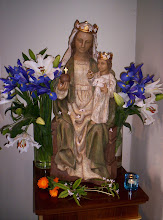
If only I had retired to a Dormitionist cloister... instead of such, after an unpleasant day at work, I had the consolation of singing with the choir (directed from the organ) at the evening Mass for the Assumption. Singing the Ordinary of the Mass, the Psalm and Alleluia, together with sundry Marian hymns ("Immaculate Mary", "O Sanctissima", a setting of the Magnificat, "Jesus, my Lord, my God, my all", and "Hail Queen of heaven") certainly revived my drooping spirits, as did the combined devotion and good cheer of the choir and organist. But what a pity there were so few at Mass, on this, a Holy Day of Obligation – and in Australia, the only remaining such, apart from Christmas. Janet, the organist, remarked afterward that time was when the church would have been packed...
Here in Launceston, there are only three parishes. The north-western parish (my own) had Mass at 10 am (not practical for workers), and a second Mass at Beaconsfield, a country town to the north, at noon (garnering an excellent, albeit older, congregation of sixty – this Mass was also the occasion for celebrating the golden jubilee of the inestimable Sr Frances, stalwart of the locality). The default option for Launcestonians, however, is to attend Mass at the city church, that of the Apostles – hence my surprise there were so few present. Certainly the Carmelites (served by a roster of the three parishes' priests) would have had their daily Mass at 7:30 am, and given past experience they would have had a reasonable number present, but their chapel is small, and the hour early... As for the southern parish, I have no information to hand, but I seem to recall they (may) have an evening Mass (I haven't been there for decades, to be honest), at least for this solemnity. But again, I cannot imagine that that church was packed – having heard from a few, ahem, ex-parishioners thereof that they now go elsewhere.
The true vocations crisis in the Church is not a lack of candidates for the priesthood: it is a lack of committed Catholics (from whose ranks a small but sufficient percentage of men would naturally be drawn to Holy Orders). There is a reason why the number of church weddings, not to mention baptisms, declines yearly: it is called erosion of the faith, decline in commitment to living out the Faith, and general forgetfulness of what previous generations, often at great cost, nevertheless succeeded in passing on – until the last half-century or so. The tradition has failed: discontinuity and rupture has broken the links formerly passing down the Apostolic tradition in continuity from one generation to the next.
In this Year of Faith, what is too evident is a crisis and a lack of faith. "My people are destroyed for lack of knowledge" – Hosea iv, 6. I recall what St Thérèse of Lisieux noted: that if there were no love in the heart of the Church (and she felt her vocation to be to live as that loving heart), the apostles would forget to preach, the martyrs would not bother to die for Christ, the missionaries would not labour to spread the Gospel. Terrible to say, what she spoke of per impossibilem has in many places throughout the West – certainly in Australia – come to pass.
What is believed by too many nominal Catholics is rather a comfortable falsehood, according to which Scripture and Tradition have little value, nor does commitment to the harder moral precepts or duties such as Mass-going (which ought in any case actually be a joy if one realize what Mass is, but I digress); rather, a fairy-floss version of eviscerated Christianity is given lip-service, according to which bourgeois niceness and thinly disguised versions of the current secular virtues (the fashions of the moment) are all that is required, to which the more pious may add lounging about on bean-bags and playing at prayer, since sometime hopefully far distant in the future we all go to "some heaven light-years away" anyway (though one should not be too serious about such fables, unappealing as they are to the worldly), and in the meanwhile "celebrating the life" and dabbling in trendy forms of do-goodery is really all that is necessary. Indifferentism replaces Christianity, in point of fact.
Despite being personally buoyed up by Mass and Holy Communion – "My soul He doth restore again" – and in a special way by helping out with the choir – "Make a joyful noise to the Lord" – I felt nonetheless saddened that the blessings freely available were offered, in vain it may seem, to an all but empty church. Granted, I didn't leer over the choirloft to enumerate the worshippers, but from what I saw the pews at least in the front of the Church of the Apostles were largely vacant.
Our priest and deacon celebrated Mass with reverence and dignity, of course; but I could not help but compare the lack of any servers to what I know would have been the case at my own parish in Perth, W.A.: Fr Rowe would have had a Missa cantata at least, quite possibly with choir singing polyphony, and certainly with acolytes, candlebearers, a thurifer and M.C. for this, one of the most important feasts of the year, the consummation of Our Lady's life in triumph, the entrance of the Mother of our God into celestial bliss. Again, there was lacking the support of, not the clergy, but the men of the parish, those who serve at the altar (I ought note that most of Fr Rowe's servers are adults). I know, also, that Fr Rowe would have carefully exhorted his flock to attend Mass on this day, and there would have been a good compliance with his reminder – as it is, many travel across Perth to attend weekday Mass, let alone Sunday or festal services there.
Personally, I was uplifted; corporately, so to say, the commitment, even the understanding of the needfulness of attendance at Mass of the Assumption, was manifestly lacking, even compared to the numbers who still more or less regularly attend Sunday Mass (as a friend of mine put it, the Devotion of the Fifty-Two Sundays is rather neglected these days). We hold great hopes that our new Archbishop, committed as he is to re-evangelizing, will direct the Church here in Tasmania to rebuild, rather than manage an ineluctable decline – God grant it.
I feel sad and embarrassed to think that the several priests from overseas who serve in Tasmania at the moment must be shocked at the lukewarmness and apathy of the Catholics here – they must wonder why a small remnant of cossetted rich people need to summon priests from countries where the needs are greater, and where the faithful are actually faithful, so that churches are packed, not all but deserted.
Dare I suppose that readers had similarly dispiriting impressions of the attendance levels at Masses of the Assumption?