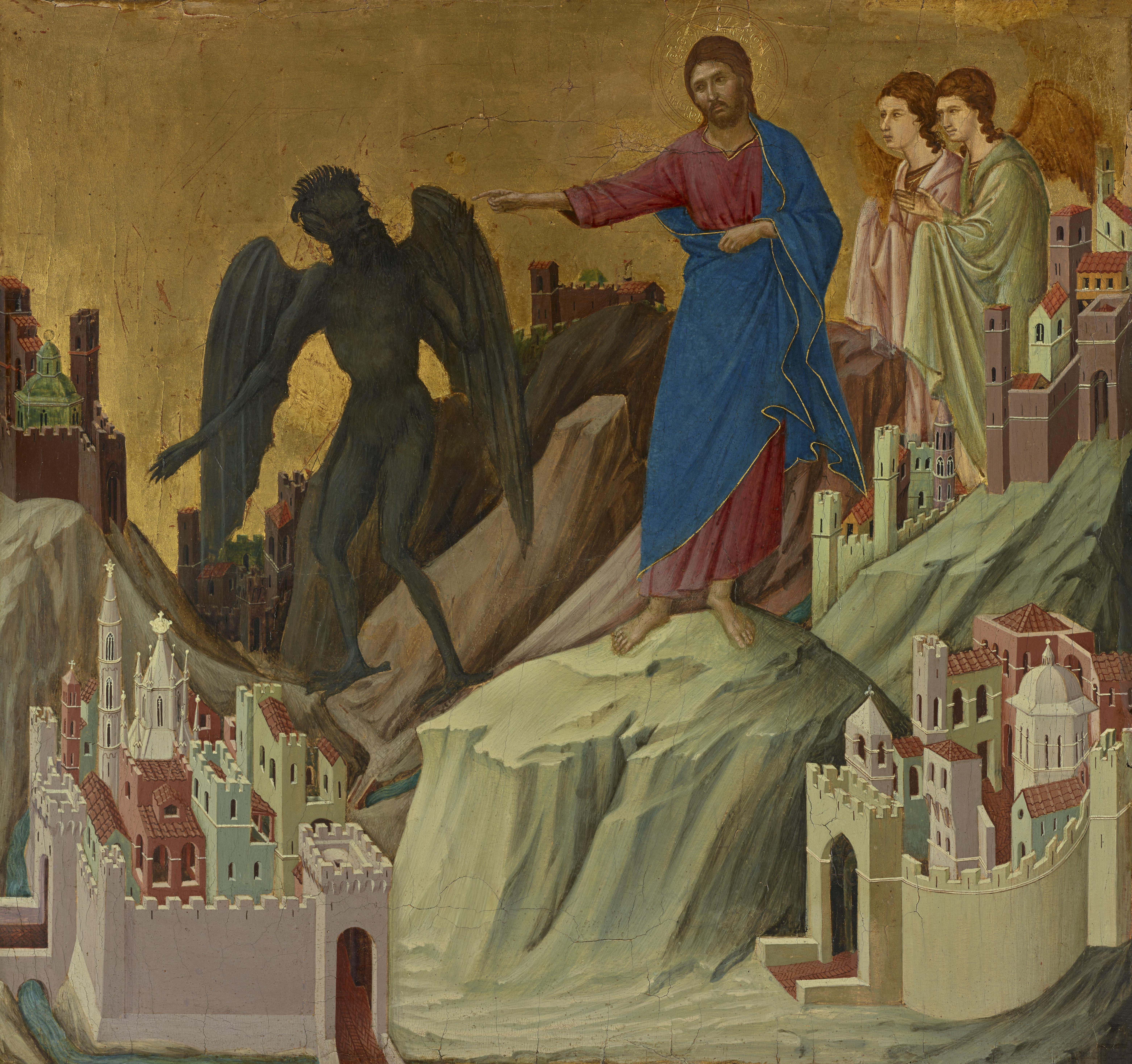
Christ's Triumph over Temptation
While having my confession heard by my ghostly father this day, he advised me to seek God's grace to conquer temptation, and in so doing imitate Our Lord God, Jesus Christ, Who remained night and day in prayer to His heavenly Father: for, though tempted by Satan forty days in the wilderness, He sinned not, but overcame all trials owing to His steadfast adherence [as man] to the Will of the Father [Whose Will is also His as God, since in the Trinity there is only one Divine Will]. Therefore, as penance he bade me read and reflect upon the Gospel of this the First Sunday of Lent (identical in both old and new rites, or rather forms of the one Roman Rite) - St Matthew iv, 1-11.

St Thomas Aquinas, I recalled while reading and thinking on the sacred text, avers that in this pericope we see how the machinations of the Devil are laid bare, for our instruction and forewarning. (The Common Doctor's own commentary on this passage can be found, in Latin,
here; and of course he discusses the Temptation of Christ in the
Summa Theologiae, III, 41 - most especially, in art.4, resp.)
First - as we know in our own lives - the crafty tempter proposes some seeming good within our power, such as, in our Lord's case. to turn stones into bread: which would seem innocent of harm, but in fact would have been incorrect, as a prostitution of wonderworking for menial and base ends conducing not to the furtherance of the Kingdom (whereas the miracles of the multiplication of the loaves and fishes were aimed at not so much sating the hunger of the many as shewing them Who it was that preached conversion to them). Second, the Evil One suggests some secretly prideful and presumptuous act, as to tempt God by calling for divine aid on the pretext of a twisted scripture. Third - here Satan uncloaks himself - he shamelessly calls us to do that which is most vile and base, as to commit devil-worship for the sake of filthy lucre and temporal sovereignty, or for whatever wrongful end.
Our Lord, however, defeats him who is a liar and murderer from the beginning by the force of the truth of God's word, in each case proving from the five books of Moses that the action proposed is contrary to faith and morals. Thus ought we depend more on God's word than on any fleshly food; thus ought we never place ourselves in some occasion of sin whereby we vainly put God to the test to see if He will save us from ourselves and our inclinations to evil;thus ought we above all remember at all times "The Lord thy God shalt thou adore, and Him only shalt thou serve".
Redemption from the Slavery of Sin
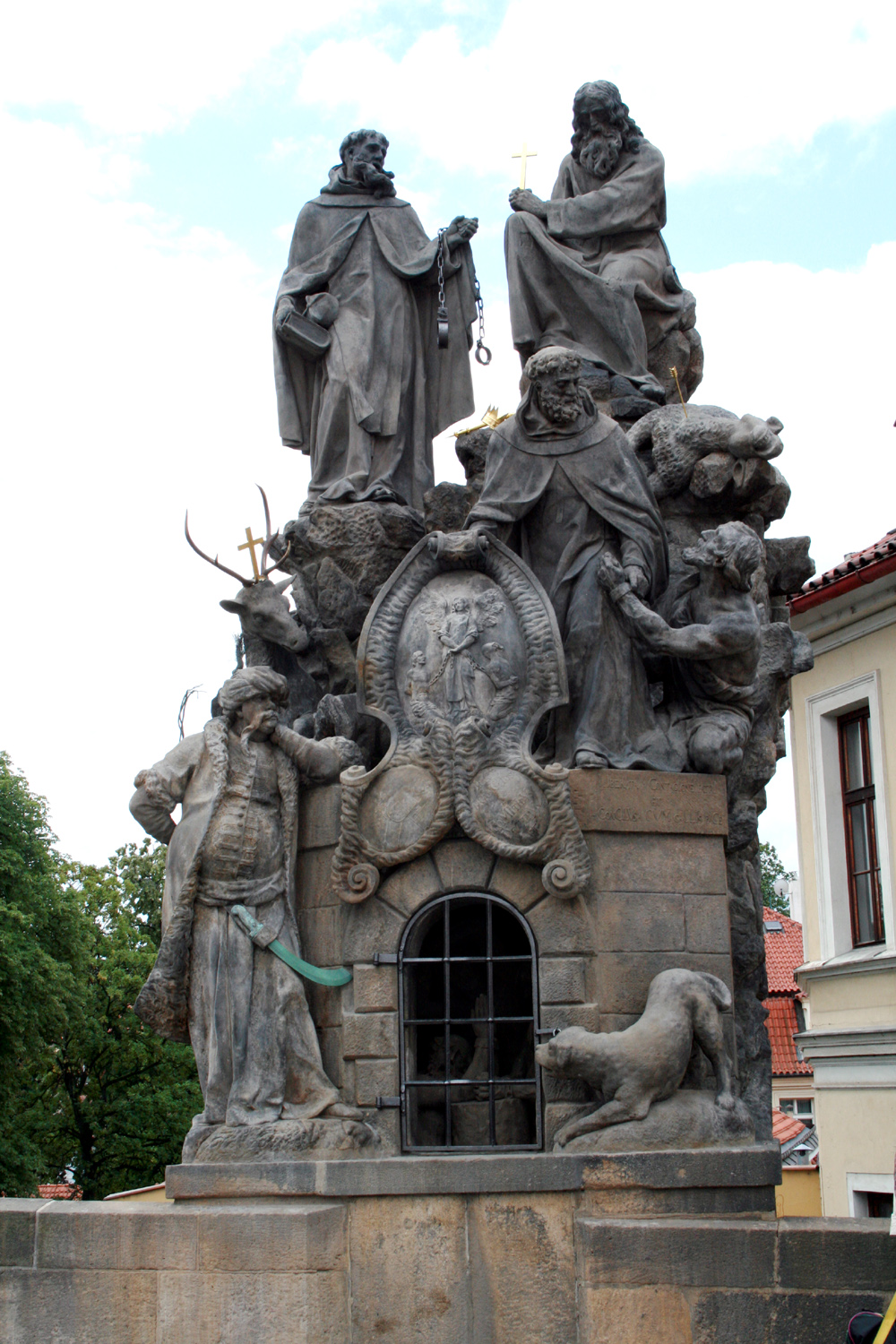
I also reflected today on two Orders, their saints, and the liturgical collects thereof, being very pertinent to the theme of being loosed from the slavery of sin and made God's children and free: those relating to the Trinitarians and Mercedarians. Both religious societies were set up, in answer to heavenly insinuations, within a few decades of each other (in 1198 and 1218/1235 respectively), and for the same object, the ransoming and rescue of Christian men held captive by the Moors and Saracens.

The former was founded by SS John of Matha and Felix of Valois, upon reception of various signs and revelations from heaven, also shared by the great Pope Innocent III, who clothed them in their white habit marked with the red and blue cross previously shewn them between the antlers of a stag, and named them the Order of the Most Holy Trinity by reason of their tricolour vesture; their Order's motto is
Trinitati Gloria, Captivis Libertas ("Glory to the Trinity; to Captives, Liberty"), or, as a prayer,
Gloria tibi Trinitas, et captivis libertas ("Glory to Thee, O Trinity, and to captives, liberty!").

The latter, named in honour of Our Lady of Ransom or of Mercy, she who manifested the will of heaven to her chosen instruments St Peter Nolasco (together with, it is said, his confessor, St Raymond of Peñafort, O.P.) and King James of Aragon, was co-founded by these men; one of its first and most famous members was St Raymond Nonnatus, so called because delivered by caesarean section after his mother's death. St Peter Nolasco died while praying the 110th Psalm, at the verse
Redemptionem misit Deus populo suo ("God hath sent redemption unto His people" ).
These saints are commemorated in the 1962 Missal with very apposite prayers, as follows:
St Peter Nolasco, Confessor, Mercedarian - 28th January:Deus, qui in tuæ caritátis exémplum, ad fidélium redemptiónem sanctum Petrum Ecclésiam tuam nova prole fœcundáre divínitus docuísti : ipsíus nobis intercessióne concéde ; a peccáti servitúte solútis, in cælésti pátria perpétua libertáte gaudére: Qui vivis et regnas...
(O God, Who for an ensample of Thy charity, didst divinely teach holy Peter to make fruitful Thy Church with a new offspring, for the redemption of the faithful: by his intercession grant unto us, being delivered from the bondage of sin, to rejoice in the endless freedom of our heavenly fatherland. Who livest and reignest...)
St John of Matha, Confessor, Trinitarian - 8th February:
Deus, qui per sanctum Joánnem órdinem sanctíssimæ Trinitátis ad rediméndum de potestáte Saracenórum captívos cælitus institúere dignátus es: præsta, quæsumus; ut, ejus suffragántibus méritis, a captivitáte córporis et ánimæ, te adjuvánte, liberémur. Per Dóminum...
(O God, Who through saint John didst deign in heavenly manner to institute the Order of the Most Holy Trinity for the redemption of captives from the power of the Saracens: grant, we beseech Thee, that at the intercession of his merits, we may by Thee be delivered from all bondage both of body and soul. Through...)
St Raymond Nonnatus, Confessor, Mercedarian - 31st August:Deus, qui in liberandis fidelibus tuis ab impiórum captivitáte beátum Raymundum Confessórem tuum mirábilem effecísti: ejus nobis intercessióne concéde; ut a peccatórum vínculis absoluti, quæ tibi sunt placita, liberis méntibus exsequámur. Per Dóminum...
(O God, Who didst effect Thy blessed Confessor Raymond marvellous in the deliverance of Thy faithful from the capitivity of the impious: by his intercession grant us that, the bonds of sin being dissolved, with free minds we may perform those things which are pleasing unto Thee. Through...)
Our Lady of Ransom, or, of Mercy - 24th September:Deus, qui per gloriosíssimam Fílii tui Matrem, ad liberándos Christi fidéles a potestate paganórum nova Ecclésiam tuam prole amplificáre dignátus es: præsta, quæsumus; ut, quam pie venerámur tanti operis institutricem, ejus páriter meritis et intercessióne, a peccátis ómnibus et captivitáte dæmonis líberemur. Per eúmdem Dóminum nostrum...
(O God, Who by the most glorious Mother of Thy Son didst vouchsafe to increase Thy Church with a new offspring for the redemption of Christ's faithful from the power of the heathen: grant, we beseech Thee, that as we piously revere the Institutrix of so great a work, by her equal merits and intercession, we may be delivered from all sins and the bondage of the devil. Through the same...)
St Felix of Valois, Confessor, Trinitarian - 20th November:Deus, qui beátum Felícem Confessórem tuum ex erémo ad munus rediméndi captívos cælitus vocáre dignátus es: præsta, quæsumus; ut per grátiam tuam ex peccatórum nostrórum captivitáte, ejus intercessióne, liberáti, ad cæléstem pátriam perducámur. Per Dóminum...
(O God, Who by a heavenly inspiration didst deign to call blessed Felix Thy Confessor from the desert to the work of the redeeming of captives: grant, we beseech thee, that, by Thy grace, at his intercession, delivered from the captivity of our sins, we may be brought to our heavenly fatherland. Through...)