The Blessed Virgin Mary as Mediatrix
according to Vatican II and John Paul II
εἷς γὰρ Θεός, εἷς καὶ μεσίτης Θεοῦ καὶ ἀνθρώπων, ἄνθρωπος Χριστὸς Ἰησοῦς.
(1 Tim 2:5)
Bonum diffusivum sui.
(St Thomas Aquinas)
Introduction
Can it be said that the Blessed Virgin Mary is Mediatrix, and what would it mean? Properly speaking, there is only one unique Mediator: “there is one mediator between God and men, the man Christ Jesus” (1 Tim 2:5). According to Aquinas, a mediator is one who brings together and unites those between whom he mediates. To unite humanity to God belongs to Christ, since he is the one through whom the world is reconciled to God (cf. 2 Cor 5:19) by his death, giving himself as a ransom for all (cf. 1 Tim 2:6). However, there is nothing to prevent calling other persons mediators between God and mankind, insofar as in some way they cooperate in uniting the latter to the former, as for instance do priests through administering the sacraments. They can share in this work because the good is diffusive of itself, permitting men to share in God’s own power in due measure.
In Catholic tradition Our Lady has been designated as Mediatrix, and even as Mediatrix of all graces – a Mass and Office of Our Lady as invoked under this title being granted to Belgium (and latterly to other dioceses that wished for it) in 1921. This latter term has not been used by the Magisterium since before Vatican II. Instead, insisting on Christ as the one Mediator, the Papacy under John Paul II has continued to develop (as will be seen below) the teaching of the Council that Mary is indeed Mediatrix, but her mediation derives from, is totally subordinate to and in union with that of Jesus Christ her Son, and is a consequence of her divine maternity and concern for all the children that she has been given by God – for her Son is the firstborn of many brethren (Rom 8:29), and to each of them applies the solemn charge, “Woman this is your son” (Jn 19:26).
Mary as Mediatrix «sub Ipso et cum Ipso» —Lumen gentium, nn.60-62
There was conflict at the Council between a minority who wished to proclaim Mary as Mediatrix of all graces and another group who wished to avoid the title altogether. According to the former group of bishops (some 382 had asked for this title to be defined when consulted prior to the Council ), Mary assists at each and every dispensation of divine grace to the world. They relied upon preconciliar Papal teachings; the axiom of St Bernard, to the effect that every grace is conferred through Mary, had been used in the writings of Popes Bl Pius IX, Leo XIII, St Pius X, Pius XII, and Bl John XXIII. However, the majority of the Fathers felt that the time was not right for defining this doctrine, as they felt it insufficiently established in the Church, not yet come to theological maturity as a definable dogma rather than as a theological opinion, and not very suitable ecumenically.
The compromise achieved was to mention the title of Mediatrix but situate the teaching within the context of the one mediation of Christ, in which Mary and all intercessors share. Christ’s grace raises all the faithful to a share in his divine life, and enables them to share in his theandric activity of saving and redeeming. Above all persons, this is true of Mary. Her historical connection with his work of redemption is prolonged by her motherly care for all her spiritual children in Christ.
The Council decreed that discussion of the mediatorial role of Mary must not be separated from the truth that Christ her Son is the one Mediator, as Scripture teaches: “for there is one God and one mediator of God and men, the man Christ Jesus, who gave himself a redemption for all” (1 Tim. 2,5-6). Her mediation does not detract from that of Christ, but can only exist as a consequence of its overflowing power, and only exists by the divine will. Neither does it detract from “the immediate union of the faithful with Christ” but of its nature serves to strengthen it.
In paragraph 61 of Lumen gentium, the Fathers of the Council show how the mediation of Mary is manifested in the economy of salvation. (This may be compared with the Rahnerian principle that the economic Trinity is the immanent Trinity, or rather reveals it.) By her predestination, which was one with the eternal decree of the Incarnation of the Logos, she was made to be Virgin Mother of God the Redeemer. She fulfilled her task and in an unique manner cooperated (singulari prorsus modo cooperata est) by her faith, hope and charity in his salvific work, united with him as his associate (socia) and united with him in her compassion (compatiens) at his sacrifice on Calvary. They conclude with the rich statement “Wherefore she is our mother in the order of grace”. As Ephesus declared her Mother of God, Vatican II declared Mary spiritual mother of the faithful. In her motherhood consists her mediation. The text of this paragraph is partially dependent on a draft text circulated at Vatican I, which spoke of Mary as “bringing forth Christ our God and Lord became to us a mother of grace and… was made mother of all the living, nor does she cease by her powerful intercession to win us gifts of eternal salvation”.
Our Lady’s mediatorial function is wholly subordinate to that of Jesus, who, as perfect God and perfect man, is priest and therefore mediator, bringing all prayer and oblation of men to God and from God bringing all graces and mercy to men. She shares in his mediation by her constant intercession, “bringing us the gifts of eternal salvation”. Her maternal charity, her love for her Son, urges her to care for all his brethren. It is for this reason that she is invoked under such titles as Advocate, Auxiliatrix (Helper), Adjutrix (Benefactress), and Mediatrix. But they are not to be understood except as wholly subordinated to the title of Christ as the one Mediator, for to that truth they add nor subtract nothing.
The reason why our Lady can be given such titles in truth, while Christ’s unique mediation is reaffirmed, is that the good is diffusive of itself, communicated in various ways to all created things, and God delights in working through secondary causes, in such wise that the primary cause of any act and its secondary causes are likewise true and proper causes of that act. Therefore, while Christ is the one priest of the New Testament, this does not exclude but rather makes possible the share of all the faithful in the common priesthood, by reason of their baptism into Christ, and likewise it allows for the ministerial priesthood to exist, sacramentally representing the one sacrifice of Christ, applying the power of the Cross and showing forth its power. Similarly, the one mediation of Christ is not exclusive, but of its fulness allows creatures to share in its power of reconciling and uniting God and man through prayer and grace. Mary’s role as mediatrix is a form of maternal help and assistance for all the faithful to be joined more perfectly to the Mediator and Redeemer.
Maternal Mediation — Redemptoris Mater
In his 1987 Encyclical Redemptoris Mater, John Paul II treated of the question of the mediation of the Blessed Virgin Mary (in nn.21-22,38-41,44-45). Throughout this compendium of Marian doctrine, he is anxious to adhere to and expound the conciliar teaching on Our Lady. To this end, in the sections dealing with her mediation, the Pope constantly quotes the relevant paragraphs of Lumen gentium (nn.60-62), always returning to them after expanding upon them.
He begins to teach the faithful about Mary’s mediation by explicating her maternal intervention at Cana (Jn 2:1-11), which he reads as an exemplar of her unfailing interventions on behalf of humanity, showing that her mediation is “in the nature of intercession: Mary intercedes for mankind”. She wishes that her Son’s messianic power be active to save and help. This intervention is maternal, because she does not act as an intermediary, a mediatrix, as an outsider, but precisely as mother of her Son, for as his mother she has the right and duty to speak to him on behalf of all who want, need, and suffer – for she is their mother also. This new motherhood is a spiritual one, not according to the flesh. The Synoptic Gospels (cf. Lk 8:19-21; 11:27-28; Mt 12:46-50; Mk 3:31-35) have Jesus asserting that motherhood according to the flesh is contrasted with membership in the kingdom of God according to the Spirit; Cana shows that the maternity of Mary is spiritual, for she has maternal solicitude for all.
This is the first indication in the Gospel of the maternal concern of Mary for all: as the Council asserted, she became “a mother to us in the order of grace”. John Paul then proceeds to quote Lumen gentium, n.60, reiterating that the mediation of Mary flows from that of Christ, the one Mediator (cf. 1 Tim 2:5), and neither diminishes nor augments it, but rather manifests its power. The third part of Redemptoris Mater is entitled “Maternal Mediation”, and this enunciates the view of the Pope that Mary’s mediation is a corollary of her role as Mother of God. It stems from her motherhood; its character is maternal; thus it is special, extraordinary, distinguished from the mediation of all other creatures, all of whom share in various ways in the one mediation of Christ, just as she does. Having been divinely elected as the Mother of God, she is made “our mother in the order of grace,” as Vatican II proclaimed.
Mary’s motherhood “in the order of grace” parallels the natural union of mother and child: her relationship to each Christian is a bond analogous to the loving relationship between persons characteristic of such a union. This relationship is between individuals, which is why Mary’s maternal love for all is indicated by the words of Christ to his Mother, that she should see the beloved disciple as her son (Jn 19:26): she is mother of all Christians as individuals; each is uniquely beloved. From this stems her maternal mediation in the Spirit, interceding for each of her children.
As Mother of the Mediator, she has given him his human nature, and it is as man that Christ is Mediator. Having accepted to become the Mother of the Incarnate Word, she from that moment shares in an unequalled manner in the one mediation between God and man of Jesus Christ the God-Man. Having been totally given to God in virginity, and understanding her acceptance of motherhood as a total donation of her person to the unfolding of the divine plan, she became both virgin and mother for ever: totally God’s, wholly committed to him, and wholly Christ’s. Thus she shared in his mediation in a unique manner, beginning at the Annunciation, giving the world its one Mediator. This is the fundamental origin of her mediation. Her honour and dignity as Mother of God is the highest state of relationship with God to which a creature can be lifted. Through her, God the Father gave his Son to men; through her, human nature was assumed into the Godhead. All this constituted her as mediatrix.
Furthermore, always cooperating with her Son in his work of salvation, even unto her unwavering stance at the foot of the Cross, her motherhood was ever being infused with perfect charity by the Spirit, becoming in union with Christ ever more desirous of the salvation of all. Being full of grace from the first moment of her existence, and thus preeminently redeemed, she above all others experienced in her integrity of soul and body the excellence of the redemption wrought by the Mediator, and so was most able to cooperate in his work, in a role of mediation subordinate to his own. She was therefore most fitted to be made by Christ “for all people their ‘mother in the order of grace’”.
Ever since the ascension of Christ, our Lady has been united in a singular way to his Church. She was there at its infancy, in a manner reliving the conception and birth of Christ by her assistance at the prayer of the apostles and disciples in the cenacle, and at the descent of the divine Spirit at Pentecost. As the Pope explains, her maternal self-giving to her Son was transferred to the Church, Christ’s mystical body; by her intercession she cooperated with his salvific work in his members. His paschal mystery won salvation for all, and so her share in his mediation had necessarily a universal dimension. It has also a universal dimension in time, for as the Council declared, even after her passing from this life, she did not cease to mediate for men.
Our Lady is preeminent among the saints in her mediation, which is always ordered to and derived from the one mediation of her Son. As all the saints in heaven pray for us, so much the more does she intercede for us. As Pius XII defined, her corporeal assumption conforms her above all other creatures to her risen and ascended Son, and in perfection of body and soul in glory she continues her collaboration with him, acting as mediatrix until the end of time, when she will return with Christ and at his side perform a special motherly role as “mediatrix of mercy” for men at the Final Judgement. Being so utterly united to Christ, her mediation excels all others, serving the work of the one Mediator and so reigning puissantly with him (cui servire regnare est – whose service is perfect freedom).
General Audiences
On 13th December 1995, 30 years after the close of the Council, the Holy Father reflected on the teaching of Vatican II about the Mother of the Lord. He explained how it came to pass that this body of doctrine was incorporated into the document Lumen gentium on the Church. While some feared that her dignity and privileges and unique level of collaboration in the economy of salvation would be insufficiently emphasised by this, the material included in chapter 8 of that document “shows real doctrinal progress” and “the danger of reductionism… proved unfounded: Mary’s mission and privileges were amply reaffirmed: her cooperation in the divine plan of salvation was highlighted; the harmony of this cooperation with Christ’s unique mediation appeared were [sic; lege more] evident.” With regard to her title of Mediatrix, the Pope noted that the hesitation of some Fathers was overcome, and it was included alongside statements affirming her mediation in other terms, such as her motherhood in the order of grace and her unique cooperation in the work of bringing supernatural life to men.
In his catechesis on the Blessed Virgin Mary, which Pope John Paul II gave during 1997 at his General Audiences, he reflected on the mediation of Our Lady. He explained that “The heavenly Father… wanted to unite to the Redeemer’s intercession as a priest that of the Blessed Virgin as a mother.” Here the derivation of her role as Mediatrix from her status of Mother of Christ and Mother of the faithful is emphasised. Furthermore, he stated that “As maternal Mediatrix, Mary presents our desires and petitions to Christ, and transmits the divine gifts to us, interceding continually on our behalf.” This is a profound sentence, as it shows not merely Mary’s intercession for us, but her active obtaining and especially her transmission of grants of grace to all.
John Paul II gave his most extensive catechesis on Mary as Mediatrix on 1st October 1997. He elucidated the meaning of the term by quoting from Lumen gentium, n.62, affirming her as bringing to all the gifts of salvation by her intercession. He reiterated his earlier teaching in Redemptoris Mater, n.38, that her mediation is maternal in nature, deriving essentially from her divine motherhood and her consequent spiritual motherhood of the faithful as children of God and coheirs with Christ. It is therefore a unique type of mediation, and moreover uniquely efficacious. She cooperates in the spiritual rebirth of humanity, and thus can be termed “mother in the order of grace”. She is “our Mother” and thus our “Mediatrix”. Some Conciliar Fathers objected to the term, but not when it was rightly explained by the Council in reply as a fruit of her maternity.
Again he quoted at length from Lumen gentium, testifying that the term Mediatrix does not take anything from the perfection of the one Mediator, but rather manifests his power of mediation. Another aspect of the question was revealed by his exegesis of 1 Tim 2:1-6, when he pointed out that St Paul prefaces his assertion of Christ as the unique Mediator by calling for intercessions to be offered up for all, and therefore, as prayers are a form of mediation, he is calling for all to share more fully in the participated mediation of Christ, excluding only a pretended mediation that would seek to do without Christ. In his great love, God desires to share what he possesses, and this gives rise among other things to the possibility for creatures to share in the mediation his Son achieves. It is at the will of the Father that Mary as a sharer in Christ’s mediation is given to the world, and she receives from his mediation “all that his heart wishes to give mankind”.
At an earlier audience, he affirmed that Mary cooperated in the Redemption by being present during the Passion in her motherly role, collaborating “in obtaining the grace of salvation” in a unique manner, acting always in subordination to the work of Christ, but really cooperating with him. She did so in virtue of being Mother of God, having brought him forth, raised him, and assisted him even at his death, suffering beneath the Cross. There, as the New Eve and icon of the Church, she represents all redeemed humanity called to share in the work of applying the salvation won by Christ on Calvary to souls and bodies. She continues by her maternal intercession to cooperate in the work of salvation accomplished by the sacrifice of Christ. It is to be noted that the Supreme Pontiff, while freely using the term “cooperator” with regard to Mary, sedulously avoided the more controversial term “coredemptrix”, preferring the former, which he mentions as being already used by St Augustine.
In 1997, the Pope candidly spoke of how Marian devotion and teachings constitute an ecumenical stumbling block to Protestants, for they see her cooperation in salvation as belittling Christ as the one Mediator, and in fact contradicting the Scriptural assertion of this truth. He related how deepened study of the Scriptures and the writings of the Reformers has led to an approach of some Protestants toward Catholic positions on these questions. Her maternal intercession he invoked, and on her maternal solicitude for all he relied, to obtain of God the gift of completed unity in faith. This is because Christians can rely on the maternal intercession of Our Lady “for every kind of grace… they can count on her motherly intercession to receive from the Lord everything necessary for growing in the divine life and for attaining eternal salvation.”
At his General Audience of 12th January 2000, the Holy Father reaffirmed the inseparability of Mary’s mediation, rooted in Christ’s, and in no way apart from it or paralleling it. Her cooperation in salvation derives from his mediation, and is “the most sublime fruit of Christ’s mediation… essentially directed to bringing us into a more intimate and profound encounter with him”
Rosarium Virginis Mariæ
In 2002, in his Apostolic Letter on the Rosary, the Pope again spoke of the maternal care of Mary for us as manifested in her unwearying intercession, which is her mode of sharing in the mediation of the one Mediator, her Son Jesus Christ. He proceeds to quote St Louis de Montfort’s principle that, as perfection consists in being conformed to Christ, among all devotions that achieve this, the most efficacious is devotion to Mary, since she of all creatures is most conformed to him, and being more and more devoted to her will draw one necessarily closer and closer to him. Hence, her mediation shows forth the power of the one Mediator, and derives its efficacy from him, as the Council declared.
As first manifest at Cana, Mary’s maternal intercession greatly aids the Church. She points to Christ, the Way, and prayer to her indubitably leads to him, as she intercedes for us with him. To use a daring expression, she is “all-powerful by grace” — «omnipotens per gratiam» — for “her maternal intercession can obtain all things from the heart of her Son.” Thus the Holy Father enunciates the principle that Mary, most conformed of all to Jesus, and preeminently sharing in his mediation, is a mediatrix for the people of God, being a mother concerned for her children, knowing their true needs, and always obtaining for them what they really need, since she only asks for what she knows is in accord with God’s will, which he therefore readily dispenses.
Advocates of a New Marian Dogma — The Status Quæstionis
In the 1990’s renewed calls were made by some Marian devotees for Our Lady to be defined as Mediatrix of all graces, even as Coredemptrix. The Holy See requested the 1996 Mariological Congress to establish a commission to inquire if this were opportune; it reported in the negative. Since by deliberate act Vatican II avoided a definition of Mary as Mediatrix of all graces, despite calls for this from several hundred bishops prior to the Council, and since there seemed no substantial advance in ecclesiology, theology or exegesis that would support the proposal, it was felt that it remained a quæstio disputata. Our Lady was defined as having a universal motherhood in the order of grace in Lumen gentium, and her maternal mediation has been shown (as in Redemptoris Mater) to be consequent upon this; it was considered that the Magisterium had prudently spoken of all that was necessary in this area. The same view was expressed with regard to the other proposed term “Coredemptrix”, which the Magisterium had avoided in all its major pronouncements for 50 years, preferring instead the more uncontroversial term “cooperator in the work of salvation”. While the proposed terms of course can be understood in conformity with the faith, they would occasion disquiet and possible misunderstanding, particularly among the separated brethren. The Holy See, having received this report, has so far taken no action on the requests for the use of the two controverted terms, and it appears that none is likely.
Conclusion
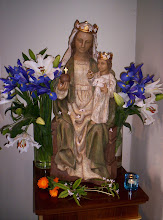
The maternal intercession of the Blessed Virgin has been developed by Pope John Paul II as the heart of the understanding that she exercises a preeminent role (always ordered to and in union with her Son, the one Mediator and Redeemer) in mediating the graces of redemption to all. As she is Mother of God, she brought God’s gift of his Son, our salvation, into the world, and she collaborated with him all his life, even suffering in union with him as she endured a spiritual martyrdom at the foot of his Cross, whereon he offered himself to redeem the world. Being made mother of men in the order of grace by her dying Son, with maternal care she joined in continuous prayer with the infant Church and, assumed to heaven, she prays for the Church unceasingly. Therefore, she is rightly invoked as Mediatrix, from whom the pilgrim people of God may expect every assistance: she is as it were the throne of grace, to which all may turn for timely aid (cf. Heb 4:16), as she is pictured in art holding her Son, the source of all grace and salvation and life.
Bibliography
Aquinas, Thomas. Summa Theologiæ.
O’Carroll, Michael. Theotokos: a theological encyclopedia of the Blessed Virgin Mary. Wilmington: M. Glazier, 1983.
Vorgrimler, Herbert (ed). Commentary on the Documents of Vatican II. Volume I. L. Adolphus, K. Smyth & R. Strachan, trans. New York & London: Burns Oates / Herder and Herder, 1966.