Showing posts with label Crown of Thorns. Show all posts

Monday, April 26, 2010

The Lord's Most Holy Crown of Thorns – III

Sure enough, the 1738 Paris Missal has a proper Mass for the Feast of the Reception of the Holy Crown of Thorns, but kept on the 11th of August.  As with most of the Neo-Gallican formularies of that Missal, the chants are selected entirely from Scripture (whereas the Dominican Mass thereof begins with the Introit Gaudeamus omnes).  Only the Gospel and the Collect of the two Masses are the same.

What particularly interested me were the Parisian Secret (which alludes to Ps 118:120a, Confige timore tuo carnes meas – "nail down my flesh with the fear of Thee") and Postcommunion (with its pleasing contrast of Christ's humiliation with His exaltation), which I now subjoin:

Deus, qui, ut peccatorum nostrorum spinas evelleres, Filii tui caput spinis transfigi voluisti: carnem nostram et corda nostra casto tuo timore confige; ut in mentibus nostris Spiritus tui gratia renovatis, et cupiditas extirpata deficiat, et caritas plantata proficiat; Per eumdem... in unitate ejusdem...
(God, Who, that Thou mightest pluck out the thorns of our sins, didst will the thorns to transfix the head of Thy Son: nail our flesh and heart with Thy chaste fear; that in our minds renewed by the grace of Thy Spirit, both extirpated cupidity may fail, and implanted charity make progress; Through the same... in the unity of the same...)
Deus, qui passionis Filii tui instrumenta fecisti ejus ornamenta triumphi; præsta per hæc mysteria, quæ sumpsimus, ut non erubescamus illius improperium portare, cujus ignominiæ insignia veneramur: Per eumdem...
(God, Who didst make the instruments of Thy Son's Passion the ornaments of His triumph: grant by these mysteries which we have received, that we may not blush to bear His shame, Whose insignia of ignominy we venerate.  Through the same...)

By contrast, the traditional Roman Missal, at least in older editions (such as the 1958 altar missal I have before me, whose flyleaf reveals it cost £13/6/-), provides a Mass of the Sacred Crown of Thorns to be said in some places (pro aliquibus locis) on the Friday after Ash Wednesday.  This Mass stands closer in its texts to the Dominican – it has the same Lesson and Gospel, and the same orations – but the Introit is the same as that in the Paris Missal (excepting the Psalm verse), and likewise they share the same first part of the Gradual.

The Roman and Dominican secret is as follows:

Tuorum militum, Rex omnipotens, virtutem robora: ut, quos in hujus mortalitatis stadio unigeniti Filii tui corona lætificat; consummato cursu certaminis, immortalitatis bravium apprehendant.  Per eumdem...
Strengthen, almighty King, Thy soldiers with power: that those in the stadium of this mortal life may rejoice in the Crown of Thine Onlybegotten Son; having finished the course of strife, may they lay hold of the prize of immortality.  Through the same...

This secret is an evident allusion to St Paul's words – the Apostle hoped to be crowned with glory by the Lord; but first the Lord Himself had worn the crown of suffering:

Nescitis quod ii qui in stadio currunt, omnes quidem currunt, sed unus accipit bravium? Sic currite ut comprehendatis.  Omnis autem qui in agone contendit, ab omnibus se abstinet, et illi quidem ut corruptibilem coronam accipiant: nos autem incorruptam.
Know you not that they that run in the race, all run indeed, but one receiveth the prize? So run that you may obtain.  And every one that striveth for the mastery, refraineth himself from all things: and they indeed that they may receive a corruptible crown; but we an incorruptible one.
 — I Cor. ix, 24-25
Labora sicut bonus miles Christi Jesu.  Nemo militans Deo implicat se negotiis sæcularibus: ut ei placeat, cui se probavit.  Nam et qui certat in agone, non coronatur nisi legitime certaverit.
Bonum certamen certavi, cursum consummavi, fidem servavi.  In reliquo reposita est mihi corona justitiæ, quam reddet mihi Dominus in illa die, justus judex: non solum autem mihi, sed et iis, qui diligunt adventum ejus.
Labour as a good soldier of Christ Jesus.  No man, being a soldier to God, entangleth himself with secular businesses; that he may please him to whom he hath engaged himself.  For he also that striveth for the mastery, is not crowned, except he strive lawfully.
I have fought a good fight, I have finished my course, I have kept the faith. As to the rest, there is laid up for me a crown of justice, which the Lord the just judge will render to me in that day: and not only to me, but to them also that love his coming.
— II Tim. ii, 3-5; iv, 7-8


Likewise, here is the postcommunion the Roman and Dominican formularies share:

Supplices te rogamus, omnipotens Deus: ut hæc sacramenta quæ sumpsimus, per sacrosanctæ Filii tui coronæ, cujus solemnia recensemus, virtutem, nobis proficiant ad medelam.  Per eumdem...
(Bowing low we pray Thee, almighty God: that these sacraments which we have received, by the power of the holy and sacred Crown of Thy Son, whose solemnity we celebrate, may profit us as a healing remedy.  Through the same...)

It may seem strange that we beg God to grant that the Sacrament heal us "by the power of the... Crown [of thorns]", but of course it is by the most stupendous merit of the voluntary sacrifice of His Passion – one element of which was bearing the cruel imposition of a thorny crown – that we are saved and raised up, and to receive Christ's very Flesh and Blood is precisely to be brought into contact with His Sacred Humanity, the Instrument whereby our salvation was won on Calvary, and from which power goes forth to heal.  All the Sacraments have their power from the Passion: and to receive a Sacrament is to be touched by the living power of Christ, Priest and Victim, a grace won for us on Calvary's tree.

It is interesting that the same feast is provided with such differing texts.

Saturday, April 24, 2010

The Lord's Most Holy Crown of Thorns – II

Here are the proper hymns for the feast of the Crown of Thorns (kept on the 24th of April in the Dominican Rite), which I think are quite fine, although I can't spare the time to translate them, alas – first, for Matins and Vespers:


Æternæ Regi gloriæ 
Devota laudum cantica
Fideles solvant hodie 
Pro Corona Dominica.

Coronat Regem omnium
Corona contumeliæ,
Cujus nobis opprobrium 
Coronam confert gloriæ.

De spinarum aculeis 
Christi Corona plectitur, 
Qua ministris tartareis 
Mundi potestas tollitur. 

Corona Christi capitis, 
Sacro perfusa sanguine, 
Pœnis solutis debitis, 
Reos purgat a crimine. 

Laus Christo, Regi gloriæ, 
Pro Coronæ virtutibus, 
Qua nos reformans gratiæ 
Coronet in cælestibus.  Amen.


And at Lauds:


Lauda, fidelis concio,
Spinae trophæum inclytum,
Per quam perit perditio
Vitæque datur meritum.

Nos a puncturis liberat
Æterni Patris Filius,
Dum spinis pungi tolerat,
Spinarum culpæ nescius.

Dum spinarum aculeum
Christus pro nobis pertulit,
Per diadema spineum
Vitæ coronam contulit.

Plaudat turba fidelium,
quod per spinæ ludibrium
purgat Creator omnium
spineti nostri vitium.

Laus Christo, Regi gloriæ,
Pro Coronæ virtutibus,
Qua nos reformans gratiæ
Coronet in cælestibus.  Amen.

Friday, April 23, 2010

The Lord's Most Holy Crown of Thorns

Feasts commemorating the Passion in Eastertide – an excellent idea!  Is not the Paschal Mystery of Christ's Cross and Resurrection the central mystery of salvation?

How pleased therefore I am to have just (by anticipation) prayed over to-morrow's Matins of the charming Dominican feast of the Sanctissima Corona Spineæ Domini, the Lord's Most Holy Crown of Thorns.

As the versicle at Matins has it,

Tuam Coronam adoramus, Domine, alleluia. – Tuum gloriosum recolimus triumphum, alleluia.

Thy Crown we adore, Lord, alleluia. – Thy glorious triumph we worship, alleluia.

(Of course, as Aquinas notes, who himself would have celebrated this feast, we pay to relics of the Passion a relative latria, worshipping not they themselves, which were foul idolatry, but Him Who shed His Blood upon them, suffering the Scourge, the Nails, the Thorns, the Cross, the Lance, all for our salvation.)

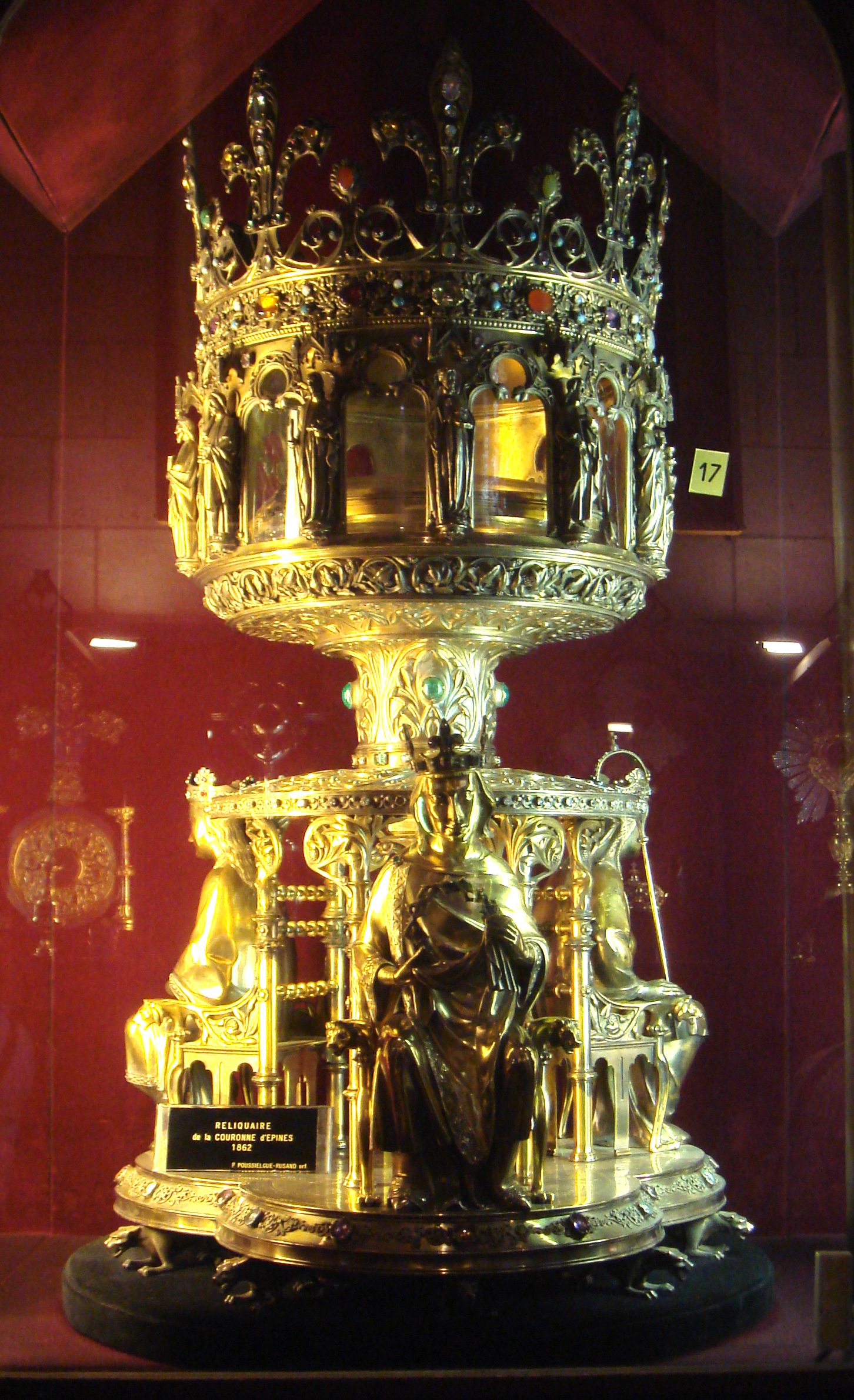
St Louis IX was gifted by Baldwin II (Latin Emperor of Constantinople) with the sacred relic of the Passion that is Our Lord's Crown of Thorns.  A kingly gift!  One refrains from enquiring too deeply into the sad events that led to the Latin Empire of Constantinople, and the redistribution of holy treasures from East to West...

Good king Louis commissioned the building of the Sainte-Chapelle, that marvel of stained glass, as a noble edifice itself one grand reliquary for the Crown of Thorns.  Later, after the outrages of the French Revolution, the relic was translated into the metropolitan church of Notre-Dame de Paris.  As two Friars Preachers had been deputed to bring the Crown to the king, St Louis gave several Spines therefrom as a gift to the Dominican Order; as the king ordered kept in his Holy Chapel the feast of the reception of the Crown of Thorns, so too the feast entered the calendar of the Dominican Order in the mid-thirteenth century.

(The above history I've cribbed from the third Lesson at Matins.)

The Dominican Office, in cleverly composed, archetypally mediæval responsories and antiphons, plays upon many themes: as at the Fall of Man it was told Adam, Thorns and thistles the land shall bring forth against you (Gen. iii, 18), "spines" or thorns may stand for Man's sin, and for his fallen state; while Christ, brought forth from a pure Virgin (sicut lilium inter spinas – Cant. ii, 2a), is as the Flower of a Lily among thorns, and by His death all are made alive: "the thorn [sting] of death is blunted by the Spines, when Life died, alleluia" – divine paradox! (Indeed, "O death, where is thy sting?")

Here is the whole masterful first Responsory, rendered as best I can:

R/. Spina carens Flos spina pungitur, per quam culpæ spina confringitur: * Spina mortis spinis retunditur, dum Vita moritur, alleluia.  V/.  Per hoc ludibrium hostis deluditur: mortis dominium per mortem tollitur.  * Spina mortis spinis retunditur, dum Vita moritur, alleluia.
R/.  Lacking the thorn [of any sin], the Flower is pricked with the thorn, by Which is broken the thorn of faults: * The thorn of death is blunted by the spines, when Life died, alleluia.  V/.  By this mockery the Enemy is duped: the dominion of death by death is taken away. * The thorn of death is blunted by the spines, when Life died, alleluia.

The Collect is as follows:

Præsta, quæsumus, omnipotens Deus: ut, qui in memoriam passionis Domini nostri Jesu Christi Coronam ejus spineam veneramur in terris, ab ipso gloria et honore coronari mereamur in cælis: Qui tecum vivit et regnat...
Grant, we beg, almighty God: that we, who in memory of the passion of Our Lord Jesus Christ do revere His thorny Crown on earth, by Him may deserve "to be crowned with glory and honour" (cf. Ps 8:6) in heaven: Who with Thee liveth and reigneth...

Some fight for earthly crowns, but we Christians contend for an incorruptible crown (I Cor. ix, 25): "Be ye faithful unto death, and I will give you the crown of life" (Apoc. ii, 10b);  "Blessed is the man that suffereth temptation, for when he hath been proved, he shall receive the crown of life, which the Lord hath promised unto them that love Him" (James i, 12); "And when the Prince of pastors shall appear, he shall receive an immarcescible crown of glory," one that fadeth not away (cf. I Peter v, 4).

As the Apostle wrote, "As for the rest, there is laid up for me a crown of justice, which the Lord, the Just Judge, will render me on that Day: and not just to me, but to them that love His Advent."  (II Tim. iv, 8a)  We are to be crowned with blessedness – if worthy – because first Christ scorned not to wear the Crown of thorns.

In the mysterious Providence of the Almighty, Who is so omnipotent as to draw good even out of evil, it was permitted that the Eternal Son of God should be crowned with glory and honour (Ps 8:6) by being crowned with a mockery of cruel thorns, prest down into His scalp, "piercing the brain" as St Alphonsus wrote, all carried away.  Yet this was in truth the Crown of the King of Kings: "Yes, I Am a King".  "Thou hast placed upon His head a crown of precious stones" (Ps 20:4) – thorns made rarer and more precious than all gems by their empurpling with His roseate Blood.

When He was mockingly brought forth in purple and wearing this gory Crown, Pilate declared more truly than he knew, Behold the Man (St John xix, 5): comes the Day when all shall see Him, and the wicked shall wail, knowing their fate, while the just shall rejoice at the Advent of the Lord in glory.  "And I saw: and behold a white cloud, and sitting upon the cloud One like unto the Son of Man, having on His head a golden crown."  (Apoc. xiv, 14)

In this Christ in His Passion was shewn forth as the true Priest, greater and more perfect than Aaron, who had worn some sort of crown or mitre in his priestly ministrations when offering the animal sacrifices that were the dumb figures and shadows of the Perfect Sacrifice of the God-Man.

As the first Lesson, quoting St Paul, tells us, "we see Jesus, on account of His suffering death, crowned with glory and honour, for that by the grace of God He tasted death in the place of all men."  (Heb. ii, 9)

As the antiphon of the Matins psalmody puts it more poetically,


Christum sub Serto spineo deridet plebs perfidiæ:
cujus cruore roseo Sertum confertur gloriæ, alleluia.

The perfidious crowd derided Christ 'neath Crown so thorny: 
by Whose roseate gore's conferred the Crown of glory, alleluia.