Showing posts with label Ascension. Show all posts

Friday, June 3, 2011

Easy Pentecost Novena

How best to make the Pentecost Novena?

I.  It was Our Lady and the Apostles (plus the holy women and Our Lord's near relations) who made the first Novena: they and the rest of the believers (whom we trust joined with them in petition), to the number of about 120 persons, were the whole Church of God on earth in those days, and it was their united supplication that won from the Father through the risen and ascended Christ – as He commanded them to ask – the uncreated Gift of the Holy Ghost.

Therefore, believing in the One Holy Catholic Apostolic Church and the communion of saints, no less than in Father, Son and Holy Ghost, it seems most reasonable to ask Our Lady and the Apostles, being the pillars and foundations of the Church, to once again join us in prayer for the descent of the Spirit, the Sanctifier, the Lord and Vivifier, that He may hallow and bless us, infusing us with grace whereby we may be supernaturalized and made perfect men.

One should thus invoke the Blessed Virgin and the Apostles, that they may pray with and for us:

Sancta Maria, Mater Jesu, ora pro nobis.
Sancte Petre, ora pro nobis.
Sancte Joannes, ora pro nobis.
Sancte Jacobe, ora pro nobis.
Sancte Andrea, ora pro nobis.
Sancte Philippe, ora pro nobis.
Sancte Thoma, ora pro nobis.
Sancte Bartholomæe, ora pro nobis.
Sancte Matthæe, ora pro nobis.
Sancte Jacobe, ora pro nobis.
Sancte Simon, ora pro nobis.
Sancte Juda, ora pro nobis.
Omnes sancti Apostoli, orate pro nobis.
Omnes sancti Discipuli Domini, orate pro nobis.

******

II. Since Our Lady is Queen of the Apostles and Queen of All Saints, and is of all creatures the closest to her Divine Son, it is only most rightful to especially call upon her loving maternal intercession.  

To this end, the Regina cæli, as sung by the Dominicans, having the Ascensiontide variant Jam ascendit, sicut dixit, is perfectly suitable, if it have subjoined the usual versicle, suitably adapted, with the Collect for Friday after the Octave of the Ascension from the 1738 Paris Missal (with per Dei Genitricem Mariam supplied):

Regina cæli, lætare, alleluja:
Quia quem meruisti portare, alleluja,
Jam ascendit, sicut dixit, alleluja.
Ora pro nobis Deum, alleluja.

V/. Gaude et lætare Virgo Maria, alleluja.
R/. Quia ascendit Dominus vere, alleluja.
Oremus.

Deus, qui nos Resurrectionis et Ascensionis Dominicæ solemnia celebrare fecisti: da famulis tuis, ut (per Dei Genitricem Mariam) et advenientis Spiritus sancti gratiam purificatis mentibus suscipere mereamur. Per eumdem Christum Dominum nostrum. R/. Amen.

(This Collect is especially good, and in itself sums up all we wish for: "O God, Who hast made us to celebrate the solemnities of the Lord's Resurrection and Ascension, grant unto Thy servants, that, by Mary the Mother of God, we likewise may deserve to receive the grace of the Holy Ghost with purified minds. Through the same Christ our Lord.  Amen.")

******

III. It ought go without saying that fundamentally and primarily we should adore and beseech God the Holy Ghost Himself, with the well-known Veni Sancte Spiritus, its versicle Emitte and the Pentecost Collect Deus qui corda fidelium (as it were thus anticipating the feast); and append the Magnificat antiphon of Ascension Day:

O Rex gloriæ, Domine virtutum, qui triumphator hodie super omnes cælos ascendisti: ne derelinquas nos orphanos, sed mitte promissum Patris in nos, Spiritum veritatis, alleluja.

As the versicle and the Collect address God the Father, while the O Rex gloriæ addresses God the Son, thus all Three Persons of the Adorable Trinity are properly worshipped, and the Gift of the Holy Ghost rightly besought.

******

I think that these three elements – asking those first pray-ers to pray with and for us, praying in especial to Our Lady, and calling upon the Holy Spirit direct – are eminently suitable and easy ways to make a good Pentecost Novena.  And as I noted above, even alone the Collect from the Missale Parisiense would do as a super-succinct Novena prayer.

Sunday, May 16, 2010

No Love for Heaven

"If in [or for] this life only we have hoped in Christ,
we are of all men most miserable." 
— I Cor. xv, 19.

The worst feature of dying Western Christianity – amongst Catholics too, alas – is that we have no hope, no appetite for heaven.  All we prate about are vague do-good platitudes.  Yet St Paul explicitly warns us, we are of all most to be pitied – to be esteemed, in fact, as miserable and wretched – if we trust in Christ for and in this present life only.


Augustine says (De Verbis Domini, Sermone 100,2): “The East,” that is Christ, “calleth thee, and thou turnest to the West,” namely mortal and fallible man.  
— St Thomas Aquinas, S.T.,IIaIIæ,189,10, resp.


It never ceases to amaze me how we turn from Christ and embrace the world.  (Well, I backslide as much as any man, but I also confess my sins and turn back to the Lord.)  Christ's glorious Ascension being the feast celebrated, you'd think we might have preaching about the glorious hope we have in Him, our Head, having gone ahead of us, that where He is, we might soon follow.  But no, all we creatures care for is that He is with us still – true enough, but not enough.  

It is a great thing, a very great thing, that Christ is with us in the Sacraments, that He is active in us, that when we do good to the least and lowliest, we do good to Him in His poor.  But if we have no sure hope for heaven, we have lost our orientation to ta Eschata, the Last Things, and "are of all men most miserable".

Since I left Fr Rowe's pastoral care in Perth, W.A., I don't think I've heard a sermon about heaven and our necessary focus on living lives aiming at getting there!  You'd think Christianity was just about bourgeois niceness, going on too much of what passes for preaching.  No wonder no one wants to be a Christian anymore.

I was suddenly struck, when about to go up to communicate at Mass, how the evident focus of the words of the Liturgy – both the Ordinary and the Proper – seemed to have been neglected so foolishly and dangerously in the preaching I heard.

Christianity does seem a religion fit only for wimps and old women, when it is portrayed, especially by its would-be leaders, both lay and clerical, as just a way of "being nice".  We shy away from suggesting some salutary "salvation anxiety", or indeed any focus on salvation at all!

Do people presume we will all just "go to heaven" and be saved by a God too nice to do otherwise (as the Scriptures don't say)?  I fear that, given the half-joking, half-ashamed words of too many when people die, to the effect that "Uncle Jack's drinking beer with God in heaven" or somesuch nonsense, that people really have no clear idea of nor belief in the immortality of the soul, let alone the future resurrection.

That is why I fear that preaching about the Ascension without mentioning our hope for heaven is completely topsy-turvy.

Precisely what we need is a strong lecture about heaven, and its reality, and the truth that all our hope for heaven is in Our Lord, Who now reigns there in His Sacred Humanity, so that the substance of our humanity is now already at God's Right.  In this is our hope!

Universalism is a type of indifferentism – and declines into disbelief into any future state.  This process has already taken place, I see it in fellow Christians.  As that appalling ditty has it, "Not in some heaven light-years away..."

Preaching ought not confirm us just in little ideas we already have, but open our eyes to what we have not considered, and strengthen our wavering belief in doctrines we don't grasp.  We need sermons about heaven, and striving for heaven – not just about living nice safe lives on earth.

Turning religion into an excuse for "being nice" alone – now that's real sin, howsoever it is dressed up.  It vitiates religion of what is its real aim – to come nigh unto God, firstly in this world, then forever in the next.  And it only attracts the rightful and well-deserved derision of non-believers.

"If in [or for] this life only we have hoped in Christ,
we are of all men most miserable."

Thursday, May 21, 2009

Ascensiontide Magnificat Antiphon

If no feasts supervene, the ferial days of Ascensiontide - which for five centuries were celebrated as days in the Octave thereof - repeat a capitulo the texts of the feast itself (to a first approximation), and in particular the magnificent Magnificat antiphon of the Ascension is sung at Vespers (attentive chanters will note its similarity to the Advent O-Antiphons, upon which it may be based); it is very suitable to pray as part of a Novena in preparation for Pentecost:


O Rex gloriæ, Domine virtutum, qui triumphator hodie super omnes cælos ascendisti, ne derelinquas nos orphanos: sed mitte promissum Patris in nos, Spiritum veritatis, alleluja.

(O King of glory, Lord of powers, Who as One triumphant this day ascended above all the heavens, leave us not orphans: but send the promise of the Father into us, the Spirit of truth, alleluia.)

Ascensiontide Doxology

At Lauds and Vespers the Church sings the Salutis humanæ Sator (or, as it was prior to Urban VIII's rewording of the hymn, Jesu nostra Redemptio), the quasi-doxology of which is as follows:

Tu dux ad astra, et semita,
Sis meta nostris cordibus,
Sis lacrimarum gaudium,
Sis dulce vitæ præmium.  Amen.

(Thou Guide to heaven, and Thou the Way!
Be Thou the Goal where our hearts tend;
Be Thou our Joy 'mid tears; we pray,
Be Thou our life's sweet Prize and End.  Amen.)

Jam Ascendit

The Dominicans (and other religious orders) have a special form of the Regina cæli for Ascensiontide: they sing, not Resurrexit, sicut dixit, but Jam ascendit, sicut dixit - "Now He's ascended, as He said" (not "Jam's gone up"!).  These words, having the same number of syllables as Resurrexit, can be sung to the same tune.

As a private devotion, very suitable for Ascensiontide as we make with all the Church the original Novena and await the Promised Spirit, one may add a modification of the usual versicle ("for the Lord hath truly ascended"), plus an appropriate collect from the 1738 Paris Missal (for Friday after the Octave of the Ascension), as follows:

Regina cæli, lætare, alleluja:
Quia quem meruisti portare, alleluja:
Jam ascendit, sicut dixit, alleluja:
Ora pro nobis Deum, alleluja.

V/.  Gaude et lætare, Virgo Maria, alleluja.
R/.  Quia ascendit Dominus vere, alleluja.

Oremus.

Deus, qui nos Resurrectionis et Ascensionis Dominicæ solemnia celebrare fecisti: da famulis tuis, ut et advenientis Spiritus sancti gratiam purificatis mentibus suscipere mereamur.  Per eumdem Dominum... in unitate ejusdem Spiritus...

(God, Who hast made us to celebrate the solemnities of the Lord's Resurrection and Ascension: give unto Thy servants that we may also deserve to receive with pure minds the grace of the promised Holy Spirit.  Through the same our Lord... in the unity of the same Holy Spirit...)

Novena to St Philip Neri: 5th Day

The Lord ascends with trumpet blast: 
sing praise to our King, sing praise!

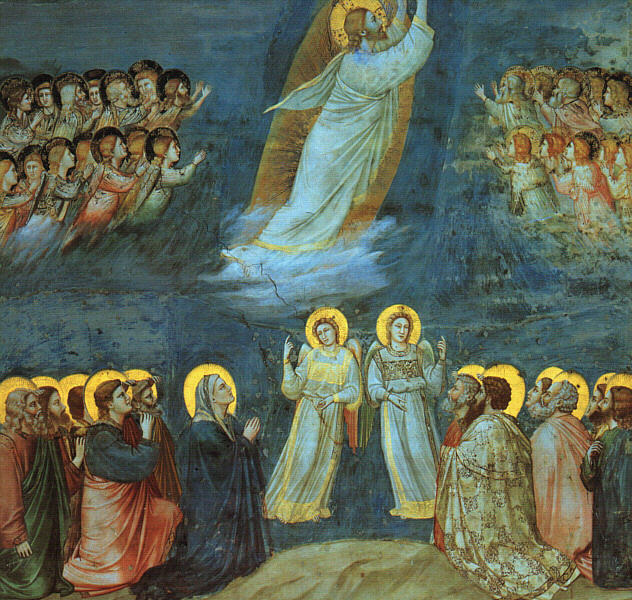
The Breviary bids this Thursday be the solemn annual remembrance of Our Lord's Ascension into heaven, marking the supreme triumph of His sacred humanity, evermore united body and soul to His Divine Person, raised up and exalted above all the heavens, and seated henceforth upon the throne of God: it is our triumph in hope, for if our Head has so ascended, so may we His members pray one day we shall join Him there, as sharers in His victory.

We ought have our thoughts on heavenly things, not on things of earth: raising our hearts to the Lord in heaven, it may also be profitable to lift up our eyes and contemplate the saints in glory, hidden with Christ in God, as we beg may be our part and portion after this life of trial has run its course.

For the same reason, let us henceforth invoke the Holy Ghost to come with yet more vehemence into our souls, to make us the saints that we are called to be - else never shall we enter heaven and there rejoice with all the saints.

Fr Faber provided meditations in preparation for the feast of his Father Founder, St Philip, which is upcoming, and happily coincides so closely with this sacred season of heavenly longing; here is a link to one I posted last year... also for the Novena, Newman's Litany of St Philip is most suitable.

St Philip Neri, pray for us unto Christ God, that He save our souls!

Friday, May 2, 2008

Fabri Filius

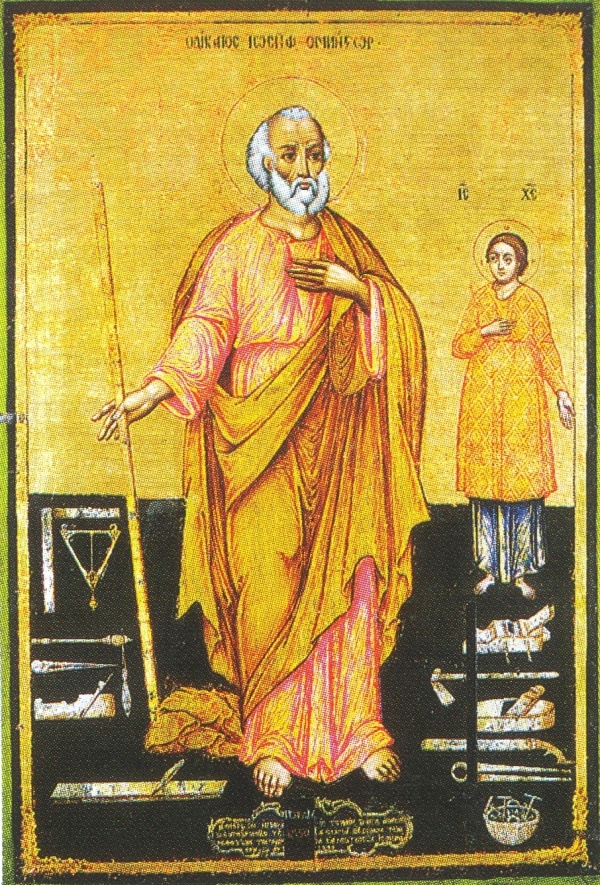
Christ our God did not esteem it beneath Him to be called the Son of a carpenter: for He was indeed the true Artisan and Architect and Author of the universe. Come, let us adore Him! And may St Joseph His foster-father intercede for us, that He may save our souls!


Since in the old calendar St Joseph the Workman is a 1st class feast [albeit only since its inception in 1956, displacing the Apostles Philip and James, no less, to the 11th!], it was transferred to today from yesterday by reason of the Ascension, and so completely supplanted St Athanasius for this year - whereas, in the new calendar, St Joseph the Worker is only an optional memorial, and so either was supplanted by Ascension Thursday, or celebrated at the choice of the priest yesterday in all places where the Ascension is celebrated on Sunday, thus leaving St Athanasius to be celebrated as a memorial today. Confusing?

In the event, since I use the modern Office, I read the Hours of St Athanasius, but his proper only contained a second reading and a collect, so, as is one's choice for memorials, the rest I took from the ferial day of the Friday after Ascension (as I had read the Ascension Office yesterday, tho' strictly here in Australia I should have waited till Sunday for that). My car having been repaired (see a recent posting below, and my comment updating the tale), when I got to the Pro. about ten past six in the evening, shortly after sunset, I found that all therein was instead, according to the '62 Ordo, in honour of St Joseph - we had Litany of St Joseph at the end of the Holy Hour, just prior to the actual Benediction, and Low Mass was of the feast, with Fr wearing his best white chasuble (bought in Rome last year), and preaching...

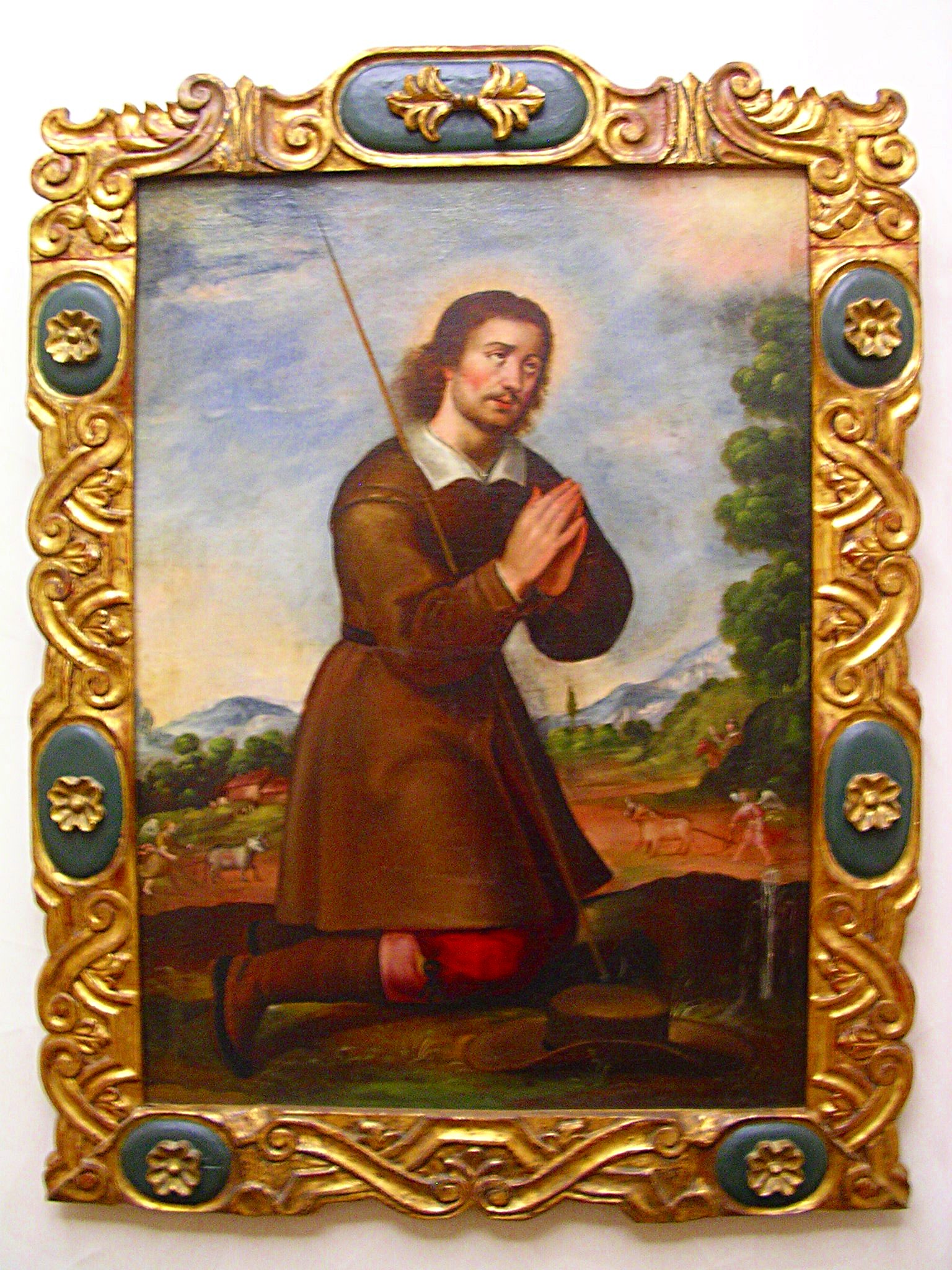
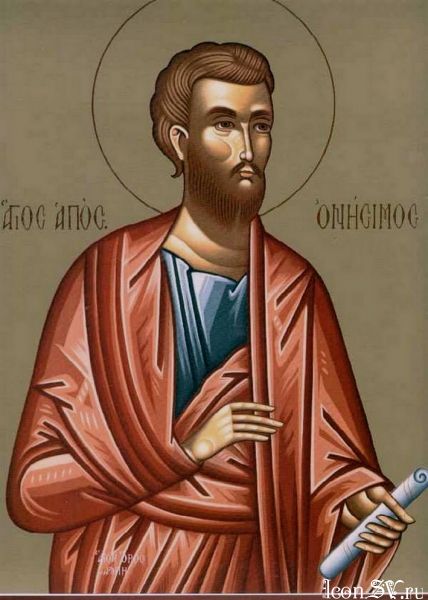
The sermon, as always, focussed on the saving of our souls (what else is as important?), and was vintage Fr Rowe: after talking of St Joseph, named in Holy Writ a "just man", who did nothing extraordinary, who did not preach or die martyred, but who did all for God and in God, and thereby won heaven, he mentioned the following examples of just and righteous workmen: St Isidore, a farmer; St Deusdedit, a humble shoemaker; St Florus, a stonemason (who was, however, a martyr); and St Onesimus and St Notburga, servants. May we be like the hermit who before any action cast his eyes up to heaven, remarking that if we remind ourselves of our goal - God - we will not miss our mark. Our having a good intention in all our works is a "holy alchemy", transforming merely natural goods into supernatural merits, for we ought in all things work for God, and do all our works in Him and by His grace.

St Joseph is the great model for us in our lives and labours: he who taught Our Lord his trade, and was graced above all other men to hold the high state of foster-father of the Son of God. To quote the prayer that is the second Alleluia verse today:

Fac nos innocuam, Joseph, decurrere vitam: sitque tuo semper tuta patrocinio.

(Joseph, make us to run an innocent life: and may it ever be shielded by thy patronage.)

St Isidore the farmer,
pray for us!


St Onesimus, patron of servants,
pray for us!


St Notburga, patroness of poor servants,
pray for us!


I made the happy error, BTW, of reading the ferial second reading at Office of Readings, before I corrected my mistake and read the proper one for St Athanasius, and thus I was granted to savour the magisterial, magnificent and majestic sermon of Pope St Leo the Great - what a Pope! - for the Ascension (Serm. II, nn. 1-4; read the whole sermon in an older translation here, or, better, let Fr Z read it to you!), commenting, in a manner very congenial to my personal adoration of our Lord, on the fact that we no longer know Christ "according to the flesh", κατα σαρκα (II Cor. v, 16), that is, as if He were but a man only, as during His earthly life He would have seemed to be to those lacking supernatural insight, but instead now as He truly Is, God Incarnate, our alone-sufficient Redeemer, because at once both God and Man:

...we commemorate and solemnize the day on which our lowly nature was raised up in Christ above all the host of heaven, above all the ranks of the angels, beyond the height of all the heavenly powers, to the throne of God the Father. We were founded and built on this succession of divine acts, so that the wonder of God's grace might become even greater; for, though everything that seemed to move us to due reverence is removed from our sight, our faith remains constant, our hope firm and our charity warm.
...
The viisble presence of our Redeemer passed over into sacraments; and so that faith might be more noble and firmer, it is grounded now not on sight but on doctrine.
...
The apostles... fixed their minds on Christ's godhead as he sat on his Father's right hand. The evidence of their eyes no longer held back their mental vision from contemplating this truth, that the Son descended from his Father without leaving him, and ascended from his disciples without leaving them.

For the Son of man, dearly beloved, was revealed more perfectly and more solemnly as the Son of God once he had returned to the glory of his Father's majesty, and in a mysterious way he began to be more present to them in his godhead once he had become more distant in his humanity.

Then faith gained deeper understanding and by a leap of the mind began to reach our to the Son as the equal of the Father.
...


Now I must attend to my Novena to the Holy Ghost...

Thursday, May 1, 2008

Disaster!

What a disaster! My car's back windscreen was smashed by person or persons unknown, and I had to spend about 4 hours when I should have been at work trying to contact my insurer, arrange repairs, and get the damaged vehicle to the motor mechanic. What a pest! ^@#*!

Before and after all this, I fitted in my Office: since I was going to Ascension Thursday Sung Mass, I offered up the Office of the Ascension, tho' strictly I should have saved it up for Sunday (since in the OF the Australian bishops have transferred the Holy Day to the Sunday): it seemed more sensible to say and celebrate the Office and Mass of the Ascension on its proper day.

With the aid of friends, plus a train trip, I did manage to make it to Mass, to sing, and to meet Fr and Justin for a quick bite to eat afterwards.

Two items of note: the special Premonstratensian Regina cæli for Ascensiontide - readingjam ascendit, not resurrexit - and a lovely Wesleyan hymn for the feast, "Hail the day that sees Him rise", with its stirring tune: as a priest said to me, one of its couplets is particularly moving: "See! He lifts His hands above, Alleluia! / See! He shows the prints of love, Alleluia!" - Christ will ever display His Sacred Wounds, transformed from the marks of torment inflicted on him by sinful men, transformed into the marks of the Lamb standing as it were slain, Who has conquered sin and death, and now ever pleads His Sacrifice before God His Father, out of love for us.

Now let all things tend upward: Sursum corda!


Therefore, if you be risen with Christ, seek the things that are above; where Christ is sitting at the right hand of God: Mind the things that are above, not the things that are upon the earth. For you are dead; and your life is hid with Christ in God. When Christ shall appear, who is your life, then you also shall appear with him in glory. (Colossians iii, 1-4)

Happy feast of the Analepsis of Our Lord, or, as the Germans say, Himmelfahrt!