Sunday, January 31, 2010

Glum

Having gone to bed very late last night, I slept in past the time for the early Mass at Carmel, or the Mass at St Francis... I ended up having to go fulfil my duty down at Apostles'.  Something about Mass there always makes me feel alienated.  It's just a straightforward Novus Ordo, but it depresses me.  I had to drag myself down there out of obedience, so I brought along my Dominican Breviary – it was all I could do to take the back pew right in the corner, and use the quiet bits to say Matins (which I haven't read for a long time), then Vespers, and Compline (after Communion).  Nunc dimittis, servum tuum, Domine...

I wonder how many of the faithful, each in their own way, find the liturgy hard to bear?  (I mean in general throughout the world.)  As a wise Dominican once told me, if you lose your faith, the last thing you should do is stop saying your prayers and going to Mass – that's when you need to!  And I suppose it is more meritorious bleakly to endure rather than joyously to celebrate.

The Wages of Sin

A dreadful murder case in Melbourne: a millionaire businessman, a happy husband and family man, fit and successful - yet who, it has now been revealed, was leading a double life, with another woman, and moreover had an addiction to sleazy gratification by swapping partners with other couples in seedy suburbs far removed from his comfortable home.  It appears his latest confederates in vice turned on him and killed him.

The wages of sin is death - and we must all add, There but for the grace of God go I: not (God help us) in so uniquely horrible a fashion, but in the realization that all of us suffer divided hearts, and through our own fault fall often into sin, sin in which we would die were the Lord not to preserve us to repent and get up and go on by His grace and absolution found in the sacraments of the Church.

As at Septuagesima we reflect on the Fall of Man from original justice, let us pray, for this poor fellow, for his bereaved family, for his murderers and associates, for all compassed by infirmity, and for ourselves.

St Hubert, D. & M.

Some groups of people have been going on about the cultus of a certain monarch supposedly worthy of veneration as a martyr-saint.

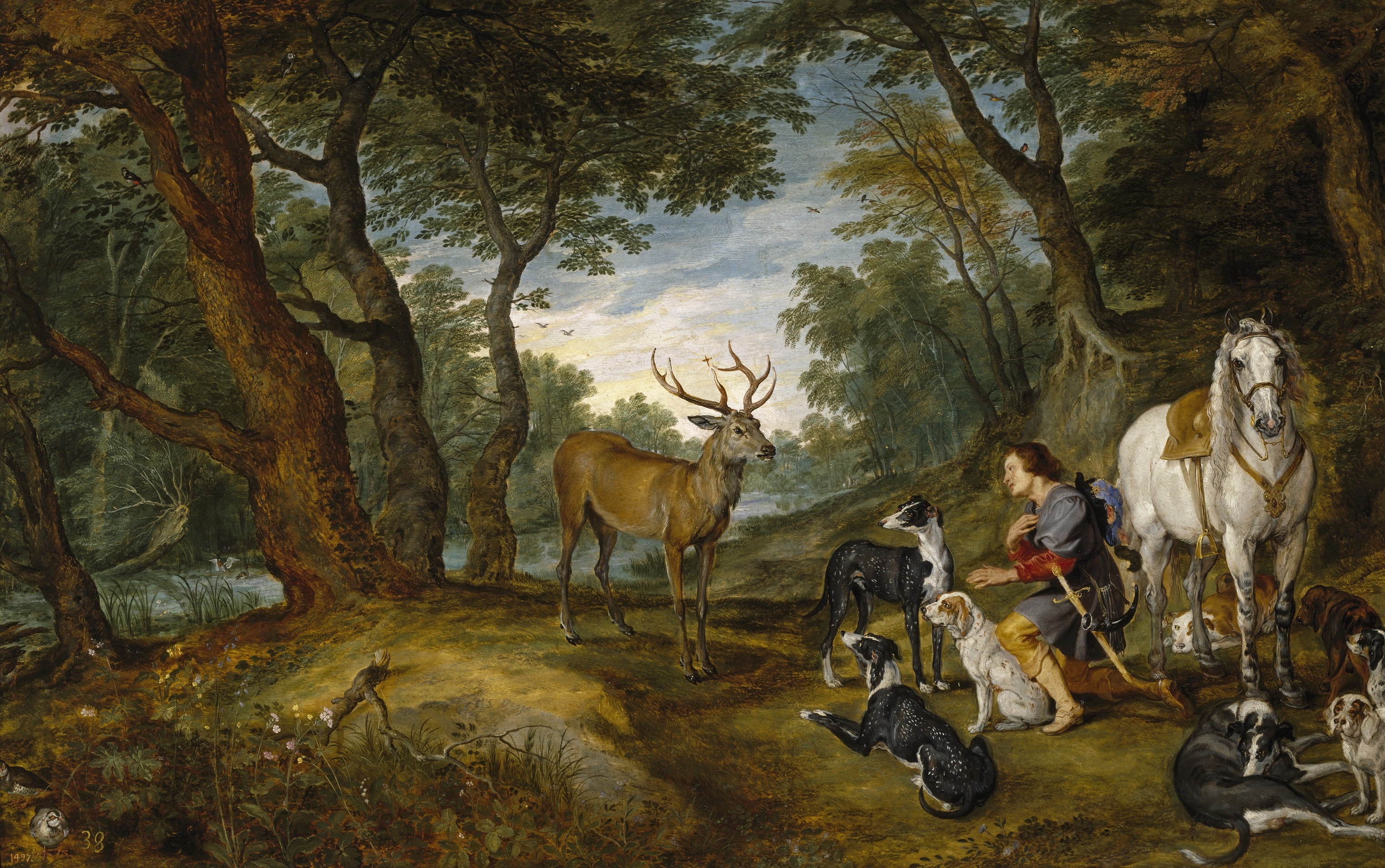
Well, I would like to tell the true tale of another whom a certain group also venerated as a holy martyr: St Hubert.


The real St Hubert, being converted while out hunting by a vision of a stag with a crucifix between its antlers

(Don't confuse this Hubert with the better-known, but arguably related, St Hubert, Bishop of Maestricht, patron saint of hunting dogs and hounds.)

Some time in the mediæval period, a Dominican out on a preaching tour came to a little village, and was surprised to find the locals very piously tending the shrine of one St Hubert, Martyr - a saint of whom the Dominican had not previously heard.  Being an inquisitor in his spare time, he decided to investigate this unknown cultus...

"Tell me," quoth the Blackfriar, "what is the legend of this Hubert?"  "He is a very great saint and martyr, yea, and a miracle-worker forsooth," said the eager villagers, adding, "Many times he works wonders in favour of women in childbirth, that their babes be preserved, just as in life and death he was ever solicitous for protecting his master's child."

Next the priest asked of the circumstances of his holy life and martyrdom.   It was explained to him that he eagerly served his master in all things throughout his brief span of life, never failing in all his duties nor ever doing ill; and - his master being away from the house - he set to guard his master's newborn, left in the cradle, from any and all dangers, as is most pious and just (for the village is in remote and wild parts, on the edge of forests dark and dangerous).  

How fortunate and providential this was - for a serpent came slithering into the house, and headed for the cradle, thinking to feed: Hubert immediately sprang upon that devilish snake, and killed it, besmearing himself with its foul blood in the process, but undoubtedly saving the child's life.

Yet - oh tragedy - at that very hour, the master returning, and seeing his faithful Hubert all bloodied beside the cradle, thought that he had in madness murdered the infant, and so, himself horrified and enraged, ran upon him with a stave and killed him by a blow, before realizing that his son still slept safe, and Hubert was the innocent victim of his own rash act of imagined revenge.

The villagers, hearing this piteous tale, at once acclaimed the faithful Hubert a holy martyr, enshrined his body and bones as sacred relics, and fell to praying him to assist them in all their fears and dangers, particularly as regarding their children: sure enough, they felt satisfied that he had not ceased to defend the young even after his own death, and praised his wonders and intercession.

"So Hubert was his master's good and faithful servant, unjustly slain?" asked the good friar.

"No," the villagers chided him, "his dog!"

The whole township had invented the cult of St Hubert, Dog and Martyr.

 You will not be surprised to learn that, in his capacity as licensed inquisitor against heretical depravity and error, the good Dominican at once denounced this superstition as veneration gone mad, paid not to a true martyr, nor even to a baptised Christian, but to an animal without an immortal soul.  

As a new Ezechias (who of old smashed Nohestan, the brazen serpent whose just memory the people of Judah had corrupted into idolatry - see IV Kings xviii, 4), he forthwith destroyed the shrine and its pretended ex votos, burnt the dog's carcass and bones and scattered them to the four winds, warning the deluded rustics never again to presume to set up their own fond cult without due ecclesiastical approval.

Need I point the moral?

Septuagesima till Easter: Rubricks

In the Dominican Office, as in the Roman, of course no use is made of Alleluia from after first Vespers of Septuagesima until Easter Sunday.  In place of that heavenly word, after the initial Glory be of each Hour, we sing the earthly words Laus tibi, Domine, Rex æternæ gloriæ.

From this day until Easter (excepting 3rd class feasts until Ash Wednesday - and from that day on never save on the few feasts of 1st and 2nd class: the Chair of St Peter; St Matthias; for Dominicans, St Thomas Aquinas; for Australians and the Irish, St Patrick; St Joseph; the Annunciation), no Te Deum is said at Matins, nor Gloria in excelsis sung at Mass.  (To avoid such festal joy entirely during the penitential season before Easter, the Mozarabic and Ambrosian Rites moved all such feasts out of Lent.)

At Lauds of ferias from now till Easter, the second, more penitential set of psalms are used, beginning every day with Psalm 50, the Miserere.  On Sunday, moreover, Psalm 117 is sung next at Lauds (not as usual at Prime, where Psalm 53 substitutes), thus entirely omitting the joyful Psalms 92 and 99.

 The old, longer daily canticles of Lauds, those used before the reforms of Pope St Pius X, also reappear: on Monday, Confitebor tibi, the Canticle of Isaias; on Tuesday, Ego dixi, the Canticle of Ezechias (Hezekiah); on Wednesday, Exsultavit cor meum, the Canticle of Anna; on Thursday, Cantemus Domino, the triumphant Canticle of Moses at the Red Sea; on Friday, Domine audivi, the Canticle of Habacuc; on Saturday, Audite cæli, the terrible Canticle of Moses against faithless Israel.  On Sunday, however, lest the Hour be too burdensome by reason of length, in place of the traditional Benedicite is sung the shorter Benedictus es, also from the Canticle of the Three Young Men.

Furthermore, in the Dominican Rite, on all ferias (as has been the case since the end of Christmastide on the 13th) the preces - threefold Kyrie and Pater noster - are said at Lauds, at Terce, Sext, and None, and at Vespers, before the Dominus vobiscum and collect.

Once Lent begins, the ferial days thereof take precedence of all 3rd class feasts, which are reduced to a Memorial at Lauds.

Already, from Septuagesima Sunday, the way the short responsories at Terce, Sext and None are read changes: the respond (the initial line) is not repeated at once as usual, but instead the versicle is said directly, then the second half of the respond (after the asterisk) as usual, then the Glory be, then the respond in full, thus:

R/.
V/.
*
Gloria Patri...
R/.

(This variation is proper to the Dominican Rite.)

First Vespers of Septuagesima - O.P. Responsory &c.

As is the custom when a new book of Scripture is about to be begun at Matins, at first Vespers to-night the Dominican Rite inserts a Responsory from the set of Historia (as they are called) for that book – Genesis:

(Genesis ii, 1 & cf. ii, 2; Genesis i, 31a.)

R/.  Igitur perfecti sunt cæli et terra et omnis ornatus eorum: complevitque Deus die septimo opus suum quod fecerat: * Et requievitAb omni opere quod patrarat.  V/.  Viditque Deus cuncta quæ fecerat: et erant valde bona. * Et requievit.  Gloria Patri, et Filio, et Spiritui Sancto. † Ab omni opere quod patrarat.

(R/.  So the heavens and the earth were finished and all the furniture of them: and on the seventh day God ended his work which he had made: * And he rested † From all his work which he had done. V/.  And God saw all the things that he had made, and they were very good. * And he rested.  Glory be to the Father, and to the Son, and to the Holy Ghost. † From all his work which he had done.)

Saturday, January 30, 2010

Prayer Request

Of your charity, could readers pray for a certain young man who tells me he is discerning his vocation?

Vespers pre- and post-1912

As all men know, Pope St Pius X did two very daring things: 
  • first, he caused a change to the traditional order of reception of the sacraments - not of set purpose but because he desired to encourage all frequently to partake of Holy Communion, and so ordered that all children having reached the age of reason could communicate - as the age for Confirmation remained what it had been previously, in most countries it transpired that children began making their first Holy Communion before being confirmed; 
  • second, he had the weekly order of reciting the psalmody in the Divine Office rearranged - so that nearly all the psalms were recited only once in the week (rather than some being repeated every day), and thereby shortening the Office, while ensuring, by a change of the rubricks, that on most days (other than the great feasts) the ferial psalms were said, so that each week most of the Psalter was prayed (by the growth in the number of feasts over the centuries, which took their psalms from the Common, many psalms allotted to ferial days were hardly ever said).

Whatever of the first concern, the second I think, over all - beware, those besotted with the ancient Roman cursus psalmorum! "Rome has spoken..." and all that - to have been beneficial.  

For a start, rather than daily reading the long Psalm 118 at the  Little Hours, and having twelve psalms to get through each night at Matins, it was decided to reduce Matins to nine psalms or portions thereof, and to redistribute the surplus psalms over Prime, Terce, Sext and None, moreover making each of those Hours somewhat shorter than before.  

This to be honest made the Little Hours much more interesting, and reduced the fatigue of the Night Office - certainly I enjoy the daily variation at Prime, Terce, Sext and None (unfortunately, the lengthy and highly repetitive nature of Psalm 118 still can make these Hours difficult on Sundays and feasts, I find), and given that I find even nine psalms or parts thereof rather tiring, I hate to imagine how twelve full psalms would seem.  The reforms reduced the length of Matins on most days by half, or even by two-thirds!

(That said, it is said that an angel appeared to one of the Desert Fathers to reveal that twelve was the right number of psalms for Matins.  Then again, I'm not a holy hermit!)

I will leave aside the changes made to Lauds for a later post...

As for Compline, I do wish that it hadn't been changed, and had remained invariable - Psalms 4, 90 and 133 are supremely suitable for the Hour.  As it is, on ferias other psalms, redistributed from Matins, were introduced, which rather destroyed one beauty of Compline: that it could be said from memory in darkness just before retiring for the night.  (Benedictines retained both their ancient invariable Compline, and the lovely custom of singing it in choir entirely unlit, but for a candle burning before the image of Our Lady, to which all turned at the end to sing her anthem.)

But my real interest is Vespers, pre- and post-1912.

Vespers had always consisted of five psalms each day, taken in order from Psalms 109 to 147 (except for four: 117, used at Prime or Lauds; 118, used at the Little Hours; 133, at Compline; and 142 at Lauds one morning).  Psalms 1 to 108 were nearly all used at Matins, and some at Lauds, Prime and Compline; Psalms 148 to 150, the Laudate psalms par excellence, were used daily together at Lauds, which was named after them.

Surprisingly little change was made: only five psalms were removed entirely (and employed at Lauds), and four were moved forward by a day, while four were divided into portions:

  • Sunday — Pss 109, 110, 111, 112, 113 [unchanged]
  • Monday — Pss 114, 115, (116 - moved to Lauds), 119, 120 (plus 121 from Tuesday)
  • Tuesday — Pss (121 - moved back), 122, 123, 124, 125 (plus 126 from Wednesday)
  • Wednesday — Pss (126 - moved back), 127, 128, 129, 130 (plus 131 from Thursday)
  • Thursday — Pss (131 - moved back), 132, (134 - moved to Lauds) 135 (broken into two), 136 (plus 137 from Friday)
  • Friday — Pss (137 - moved back), 138 (broken into two), 139, 140, 141
  • Saturday — Pss 143 (broken into two), 144 (broken into three), (145, 146, 147 - all moved to Lauds)
One happy consequence of this reform was that the disparity in length of psalmody (measured by the number of verses of the psalms to be recited) between different evenings at Vespers was diminished: before 1912, Monday, Tuesday and Wednesday Vespers were all very short, less than half as long as Vespers of the other days - while Thursday evening had a particularly lengthy Vespers, which was cut down to size by the reforms.  By roughly evening the evenings up, it would seem that some good was effected.

In summary, Sunday Vespers remained unchanged, Vespers of Monday through to Friday more or less had two changes each, but remained mainly unchanged, and only Saturday Vespers (first Vespers of Sunday) was markedly affected.

Yes, it will be noticed that it is Saturday Vespers - such as first Vespers of Septuagesima, which I've claimed below can be truly called the start of the Church's Year of Grace - that has been cut down.

Perhaps, pro pia devotione, one could read Psalms 145, 146 and 147 after Saturday Vespers, to experience somewhat of the character of that Hour in its older form.

Eve of Septuagesima: Farewell Alleluia: New Year of Grace

Pius Parsch once cogently argued that the Liturgical Year - the Church's Year of Grace - doesn't begin with Advent Sunday, but with Septuagesima Sunday!

For at Septuagesima, the Matins Lesson begin "In the beginning...", with Genesis chapter one, verse one.  The sober liturgy proceeds through the account of Man's Creation and Fall, and then through the Patriarchs and God's continual call of them back from doom to salvation - at Sexagesima, Noë and the Flood; at Quinquagesima, the call of Abraham.

(The Mozarabic Liturgy for Lent similarly proceeds through the Books of Moses and those of the Kings, but on a much more fulsome scale, with long readings even at the Little Hours, concluding with the Fall of Jerusalem, symbolic of Israel's persistent and final failure to keep the Law, of the ultimate frustration of the Old Testament without the grace of the New.  But even then, the Return from Exile in Babylon, and the comforting words of the prophets, foretell the Messianic Age when all Israel shall be saved.)

We cannot begin the New Year of Grace, without remembering how for Man it all started so well, and so quickly went so bad - we cannot begin the New Year of Grace without in sombre recollection thinking on our own sin.  We spend the time from now through till Easter turned toward the Lord, conscious of our need and insufficiency, conscious of His mercy and His making speed to save us.

We do not so much put away Alleluia for a time, as begin the Year with it - at first Vespers of Septuagesima (once at the start, and four times at the end with the Benedicamus Domino otherwise special to Paschaltide), signifying that "In the beginning" Man and all that God created was "very good" (as in the Dominican Office the special Responsory at first Vespers tells) - then immediately leave it aside (symbolizing the Fall and the consequent captivity of all men under sin) till Christ by His Victory, bursting forth from the tomb on Easter morn, restores all things in Himself, making all things new.

"Alleluia, our transgressions / Make us for a while give o'er..."

The mediævals called this the Depositio Alleluia, the burial, even of the Alleluia - for as Adam sinned and died and was buried, so the heavenly song of original justice must be laid aside.  (Some local ceremonies of old time for this involved writing Alleluia on parchment, and actually burying it!)

At Easter, all that had been foreshadowed is accomplished: "freed from Pharaoh's bitter yoke, Jacob's sons and daughters" - by the new Moses, Our Saviour, Who leads us through the waters of Baptism.  With Him as Shepherd and Guide, we set forth for the Promised Land...

We celebrate for fifty days the glory of the Resurrection, which is our resurrection, laying hold on it by grace - for Christ stretches forth His hand to draw us also, like Lazarus, from the tomb.

Pentecost is the Gift of the Spirit, completing the Paschal Mystery; after Pentecost, we live through the Ages of the Church; Advent is the season of looking forward to the Return of Christ; at Christmas and Epiphany, we ought not so much indulge in mawkish fawning upon "the Little Boy Jesus / Asleep on the hay" as see in Him our Goal, as see these feasts as prefigurations of the glory that is to come, that in Heaven we shall be united forever with the Lamb of God, "casting down [our] golden crowns" before Him.

The conclusion of the Liturgical Year, then, is not Stir-up Sunday, nor Christ the King (for, He reigns now, as He has for all ages as God, and as Incarnate Deity enthroned above since His Ascension, His return back to His Father in robes of glory, His Sacred Humanity: Christ the King ought not be an eschatological safe dream, but our motto for life in this age - Viva Cristo Rey!).

The End of the Liturgical Year is Candlemas, the Meeting with Christ in the Temple - when we too, as Simeon, can say Nunc dimittis.

How happy it is that Candlemas and Septuagesima Sunday so often overlap, as they do this year (2nd February and 31st January) - the Liturgical Year is the image, repeated for our edification and sanctification, until the Lord completes the cycle in us by our death, and in the Church by His Return in glory.  When we are judged, though like Adam, and ancient Israel, and the new Israel, the Church in her members, we will admit many falls and backslidings, may we in our own persons attest that God's grace is stronger than human weakness: "And all things shall be well, and all manner of things shall be well."

(Need I add that for sundry reasons, it seemed good and fitting to go to confession and disburden myself this morning?)

Friday, January 29, 2010

Anglican Liturgical Round-up

For any and all interested - here are gathered together all my posts on Anglican liturgy, given Anglicanorum cœtibus and all that.

The Third Quotidian Sunday - III

To-day in the Mozarabic Rite is a feria; that means that in Toledo Cathedral's Capilla Mozárabe in a few hours' time (9 am daily, 9.45 am on Sundays and Holy Days), the priest celebrating that ancient rite will either read the Mass of last Sunday again - which is that of the 3rd Sunday de cotidiano, the one I've so poorly translated below - or, as was the old custom, it being Friday, celebrate a Votive Mass pro infirmos (a complete text of which is in their missal, and even has an accompanying Office in the Gothic Breviary).

On Sunday, the Mass would have begun with entrance chant (Prælegendum, meaning "to be sung before the lessons"), Gloria in excelsis and Prayer after the Gloria.

On a weekday, as to-day, all that would be omitted, and the initial Dominus sit semper vobiscum would at once be followed by the readings.

Here, then, is the first half of the Mozarabic Mass for the 3rd Quotidian Sunday:


MOZARABIC RITE MASS FOR THE 3RD QUOTIDIAN SUNDAY

The priest and ministers proceed to the altar; bowing in silence he prays, then ascends to the altar and kisses it.
_____________________________________________________________________

INITIAL RITES

PRÆLEGENDUM – FOR THE 3RD QUOTIDIAN SUNDAY (Pss 28:11; 105:4)

Give, Lord, strength to Thy people, alleluia, and bless Thy people with peace, alleluia, alleluia, alleluia.
V/.  Remember us, O Lord, in the favour of Thy people: visit us with Thy salvation.
R/.  And bless Thy people with peace, alleluia, alleluia, alleluia.
Glory and honour to the Father and to the Son and to the Holy Ghost, unto the ages of the ages.  Amen.
R/.  And bless Thy people with peace, alleluia, alleluia, alleluia.

GLORIA IN EXCELSIS

Glory be to God in the highest.  And on earth peace to men of good will.  We praise Thee, we bless Thee, we worship Thee, we glorify Thee, we give thanks to Thee for Thy great glory, Lord God, heavenly king, God the Father Almighty.  O Lord, the Onlybegotten Son, Jesu Christ; Lord God, Lamb of God, Son of the Father, Who takest away the sins of the world, have mercy upon us.  Who takest away the sins of the world, receive our prayer.  Who sittest at the right hand of the Father, have mercy upon us.  For thou only art holy; thou only art the Lord; thou only art most high, Jesu Christ, with the Holy Ghost, in the glory of God the Father. Amen.

PRAYER AFTER THE GLORIA

Our glory, our God, Who in the heavens by the angels is shewn forth and sung forth for ever, now here solemnly and faithfully is preached, grant unto us by Thy most abundant piety to be delivered from our evils, and evermore to be glorified in Thy praises. 
R/.  Amen.

By Thy mercy, our God, Who art blessed and livest and over all things rulest unto the ages of the ages.
R/.  Amen.
_____________________________________________________________________

LITURGY OF THE WORD

On all ferias, all the above is omitted, and Mass begins with:

The Lord be ever with you.
R/.  And with thy spirit.

PROPHECY – FOR THE 3RD QUOTIDIAN SUNDAY (Is 5:18-27)

A reading of the book of Isaias the prophet.
R/.  Thanks be to God.

Thus saith the Lord:
Woe to you that draw iniquity with cords of vanity, and sin as the rope of a cart.  That say: Let him make haste, and let his work come quickly, that we may see it: and let the counsel of the Holy One of Israel come, that we may know it.  Woe to you that call evil good, and good evil: that put darkness for light, and light for darkness: that put bitter for sweet, and sweet for bitter.  Woe to you that are wise in your own eyes, and prudent in your own conceits.  Woe to you that are mighty to drink wine, and stout men at drunkenness.  That justify the wicked for gifts, and take away the justice of the just from him.  Therefore as the tongue of the fire devoureth the stubble, and the heat of the flame consumeth it: so shall their root be as ashes, and their bud shall go up as dust: for they have cast away the law of the Lord of hosts, and have blasphemed the word of the Holy One of Israel.  Therefore is the wrath of the Lord kindled against his people, and he hath stretched out his hand upon them, and struck them: and the mountains were troubled, and their carcasses became as dung in the midst of the streets.  For all this his anger is not turned away, but his hand is stretched out still.  And he will lift up a sign to the nations afar off, and will whistle to them from the ends of the earth: and behold they shall come with speed swiftly.  There is none that shall faint, nor labour among them: they shall not slumber nor sleep, neither shall the girdle of their loins be loosed, nor the latchet of their shoes be broken.
– Saith the Lord almighty.
R/.  Amen.

PSALLENDUM – FOR THE 3RD QUOTIDIAN SUNDAY (Ps 9:10-11)

The Lord is become a refuge for the poor: a helper in due time in tribulation.
V/.  Let them trust in thee who know Thy name: for Thou hast not forsaken them that seek Thee, O Lord.
R/.  In tribulation.

APOSTLE – FOR THE 3RD QUOTIDIAN SUNDAY (Romans 6:19-23)

The Epistle of Paul the Apostle to the Romans.
R/.  Thanks be to God.

Brethren:
I speak an human thing, because of the infirmity of your flesh.  For as you have yielded your members to serve uncleanness and iniquity, unto iniquity; so now yield your members to serve justice, unto sanctification.  For when you were the servants of sin, you were free men to justice.  What fruit therefore had you then in those things, of which you are now ashamed?  For the end of them is death.  But now being made free from sin, and become servants to God, you have your fruit unto sanctification, and the end life everlasting.  For the wages of sin is death.  But the grace of God, life everlasting, in Christ Jesus our Lord.
R/.  Amen.

GOSPEL – FOR THE 3RD QUOTIDIAN SUNDAY (St Matthew 8:1-13)

The Lord be ever with you.
R/.  And with thy spirit.

A reading of the holy Gospel according to Matthew.
R/.  Glory to Thee, Lord.

At that time:
Our Lord Jesus Christ,
when He was come down from the mountain, great multitudes followed Him: and behold a leper came and adored Him, saying: Lord, if Thou wilt, Thou canst make me clean.  And Jesus stretching forth His hand, touched him, saying: I will, be thou made clean. And forthwith his leprosy was cleansed.  And Jesus saith to him: See thou tell no man: but go, shew thyself to the priest, and offer the gift which Moses commanded for a testimony unto them.  
And when He had entered into Capharnaum, there came to Him a centurion, beseeching Him, and saying, Lord, my servant lieth at home sick of the palsy, and is grieviously tormented.  And Jesus saith to him: I will come and heal him.  And the centurion making answer, said: Lord, I am not worthy that Thou shouldst enter under my roof: but only say the word, and my servant shall be healed.  For I also am a man subject to authority, having under me soldiers; and I say to this, Go, and he goeth, and to another, Come, and he cometh, and to my servant, Do this, and he doeth it.  And Jesus hearing this, marvelled; and said to them that followed Him: Amen I say to you, I have not found so great faith in Israel.  And I say to you that many shall come from the east and the west, and shall sit down with Abraham, and Isaac, and Jacob in the kingdom of heaven: but the children of the kingdom shall be cast out into the exterior darkness: there shall be weeping and gnashing of teeth.  And Jesus said to the centurion: Go, and as thou hast believed, so be it done to thee. And the servant was healed at the same hour.
R/.  Amen.

HOMILY

PRAISES – FOR THE 3RD QUOTIDIAN SUNDAY (Ps 19:10)

Alleluia.
V/.  O Lord, save the king: and hear us in the day that we shall call upon thee.
R/.  Alleluia.


For the continuation of this Mass, please look to my earlier posting below...

The Third Quotidian Sunday - II

Returning to some much earlier musings on the Mozarabic Rite after a long hiatus, I first gave the texts of the Eucharistic Liturgy for the Third Quotidian Sunday below.  Now, I wish to discuss two aspects - the Oblation and Intercession, and the "Canon", but in reverse order.

First, the Canon, in Roman terms, from after the Sanctus until the end of the doxology:


PRAYER AFTER THE SANCTUS– FOR THE 3RD QUOTIDIAN SUNDAY:
Truly Thou art holy, Lord, and Thy sanctity brighter than all the saints, Whom His heavenly and terrestrial creatures confess and laud as Lord; for Thou art the propitiation of sins and of all the faithful.
God the Lord and the Redeemer eternal.
Who the day before He suffered, took bread and giving thanks, blessed and broke, and gave to His disciples, saying: Take and eat: This is My Body, which is given up for you.  Whensoever ye shall eat It, do this in My commemoration.
R/.  Amen.
And similarly the chalice after they had supped, saying: This is the chalice of the new testament in My Blood, which for you and for many is poured out in remission of sins.  Whensoever ye shall drink It, do this in My commemoration.
R/.  Amen.
Whensoever ye shall eat this Bread and drink this Chalice, ye shall announce the death of the Lord until He come in glory from the heavens.
R/.  So we believe, Lord Jesus.
PRAYER AFTER THE PRIDIE– FOR THE 3RD QUOTIDIAN SUNDAY:
Sanctify, Lord, the gift of the offered Victim, and stand propitious to the vows of the faithful; that both Thou accept what is offered, and, propitiated, sanctify those who are offering.
R/.  Amen.


Grant this, Father unbegotten, by Thy Onlybegotten, our Lord Jeus Christ, through Whom Thou, for us Thy unworthy servants, createst exceedingly good, sanctifiest, + vivifiest, blessest and grantest unto us all these things, that they be blessed by Thee our God unto the ages of the ages.
R/.  Amen.


The two indented passages are variable texts - often they are short, but sometimes they are quite lengthy. It will be observed that the Oratio post Pridie could easily function as a Secret (Prayer over the Gifts/Oblations) in the Roman Rite, while the Oratio post Sanctus is of the nature of a bridge between the Sanctus and the Institution Narrative.

The double Consecration is effected by the Verba Domini, to which the people reply Amen; the Anamnesis, here couched as a command (following St Paul's stricture) to recall the Lord's Death "until He come" - Sic credimus, Domine Jesu (a touching cry).

The short variable prayer following is usually epicletic, but not in the highly developed manner of Eastern Anaphoræ: instead in the case of the present text, God is begged to hallow the Victim offered, that is, to accept the Oblation of the people, and to sanctify them, being appeased thereby.  This unites Oblation with a Communion Epiclesis, just as the final doxology (here with a variant opening line) does.

What is surprising about this Canon is its brevity! - all other Eucharistic Prayers (the Roman Canon, those of St Chrysostom and St Basil, etc.) are quite long, and moreover contain a long intercession.  Uniquely, the Mozarabic Rite places its diptychs, its naming of the living and the dead for whom the Sacrifice is offered, long before the Canon, and instead has the altar set, and then such impetration made:


THE SOLEMN INTERCESSIONS
PRAYER OF ADMONITION – FOR THE 3RD QUOTIDIAN SUNDAY
Dear Brothers:
In order to obtain the mercy of the Lord, we pray with all our spirit, we present to God, through whom we want to be heard, the unanimous feelings and desires of our community, that the Catholic Church, which stem from our interest and efforts in hosting His love for all purposes, to rightly dispense her desired goods to all.
Be there one confession of faith, by extension numerous; unique in its sacraments, not only in one place; scattered, but not divided; illustrious in priests, and prudent in teachers; peaceful in brotherhood, holy in ministers; faultless in ministers, incorrupt in virgins; helpful in widows, rich in believers; free among the nations, caring for the sick; to penitents forgiving, clement toward the lost; rich for the needy, humble with the poor, generous thanks to the rich.
So full of all good, that for us is made potent, for us and to recover those who seek and retain those who have recovered.
R/.  Amen.

By help of His mercy, Who liveth and reigneth, God, unto the ages of the ages.
R/.  Amen.


Let us pray.
R/.  Hagios, Hagios, Hagios, Lord God, King eternal, to Thee be praise and thanks.

The deacon recites the Diptych:
Let us have in mind in our prayers the Holy Catholic Church, that the Lord propitiously deign to augment her faith, hope and charity.
R/.  Grant it, eternal, almighty God.
Let us have in mind all the lapsed, captive, infirm and pilgrims, that the Lord propitiously deign to regard, redeem, heal and strengthen them.
R/.  Grant it, eternal, almighty God.
ANOTHER PRAYER – FOR THE 3RD QUOTIDIAN SUNDAY
O God, Whose clemency is ineffable, piety profound, mercy infinite, magnitude inestimable, Who art so angered that Thou correct, castigatest that Thou recall, corrects that Thou emend, invitest that Thou love, scourgest that Thou spare, generously embrace and propitiously behold the prayers of Thy people; and because what we deserve, or what we suffer Thou knowest, by Thee grant unto us what Thou art prayed; that from all temptations of the enemy, which snares that adversary of our soul without ceasing has laid, freed by the power of Thy right, may we deserve to be admitted to Thy kingdom.
R/.  Amen.

By Thy mercy, our God, in Whose sight the names of the holy Apostles and Martyrs, Confessors and Virgins are recited.
R/.  Amen.


The deacon recites the other Diptych:
Our Priests, N. the Pope of Rome and the rest, offer oblations to the Lord God for themselves and for all the clergy, and for the people of the Church assigned to them, and for the universal brotherhood.
R/.  They offer for themselves and for the universal brotherhood.
Again all Priests, deacons, clergy and the people standing around offer in honour of the Saints, for them and theirs.
R/.  They offer for themselves and for the universal brotherhood.
Making commemoration of the most blessed Apostles and Martyrs, the glorious Saint Mary the Virgin, Zachary, John [Baptist], the Infants [the Holy Innocents], Stephen, Peter and Paul, John [Evangelist], James, Andrew, Acisclus, Torquatus, Fructuosus, Felix, Vincent, Eulogius, Justus and Pastor, Justa and Rufina, Eulalia, the other Eulalia, Leocadia.
R/.  And of all Martyrs.
Names of other martyrs may be added.
Again, of the Confessors Hilary, Athanasius, Martin, Ambrose, Augustine, Fulgentius, Leander, Isidore, Braulio, Eugene, Ildephonsus, Julian.
R/.  And of all Confessors.
Names of other saints may be added.
The holy Catholic Church of God offers for the souls of all the sleeping, that the Lord propitiously deign to emplace them among the assembly of the blessed.
R/.  Grant it, eternal, almighty God.
PRAYER AFTER THE NAMES – FOR THE 3RD QUOTIDIAN SUNDAY:
Be present, Lord, to our supplications , and fill the oblations of Thy servants with Thy power, let the petition of no one be empty, let the vow of no one be unfulfilled; that what each has offered to the honour of Thy name, may both profit all the living unto salvation, and avail all the dead unto rest.
R/.  Amen.


For Thou art the life of the living, the health of the infirm, and the rest of all the faithful departed to eternal ages of ages.
R/.  Amen.

Recall again that the indented prayers are proper to each Mass, and vary from day to day. They vary in length from short - though even then more prolix than Roman collects - to extremely long (especially on saints' days).

I am particularly interested in the second diptych, concluding with the Oratio post Nomina and its doxology - for the language of offering and oblation is marked:

"Our Priests, N. the Pope of Rome and the rest, offer oblations to the Lord God, for themselves and for all..."

"Again all Priests... and the people... offer in honour of the Saints, for them and theirs."

"The Holy Catholic Church offers for the souls of all the sleeping [in death]..."

It is evident that the Mass is conceived of as a Sacrifice offered up for determinate ends.  The Oratio post Nomina of this Sunday sums it up well: may the Lord fill the oblations with His power, that what each has offered may profit the living unto salvation and the dead unto eternal rest.  Again, it is interesting how this prayer could easily function as a Secret (Prayer over the Gifts/Oblations) in the Roman Rite.

Thursday, January 28, 2010

1962 Dominican Rite Ordo for the remainder of January and February

I have had one of those requests only I engender... for an ordo for the Dominican Breviary of 1962.  Well, as a fool I'll rush in - this is a rushed job, so beware!

UPDATE: I had forgotten that ferial Saturdays of 4th class have Our Lady's Office.  The error is now corrected.

******

2010 ORDO FOR THE 1962 DOMINICAN BREVIARY

JANUARY

28 - St Peter Nolasco, Conf. - 3rd class; Memorial of St Agnes, V. & M., at Lauds
29 - St Francis de Sales, B., C., D. - 3rd cl.
30 - Our Lady on Saturday - 4th cl.; Memorial of St Martina, V. & M., at Lauds; first Vespers of Septuagesima
31 - Septuagesima Sunday - 2nd cl.

FEBRUARY

1 - St Ignatius, B. & M. - 3rd cl. (no first Vespers of the Purification this year)
2 - Purification of Our Lady - 2nd cl.
3 - Feria - 4th cl.; Memorial of St Blaise, B. & M., at Lauds
4 - St Andrew Corsini, B. & C. - 3rd cl.
5 - St Agatha, V. & M. - 3rd cl.
6 - Our Lady on Saturday - 4th cl.; Memorial of St Vedast & Amandus, BB. & CC., at Lauds; first Vespers of Sexagesima
7 - Sexagesima Sunday - 2nd cl.
8 - St John de Matha, C. - 3rd cl.
9 - St Cyril of Alexandria, B., C. & D. - 3rd cl.
10 - St Scholastica, V. - 3rd cl.
11 - Apparition of Our Lady at Lourdes - 3rd cl.
12 - Seven Holy Founders of the Servites, CC. - 3rd cl.
13 - St Catherine de Ricci, O.P., V. - 3rd cl.; first Vespers of Quinquagesima
14 - Quinquagesima Sunday - 2nd cl.
15 - Bl Henry Suso, O.P., C. - 3rd cl.
16 - Feria - 4th cl.
17 - Ash Wednesday - 1st cl.
18 - Feria of Lent - 3rd cl.
19 - Feria of Lent - 3rd cl.
20 - Feria of Lent - 3rd cl.
21 - 1st Sunday of Lent - 1st cl.
22 - Chair of St Peter, Ap. - 2nd cl.; Memorial of the Lenten Feria at Lauds & Vespers
23 - Feria of Lent - 3rd cl.; Memorial of St Peter Damian, B., C., D., at Lauds
24 - St Matthias, Ap. - 2nd cl.; Memorial of the Lenten Ember Wednesday at Lauds & Vespers
25 - Feria of Lent - 3rd cl.
26 - Ember Friday of Lent - 2nd cl.
27 - Ember Saturday of Lent - 2nd cl.
28 - 2nd Sunday of Lent - 1st cl.