Saturday, December 6, 2008

St Sabbas - and the Sacred Heart

While I missed confessions at St Joachim's, I did spend an hour in the church in Highgate praying the Office, and later on made my confession during the First Friday Holy Hour at the Pro., before hearing Mass of St Sabbas, Abbot.  Fr Rowe kindly remembered all those who read this blog at the memento vivorum in the Canon.  You were prayed for!

I was reminded in confession that among the promises of Our Lord is that of obtaining the grace of final perseverance through devotion to His Sacred Heart; and was given the penance of saying twelve times, Most Sacred Heart of Jesus, have mercy on us.  I must say I found these words, as I focussed on them while praying them, very rich in meaning, and I slowed down so much, it seemed I couldn't get over them...

At Benediction's end, we sang that seemingly rather saccharine but actually quite sensible hymn, "Sweet Heart of Jesus", which asks for what things alone are necessary - love of God, detachment from the world, and longing for heaven; I found myself singing it in the car afterward, at first overdoing its melodrama, but later with real conviction that its sentiments are right:

Sweet Heart of Jesus, Fount of love and mercy,
To-day we come Thy blessings to implore: 
O touch our hearts, so cold and so ungrateful, 
And make them, Lord, Thine own for evermore. 

Sweet Heart of Jesus! We implore 
O make us love Thee more and more. 

Sweet Heart of Jesus! Make us know and love Thee, 
Unfold to us the treasures of Thy grace, 
That so our hearts, from things of earth uplifted, 
May long alone to gaze upon Thy Face. 

Sweet Heart of Jesus! We implore 
O make us love Thee more and more.

Friday, December 5, 2008

Why is Catholic Preaching So Bad?

A challenge to all, especially to any former or present non-Catholics: why is the present state of Catholic preaching so bad?  

With honourable exceptions (various priests known to me spring to mind), the preaching done by priests at Mass in Australia (they never preach otherwise, which is in itself a damning inditement) is mind-numbingly boring - even leaving aside whatever ideological viewpoint is being expressed!

Contrariwise, on the rare occasions I've heard an Anglican or Lutheran preach, disregarding their particular viewpoint, they are far better at preaching.

Now, this is paradoxical: the Catholics have the grace of state imparted at ordination, the others, not; but, as "grace builds on nature", if no real learning about homiletics has been undertaken (I am aware of the very limited and very ideologically slanted courses available at Catholic institutions here in Oz), then there is very little for the Holy Ghost to work with - albeit He had no problem with a bunch of rough fisherman who'd been instructed by Our Blessed Lord, He did particularly succeed in imparting the gratia prædicationis to that learned erstwhile Pharisee, St Paul.

Since "faith comes through hearing" (Rom. x, 17), we have here a profound problem, at least partially responsible for the indifference, that is, the practical apostasy we see around us, and the fact that "my people are destroyed through lack of knowledge" (Hosea 4:6, in the Hebrew):

For whosoever shall call upon the name of the Lord, shall be saved.  How then shall they call on him, in whom they have not believed? Or how shall they believe him, of whom they have not heard? And how shall they hear, without a preacher?  
(Rom. x, 13f)

I myself feel that the overdone emphasis on preaching, not sermons, but homilies (as if the former were somehow wicked), that is, on preaching on the readings of the day exclusively, turns "proclaiming the word of God" (I gnash my teeth at even repeating such jargon...) into an exercise in amateurish exegesis, regurgitating a sanitized version of the readings (in most cases, at the OF people find the first reading from the Old Testament obscure and irrelevant, the second from the Apostle too confusing, and the Gospel wearisome from long repetition), predictably ending in an bourgeois exhortation to "be nice" or indulge in a spot of social justice.  Such a homily has no content; it would be better to be silent!

The pressing need to-day is precisely to preach sermons, homiletical if you will, that actually set out to illumine our intellects and inspire our wills, that we may depth (!) our understanding of our most holy Faith, and match our actions to its precepts.  What is particularly lacking is any motive for believing and practising - that is, to have a dose of "salvation anxiety" as Fr Dom Murphy would say, to point out that we have before us the Two Ways, the way of life or the way of death, and that we must work to win heaven and avoid hell.  Since most contemporary Catholics, priests and people, are indifferent Universalists in fact, they see no threat of hell and have an assurance of heaven only mitigated by their very minimal belief in the afterlife: so why bother saying or doing anything?  The peculiarly Australian anti-intellectualism that afflicts our Church also militates against trying to impart doctrine; and since 1968 few dare to challenge a congregation to strive for anything against their inclinations, sacrifice being a dirty word.  (This attitude also explains why for most men Confession is a forgotten sacrament, since it is utterly against the Zeitgeist.)

David and Terra, et al., as my fellow Aussie Catholic bloggers I call upon you to contribute to this discussion!

First Anniversary

A year ago I began this blog - please consult my first entry, explaining its purpose and name, and commending it to the heavenly patronage of St Sabbas, whose feast falls each year on this the 5th of December.  

(He has a church in Rome, San Saba Abate on the Aventine, founded by Greek monks in the 7th century: their monastery died out, but his church, rebuilt in the 15th, remains; the good people of the area still celebrate his cult, not just on his feast, but also on the Sunday in the third week of August, with Mass and a typical Italian procession and festa.)

In his honour, and to pray for myself, for this blog (?!) and my readers, I will hear Mass at the Pro. this afternoon; I hope to go to confession at the other Pro., St Joachim's, the current stand-in for the Cathedral (which is being rebuilt), earlier in the day...

May the intercession, we beseech, Lord, of blessed Abbot Sabbas commend us: that, what by our merits we cannot achieve, by his patronage we may attain.  Through...

P.S. As I only turned on my site meter some six days later, I would say that I've had about 13,000 visits in the past year, with a linear progression in readership each month.

St Bernard on Advent

From the Sermons of St Bernard (Sermon 5 on Advent):

We have come to know a threefold coming of the Lord. The third coming takes place between the other two. They are clearly manifest but the third is not. In the first coming the Lord was seen on earth and lived among men (Bar 3:37)… In his last coming ‘all flesh shall see the salvation of our God’ (Lk 3:6)… The other coming is hidden. In it, only the chosen see him within themselves and their souls are saved. In brief, his first coming was in the flesh and in weakness, this intermediary coming is in the spirit and in power, the last coming will be in glory and majesty.

This intermediary coming is like a road leading from the first to the last coming. In the first coming Christ was our redemption, in the last he will appear as our life (Col 3:4), in this intermediary coming he is our rest and consolation.

The effect of this coming will be that just as we have borne the image of the earthly man, so shall we bear the image of the heavenly man (1 Cor 15:49). …so now let Christ take possession of the whole man, for he created the whole man, he redeemed the whole man and he will glorify the whole man.

Thursday, December 4, 2008

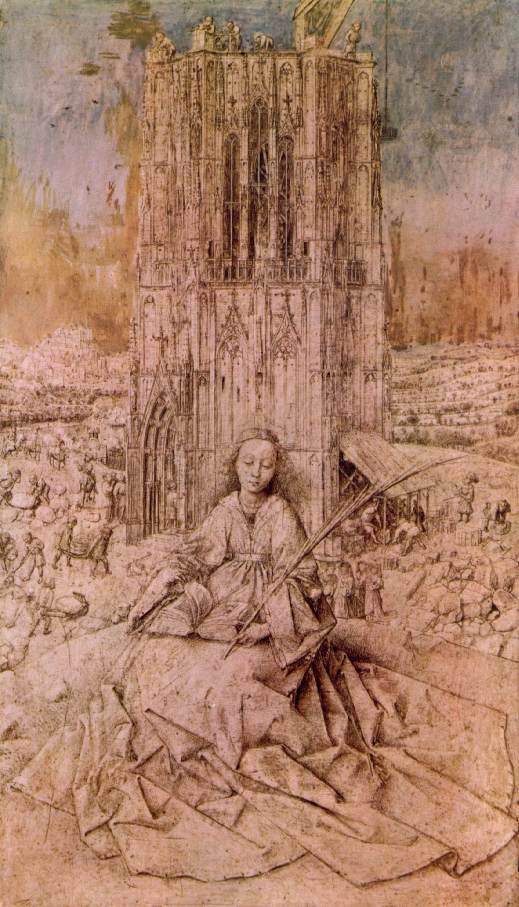
St Barbara

I caught the end of Mass to-day (after my doctor's appointment), arriving at the Supplices te rogamus; and was moved to check, once I returned home after lunch - having very unexpectedly met up with a dear religious I hadn't seen in years - on the status, shall we say, of St Barbara, who was commemorated (after the feria) on this, the feast of St Peter Chrysologus.

To my delight, St Barbara is included even in the modern Martyrology, as one said to have been a virgin and martyr at Nicomedia - and this recognition of her especially pleases me as Barbara is my Mum's name, and I'm glad she has such a celestial namesake and patron.

Stress - II

I'm taking next week off on sick leave, which I think will do me good, and give me a chance to get over my stress.

Of your charity, pray for me, since next year approaches, with a move to another State and another job, and I trust in God's Providence that "all shall be well and all manner of things shall be well", just as I have always fallen on my feet - yet without being so foolish as to think that I do not have to make some changes and prepare to do better in the future.

Alternative Mythologies

Myths are "lies breathed through silver", thought C. S. Lewis - though Tolkien sharply contradicted him, holding that myths, insofar as they are tales of the literary craft, are not untruths, but works of sub-creation, made by man's imagination expressed in words in imitation of the Divine Mind's act of creation through the Word; and moreover, J. R. R. argued, the finest myth of all, because the true myth, is that of Christ: Whose tale is not merely the greatest eucatastrophe of all, having the archetypal "happy ending" of a fairytale, but a tale, so much more than an imagined myth no matter how wondrous, that is at once an account of the real world and a revelation of the deeper truth and surpassing wonder of reality previously hidden from all ages.

Unfortunately, modern man is unable to accept a true myth, or for that matter a Realsymbol as the Germans say, something that is both symbolic and also real - such as the Blessed Eucharist, symbolic of food, signifying its use as spiritual nourishment, and yet profoundly and verily the Real Presence of Christ as our truest meat and drink.  No, for worldlings a myth may be charming, readable and interesting, as the Greek and Roman, Norse and other classical myths are, but by no means true, an account of things as they are.  For something to be a myht is for it to lack veracity.  Similarly,the term "legend" - from legenda, "things to be read" - is debased to mean a false and fabulous tale.

Now, those who are not believers generally find the Christian myth not only untrue, but unreadable and uninteresting - those who like the classical myths don't so much enjoy the Bible or the lives of the saints, though I hope I'm wrong in making this generalization!  It remains the case, however, that even among those claiming to be Catholic or otherwise Christian by reason of a barely-remembered baptism, the majority live as practical atheists and agnostics, and display the most woeful ignorance of their religion's spiritual, æsthetic and narrative world (honorable exceptions excepted).  A priest of my acquaintance met some young British tourists in the Church of the Holy Sepulchre, at the very site of Christ's Tomb, who were clearly unaware of even the idea of His Resurrection - they politely asked if His Body were indeed buried there, and reacted with shock at meeting a madman when he told them, "No, He is risen."

Thus it is that Adventide in the busy world outside of church is marked - before it even begins - with a cacophony of Christmas carols and hymns, to the extent that one is sick of them before Christmas arrives; but the hymns are supplemented and in popular iconography overshadowed by the endless cloying variations on Santa Claus, not to mention his wretched elves, labouring under inhumane conditions like unto a Stalinist gulag one imagines, at some vulgar toy factory on our melting northern icecap.  Thank you, Coca-Cola, for the advertising blitz that turned a half-correct recognition of St Nicholas, bishop of Myra and according to legend giver of gifts, into the rotund, heartily happy and totally this-worldly figure we all know so well, whether we wish to or not.  Even the older Father Christmas at least featured the name of Christ's Mass; but the burgeoning myth of Santa and his little helpers (don't forget the ballad of Rudolph!), complete with B-grade movies and animatronic representations in store windows, seems to push Christ in the crib into the background.  Why oh why do we in Australia even spray windows with artificial snow?

"'Tis the season to spend money, fa-la-la-la-la, la-la-la-la... rack up credit, empty wallets, fa-la-la, fa-la-la, la-la-la!"  It is of course a loving and generous thing to give gifts that we may succour others and cheer their hearts, especially in memory of the great Gift that God gave us at Christmas: but divorced from this motive for shopping, Advent becomes the season of materialist indulgence, of shop-till-you-drop madness, of worry over needless and wasteful expenditure, leading to a horrid reckoning come January.  How many frazzled mothers are unnaturally dominated by selfish spoilt brats, demanding some useless toy of transient fame?  And how many adults succumb to shameful pleasures when the notorious office Christmas parties get out of hand?  All alike, deceiving and deceived, while the Voice of Truth eternal cries unheard.

Then, once Christmas arrives, instantly, all the "Chrissie-dec's" come down, and Boxing Day marks the post-Christmas sales, so as to clear shelf space for the monstrous Easter eggs, impossibly laid by a wholly mythical anthropomorphic bunny rabbit, like some cuddly Egyptian god, whose antics and sugary, fatty chocolate droppings shall beguile us and distract us from Lent all the way through until Pascha.  (And don't forget to stuff yourself on hot cross buns like a good consumer throughout those coming Forty Days...)  No more Octave, no more Epiphany, just as Advent has been so overdosed with good cheer and changed from a sober preparation for Christmas into a prolonged meditation upon its excesses, that we are relieved to end the "festive season" early.

I would wish that legendary Japanese department store be imitated, which in its attempt to get right a depiction of two mythologies, both misunderstood, put in its window Santa Claus crucified.

Sufficit.

Another Advent Classic

A perceptive comment left by Herr Schütz, to the effect that many Protestant hymns are more catholic than the drear Catholic ditties oft-inflicted, reminded me of the magnificent words and music of Wachet auf, that great chorale, so apt for Advent, by Philipp Nicolai as set by Bach, and here translated by Winkworth; I first embed something of Bach's derived cantata:


Wake, awake, for night is flying;
The watchmen on the heights are crying:
Awake, Jerusalem, at last!
Midnight hears the welcome voices
And at the thrilling cry rejoices;
Come forth, ye virgins, night is past;
The Bridegroom comes, awake;
Your lamps with gladness take;
Alleluia! 
And for His marriage feast prepare
For ye must go and meet Him there.

Zion hears the watchmen singing,
And all her heart with joy is springing;
She wakes, she rises from her gloom;
For her Lord comes down all glorious,
The strong in grace, in truth victorious.
Her Star is risen, her Light is come.
Ah come, Thou blessèd One, 
God’s own belovèd Son:
Alleluia! 
We follow till the halls we see
Where Thou hast bid us sup with Thee.

Now let all the heavens adore Thee,
And saints and angels sing before Thee,
With harp and cymbal’s clearest tone;
Of one pearl each shining portal,
Where we are with the choir immortal
Of angels round Thy dazzling throne;
Nor eye hath seen, nor ear 
Hath yet attained to hear
What there is ours, 
But we rejoice and sing to Thee
Our hymn of joy eternally.

******

“Wachet auf,” ruft uns die Stimme
Der Wächter sehr hoch auf der Zinne,
“Wach auf du Stadt Jerusalem!
Mitternacht heiß diese Stunde!”
Sie rufen uns mit hellem Munde:
“Wo seid ihr klugen Jungfrauen?
Wohlauf, der Bräutigam kommt,
Steht auf, die Lampen nehmt!
Halleluja!
Macht euch bereit zur Hochzeitsfreud;
Ihr müset ihm entgegengehen!”

Zion hört die Wähter singen,
Das Herz tut ihr vor Freuden springen,
Sie wachet und steht eilend auf.
Ihr Freund kommt vom Himmel prächtig,
Von Gnaden stark, von Wahrheit mächtig;
Ihr Licht wird hell, ihr Stern geht auf.
Nun komm, du werte Kron,
Herr Jesu, Gottes Sohn!
Hosianna!
Wir folgen all zum Freudensaal
Und halten mit das Abendmahl.

Gloria sei dir gesungen
Mit Menschen- und mit Engelzungen,
Mit Harfen und mit Zimbeln schön.
Von zwölf Perlen sind die Tore
An deiner Stadt, wir stehn im Chore
Der Engel hoch um deinen Thron.
Kein Aug hat je gespürt,
Kein Ohr hat mehr gehört
Solche Freude.
Des jauchzen wir und singen dir
Das Halleluja für und für.

Wednesday, December 3, 2008

Stress

Work (on top of the very inconvenient loss of my wallet and contents) has been very stressful of late, and I am feeling quite off; to-morrow, at suggestion of others, I'm seeing my doctor and having a "mental health day".  

Ira furor brevis est: anger is a brief madness.  I have a short temper, but that is a passion I ought be overcoming by growing in virtue, bridling it and subjecting it to right reason, rather than slothfully taking the downward path.

"Man's anger worketh not the justice of God" (James i, 20), and such ire is a sure symptom of pride, the root of all evil, and enemy to Christian humility - which, after all, is but the recognition of our true, lowly place in the scheme of things; whereas to be puffed up with overestimated worth is a very madness. 

Please of your charity pray that I obtain the patience I need, since I should wish rather to be united with Christ upon His Cross than - mea maxima culpa - more securely nail Him to it.

Prayer against anger 
from the Cœleste Palmetum of Wilhelmus Nakatenus (1617-1682)

Should man reserveth anger for his fellow man and yet seek remedy from God? Should he that hath no mercy on one like himself entreat God for his own sins? Who shall obtain pardon for his sins? (Eccli 28:3-5) By these words Thou hast spoken to me though Thy servant Sirach, O Lord God. And after this dare I foster anger and hate against anyone? Spare me, O Lord, spare me of my malice and stubbornness in which I have persevered even unto now. From my soul I now overlook and forgive whatever anyone has done against me. I humbly beg Thee, O Lord, do not rebuke me in Thy fury, nor chastise me in Thine anger. (Ps 37:2) O how would that I be like the deaf who does not hear and the mute who does not speak (Ps 37:14) whenever my enemies rise up in force against me, and those who seek my soul use violence. (Cf. Ps 37:12c) Do not forsake me, O Lord my God, do not depart from me (Ps 37:22), for Thou art my patience. (Ps 70:5a)

Another collection of prayers I make use of is an old High Church Anglican compilation by Oldknow & Crake, as revised by Briscoe:  The Priest's Book of Private Devotion...

Against Anger

O Lord, who art slow to wrath, ready to pardon, and of great kindness, remove from me all causeless and immoderate anger, all pride and prejudice, and too much concern for the things of this world, all intemperate speeches and undue excitement.  Give me, O God, a mild, peaceable, and humble spirit, that, remembering my own infirmities, I may bear with those of others:... that I may think lowly of myself, and not be angry when others also think lowly of me: that I may be patient towards all men, gentle and easy to be entreated: that thou, for Christ's sake, mayst be so towards me.  Amen.

Tuesday, December 2, 2008

St Bibiana, Virgin and Martyr

A virgin martyr graces this Advent day: St Bibiana, who suffered for her Catholic Faith in Christ during the reign of impious Julian the Apostate.  As her Breviary legend relates, she was noble by birth, but nobler by far for her Faith.  First her father, then her mother, then her sister, and last of all she herself died confessing Christianity - she, last of all, having triumphed over loss of parents and sibling, sequestration of wealth and property, lack of food, threats and blandishments of persecutors, lewd temptations against her purity, and finally the horror of being scourged with leaden whips unto death: all for love of Him Who deigned to shed His Blood and die for her.  

To be whipped to death!  To the world, unspeakable terror; to the faithful, the means whereby she won her inestimable reward: Pretiosa in conspectu Domini mors sanctorum ejus.

And as for Julian: that foolish man perished utterly, unsuccoured by all his fruitless pomps, crying "Thou hast conquered, Galilean" - Mors peccatorum pessima.

May we die even as she did, rather than as he did.

Miracle! her body, reduced to one bloody wound - yet in a manner triumphant, empurpled in a wedding garment fit for a chaste Virgin espoused to the King of kings - lay a prey for feral dogs, but from all bestial rending was preserved, and at length given holy burial by a good priest near her sainted mother and sister; all of whose relics were later rediscovered during the reign of Urban VIII in the church built over them and reinterred under its high altar: in the church of to-day's saint, the Church of St Bibiana on the Esquiline, named by Pope St Simplicius in her honour.  (Her head is kept in a reliquary at St Mary Major.)

Her collect is poetic, playing upon the word conjugere, to yoke or join together (in marriage: one word for spouse is conjux), and unusual, in that it lacks the usual præsta quæsumus or concede propitius:

Deus, omnium largitor bonorum, qui in famula tua Bibiana cum virginitatis flore martyrii palmam conjunxisti: mentes nostras ejus intercessione tibi caritate conjunge; ut, amotis periculis, præmia consequamur æterna.

(God, of all goods the Giver, Who in Thy handmaid Bibiana to the flower of virginity didst yoke together martyrdom's palm: wed our minds at her intercession to Thee in love; that, perils removed, we may obtain rewards eternal.  Through...)

Dom Guéranger provides the following élévation to St Bibiana:

Holy Bibiana, most wise virgin! thou hast gone through the long unbroken watch of this life; and when, suddenly, the Spouse came, thy lamp was bright and richly fed with oil.  Now thou art dwelling in the abode of the eternal marriage-feast, where the Beloved feeds among the lilies.  Remember us who are still living in the expectation of that same divine Spouse, Whose eternal embrace is secured to thee for ever.  We are awaiting the birth of the Saviour of the world, which is to be the end of sin and the beginning of justice; we are awaiting the coming of this Saviour into our souls, that He may give them life and union with Himself by love; we are awaiting our Judge, the Judge of the living and the dead.  Most wise virgin! intercede for us, by thy fervent prayers, with this our Saviour, our Spouse, and our Judge; pray that each of these three visits may work and perfect in us that divine union, for which we have all been created.  Pray also, O faithful virgin, for the Church on earth, which gave thee to the Church in heaven, and which so devoutly watches over thy precious remains.  Obtain for her that strict fidelity, which will ever render her worthy of Him, Who is her Spouse as He is thine.  Though He has enriched her with the most magnificent gifts, and given her confidence by His promises which cannot fail, yet does He wish her to ask, and us to ask for her, the graces which will lead her to the glorious destiny which awaits her.

Ora pro nobis, beata Bibiana: 
Ut digni efficiamur promissionibus Christi.

Polish Novus Ordo - incl. Chaplet!

This evening Mike and I caught Mass at the Polish chapel - why is it that everything seems to take so much longer to say in Polish? even the Lord's Prayer takes forever - and, since the constant incomprehensible ńyś-ńyś-ńyś (no offence intended, it must be a lovely language but I can't speak it) allows me to say what prayers I like in the interim, I took along my Trad. Missal and read Mass of St Bibiana to myself.  Indeed, as we were running a bit late he and I said the Judica me and Confiteor in the car on the way there, as preparation!

Strangely, while I read the Gloria to myself in Latin, the good Poles were reciting it in their tongue - at a Novus Ordo Advent ferial Mass, as the purple vestments signified.  Why?  And even more oddly, albeit devoutly, after all had communicated and the priest had done the ablutions, he, standing at the altar, led the people in the Chaplet of Divine Mercy (I recognized by their length and a few words the opening Pater, Ave, and Credo, then the five decades of the "Eternal Father..." and ten "For the sake...") before saying the prayer after communion!  (It seemed good to get out my beads and join in: though I started after them, I finished before they did - why does it take so long to say anything in Polish?)

First Feria of Advent

It was good to have Monday as a feria - it gave me a chance to familiarize myself with the Advent Office, with its special antiphons, little chapters, responds, and so forth, and its use of Lauds II (beginning with the Miserere).  I calculate that this year the ferial Office will be used 12 days out of the 25, and the Lauds and Vesper preces on 7 of them (but are they said on the Vigil of Christmas, which falls on a Wednesday?)...

Fr Rowe must have had similar thoughts, for he offered up Mass of the feria, that is, a repeat of the Sunday Mass, but for the omission of the Alleluia and its verse.  Since the Gloria is otherwise said on all Sundays and feasts outside of Advent, Septuagesimatide and Lent, its absence remains striking.