Saturday, January 5, 2008

In a Country Churchyard

Late this arvo I'm heading down to Hobart to visit friends.  On the way, however, I do hope to stop as is my wont at St Michael's in Campbell Town (just turn off the main road down King St), about 70km along the Midlands Hwy, that I may visit the three priests' graves in the churchyard there, and say a De profundis for their souls, with the proper collect:


Deus, qui inter apostolicos sacerdotes famulos tuos N., N., et N. sacerdotali fecisti dignitate vigere: præsta, quæsumus; ut eorum quoque perpetuo aggregentur consortio.  Per Christum Dominum nostrum.  R/.  Amen.


The three repose in a very clerical select graveyard of their own (the laity are kept elsewhere), and are quite noteworthy, especially the first-buried, the Very Reverend Dom Maurus (Daniel Vincent) O'Connell, O.S.B., quondam Dean of St Mary's Cathedral, Sydney, and first Rector of St John's College (where a friend of mine now holds his place), died 12th September 1901: for he is the first Australian-born priest, born in 1825, the son of early settlers near Campbell Town, who became a Benedictine in Sydney in the early days under Polding when the dream was for a monastic clergy for Australia.  Howbeit, he ended his days where he began them, and is buried by the present church (built 1857) where mayhap he offered many a Holy Mass.


Likewise, the other two sleepers have local connexions: the middle Father was a missioner (an Oblate of Mary Immaculate, I recall [wrongly! - see below]), who died while on preaching rounds in the area; the last-interred [not a Monsignor, as I'd thought] was the last parish priest of Campbell Town, having held that post for decades and dying in the 1980's.  (Nowadays, the parish has been merged with others, and has Mass on Sundays twice a month.)


Very annoyingly, I cannot recall these last two priests' names!   That's why I hope to call by.


[Update: the missioner was Fr "Henry" (sic; lege Henri) Chetail, "M.S.H." (sic; lege M.S.C.), died 15th March 1904; the P.P. was Fr Leo Bernard Kirkham, died 11th April 1985.]


(Photos pinched, I hope understandably, from the relevant page of Australian Cemeteries.)

Pronunciation Bugbears

There are a few tongue-twisters in the Gallican Psalter (and the rest of the Vulgate!) as used in the 1962 Breviary; I find the following very hard to pronounce:


Cœnomyía(m)  (Pss 77:45 & 104:31) – is this, respelling it, "che-no-mi-í-a(m)"?  So ugly!   Then again, this is a word (from the Greek, isn't it? – having just looked it up in my Septuaginta, I see it spelt there κυνóμυια(ν), rather than beginning κοι- as I had assumed from the digraph œ; a quick google reveals in other recensions of the Vulgate the word is transliterated cynomia, rarely cynomyia) for (dog)flies; which Luther held to be the creation of the devil...


Æthiópia/Æthíopes/Æthíopum  (Pss 67:32; 71:9; 73:14; 86:4 – the LXX has Α’ιϑιοπ´ια / Α’ιϑ´ιοπες / Α’ιϑ´ιοψιν /Α’ιϑι´οπων) – should I follow the general rule that "t" before "i" and then another vowel should be "ts", or does the "h" keep the "t" hard: in other words, is it "e-ti-op-" or "e-tsi-op-"?  Sometimes I cheat and pronounce the "th" here and elsewhere as in English...


Eleemósyna &c., "almsgiving" (Gk. ’ελεημοσ´υνη – which isn't in the Psalms, but in Tobit, Ecclesiasticus, Daniel iv. 24, S. Matthew, S. Luke, and Acts) – how to pronounce this smoothly?  (I'm aware that the doubled "e" must be pronounced as two syllables, just as Aaron is "A-a-ron".)  If only it had been rendered in Latin as *eleimosyna, like eléïson from ’ελ´εησον, which would make it easier to say!  I suppose one must consciously try to remember to put a subsidiary accent two syllables before the main one, that is, on -le-, and pronounce it as eléemósyna.

Thursday, January 3, 2008

History of the Vandal Persecution

Thanks to alibris, this morning arrived my long-awaited copy of Victor of Vita's History of the Vandal Persecution (tr. J. Moorhead).  I have long had an interest in the history, triumphs, trials – and sad end – of Christianity in North Africa, and am looking forward to reading and blogging about what Victor (fl. 484) has to say.  What a Church, to have withstood a century of persecutions under the Arian yoke of the barbarian Vandals!


There is a fine edition online, thanks to Google Books, of Dom Theodoric Ruinart's 1694 compilation Historia Persecutionis Vandalicæ, which incorporates the whole of the Historia Persecutionis Africanæ Provinciæ, Temporibus Geiserici et Hunirici regum Wandalorum (or Hist. Pers. Afr. Prov. for short) by this Victor Vitensis.  But my Latin isn't good enough to read it, apart from now referring to the English version I've just obtained.


There is an interesting article, considering The Role of Arianism in the Vandal Kingdom, by Emőke Horváth, giving a good modern overview of the period, and of the enduring worth of Victor's account.


Omnes sancti Martyres Africæ, orate pro nobis.

For ever I will sing

Christmas Matins features some of the best and most apposite psalms: 2, 18, 44; 47, 71, 84; 88, – of which more below – 95, 97.  It is, however, long...

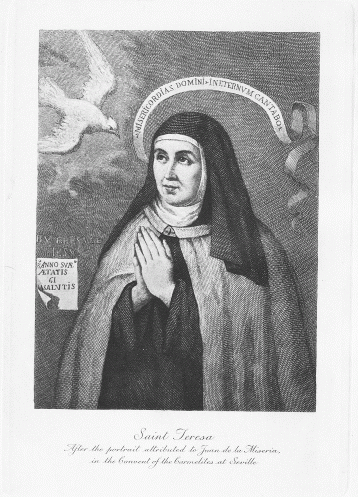
Having ploughed through the beautiful but very lengthy Matins for Christmas, whose psalmody was repeated for the 5th day in the Octave, for Sunday in the Octave, and for the 7th day in the Octave, I now appreciate better the wry comment of one of the patres graviores known to me from the Dominicans in Melbourne.  Referring to Psalm 88, Misericordias Domini in æternum cantabo, he emphasised its "for ever I will sing": it is a long psalm, 51 verses, which even when broken up into three parts makes for an exceptionally long None on Fridays (longer even than the 48 verses it has on Sundays), and which when present in its entirety as the 7th psalm at Matins is a real killer!

St Teresa of Avila, Re-Foundress of Carmel, Virgin and Doctor of the Church, as well as being a great saint, was also a very shrewd, lively and humorous woman (in the original Spanish of her writings she apparently can sound very amusing), and no doubt it was not just piety that caused her to be so attached to this phrase as to have it painted on her portrait.

Indeed, it is said of her that, even after having gained the highest degree of spiritual union with God, she never concluded a period of prayer without heartily sighing as she exclaimed, "Thank God that's over!"

Preces for the Holy Name

Here's something I found last year, I think: the modern Liturgia Horarum has the following preces for Vespers of 2nd January and Lauds of 3rd January, obviously alluding to the (then-suppressed) Feast of the Holy Name, and based upon the Litanies thereof:


Deus, multifariam loquens patribus nostris in prophetis, novissime locutus est nobis in Filio suo.  Ejus misericordiam imploremus, dicentes: Kyrie, eleison.
Pro Ecclesia tua sancta, – ut filii tui fideliter fortiterque confiteantur nomen Salvatoris.  Kyrie, eleison.  
Pro evangelizantibus, – ut operarii a te missi cum omni fiducia prædicent gentibus nomen Salvatoris.  Kyrie, eleison.
Pro fratribus nostris infirmis, – ut sanitatem obtineant invocantes nomen Salvatoris.  Kyrie, eleison.
Pro christianis persecutioni obnoxiis, – ut injurias patienter sustineant propter nomen Salvatoris.  Kyrie, eleison.
Pro fratribus nostris, qui culpa hominum obierunt, – ut tua misericordia vitam consequantur.  Kyrie, eleison.


Redemptorem nostrum, Filium Dei, qui homo factus est, ut hominem renovaret, lætanter invocemus, dicentes: Esto nobiscum, Emmanuel.  
Jesu, Fili Dei vivi, splendor Patris, lux æterna, rex gloriæ, sol justitiæ, fili Virginis Mariæ, – incarnationis tuæ gloria diem hunc illumina.  Esto nobiscum, Emmanuel.
Jesu, admirabilis consiliarius, Deus fortis, pater futuri sæculi, princeps pacis, – humanitatis tuæ sanctitate viam nostram dirige.  Esto...
Jesu, omnipotens, patiens, obœdiens, mitis et humilis corde, – omnibus mansuetudinis potentiam manifesta.  Esto...
Jesu, pater pauperum, fidelium tuorum gloria, pastor bone, lux vera, infinita sapientia, immensa bonitas, via et vita nostra, – spiritum paupertatis Ecclesiæ tuæ concede.  Esto...


To the last intercession I would append my own (cf. IGLH, n. 188 – Licet tamen... quasdam intentiones addere particulares):


Jesu, amator castitatis, amator noster, Deus pacis, auctor vitæ, exemplar virtutum, zelator animarum, Deus noster, refugium nostrum, – da nobis tuam pacem, et vitam æternam.  Esto...
Jesu, gaudium Angelorum, rex Patriarcharum, magister Apostolorum, doctor Evangelistarum, fortitudo Martyrum, lumen Confessorum, puritas Virginum, corona Sanctorum omnium, – precibus et meritis eorum perducas nos ad societatem civium supernorum.  Esto...


Furthermore, thumbing back thro' vol. I of the Lit. Hor. turns up much of the rest of the Litanies of the Holy Name turned into intercessions at Vespers for the 26th of December (which is not of St Stephen a capitulo, unlike in the older Breviary):


Verbum Dei, quod, in nobis habitando, salutis perpetuæ tramitem reseravit, deprecemur et sincera humilitate rogemus: Ab omni malo, libera nos, Domine.
Per mysterium incarnationis tuæ, per nativitatem et infantiam tuam, – per totam vitam tuam Patri dicatam: Ab omni malo, libera nos, Domine.
Per labores tuos, per prædicationes et itinera tua, per conversationem tuam inter peccatores:
Per agoniam et passionem tuam, per crucem et desolationem tuam, – per angustias tuas, per mortem et sepulturam tuam: Ab...
Per resurrectionem et ascensionem tuam, per donationem Spiritus Sancti, per gaudia et gloriam tuam æternam, – fratres nostros, jam defunctos, libera, Domine.  Ab...


Again, I would add before the last petition, as is allowable:


Per sanctissimæ Eucharistiæ institutionem tuam: Ab omni malo, libera nos, Domine.

The Holy Name

While I kept the Feast of the Most Holy Name of JESUS yesterday, since I was praying the 1962 Breviary (altho' I didn't get round to it till late at night after a very busy day!), in the modern Roman Rite the same feast (as an optional memorial) falls today, rather than attaching to the Sunday between the 2nd and the 5th inst., or failing that, on the 2nd; and the modern Martyrology declares:


Sanctissimi Nominis Jesu, in quo solo omne flectatur genu, cælestium, terrestrium et infernorum, ad gloriam divinæ majestatis.

(Of the Most Holy Name of Jesus, at which alone every knee shall bend, of celestials, of terrestrials and of infernals*, to the glory of the divine majesty.  [Cf. Phil. ii, 10-11.])

[*i.e. "of those who are in heaven, on earth, and in hell" – my little joke.]


This reminds me: one of the many things I like about the modern Divine Office is the inclusion of New Testament canticles at Vespers; and I liked to genuflect at the words Ut in nomine Jesu omne genu flectatur, cælestium, terrestrium, et infernorum, which appear each Saturday in the cancticle from Philippians ii, 6-11; I based this on the rubric requiring this genuflection at the same words when read on Palm Sunday (and on the feasts of the Holy Cross) as part of the Epistle at the Traditional Mass.


I also try to maintain the formerly universal Catholic custom of bowing the head at the name of Jesus.  It is a sad sign of secularization that this salutary practice has become so rare.


Today's a good day (especially since I hardly celebrated the Feast yesterday) to pray the Litanies of the Most Holy Name; also a good day to delight in the moving Office hymns – Jesu Rex admirabilis (at Matins), Jesu decus angelicum (at Lauds), and Jesu dulcis memoria (at Vespers)  – proper to the (Traditional version) of the feast, drawn from the Jubilus Rhythmicus (wrongly) attributed to St Bernard.


Certain versicles in the Office, widely used elsewhere in the Church's Liturgy, have great appeal also:


V/.   Sit nomen Domini benedictum.
R/.  Ex hoc nunc et usque in sæculum.  (Ps 112:2)

V/.  Adjutorium nostrum in nomine Domini.
R/.  Qui fecit cælum et terram.  (Ps 123:8)

V/.  Magnificate Dominum mecum.
R/.  Et exaltemus nomen ejus in idipsum.  (Ps 33:4)

Domine, Dominus noster, quam admirabile est nomen tuum in universa terra!  (Ps 8:2)

Ego autem in Domino gaudebo, et exsultabo in Deo Jesu meo.  (Hab.  iii, 18)


The last sentence - the 3rd antiphon at Vespers – is unique in that it is the actual Vulgate rendering of "But I will rejoice in the Lord, and exalt in God my Saviour": for that is the import of the Name Jesus.


This also reminds me of the pious customs for those at Sunday or festal Vespers to bow their heads (and doff their birettas...) at the half-verses Sanctum et terribile nomen ejus and Sit nomen Domini benedictum in Psalms 110 and 112, and even at et sanctum nomen ejus in the Magnificat.


Yesterday's Postcommunion at Mass in the extraordinary form is quite unusual:


Omnipotens æterne Deus, qui creasti et redemisti nos, respice propitius vota nostra: et sacrificium salutaris hostiæ, quod in honorem nominis Filii tui, Domini nostri Jesu Christi, majestati tuæ obtulimus, placido et benigno vultu suscipere digneris; ut gratia tua nobis infusa, sub glorioso nomine Jesu, æternæ prædestinationis titulo gaudeamus nomina nostra scripta esse in cælis.  Per eumdem Dominum...

(Almighty eternal God, Who hast created and redeemed us, graciously regard our prayers: and deign to receive with a placid and benign countenance the sacrifice of the saving Victim which we have offered unto Thy Majesty, in honour of the Name of Thy Son, our Lord Jesus Christ; that Thy grace being poured forth into us,  we may rejoice at our names to be written in heaven under the glorious Name of Jesus as a title of eternal predestination.  Thro' the same...)


"For there is no other name under heaven given to men, whereby we must be saved."  (Acts iv, 12.)

Tuesday, January 1, 2008

Once a Planet

The other anniversary that the 1st of January brings to mind is that on this night in 1801, Piazzi discovered Ceres (named after the goddess of agriculture; symbol: the sickleSickle variant symbol of Ceres), hailed then as the fifth planet, located between Mars and Jupiter, as 'predicted' by Bode's Law.


Its size, however, shewing only as a starlike point of light (hence 'asteroid', a term Herschel coined) seemed much less than that of the other known planets.  Within a few years several other such bodies (Juno, Pallas, Vesta,, etc.) were found, and after several decades more were found, then more, then even more... by the 1850's, Ceres was demoted from planet to asteroid.  It is now known to be about 975 km across, containing 30% of the total mass of the asteroid belt, composed of at least 100,000 'small solar system bodies'.  It is much smaller than the Moon.


Come 1930, Pluto was found - observe the parallels with Ceres - being acclaimed as the "Planet X" long-sought, whose gravitational influence would explain divergences in the orbits of Uranus and Neptune.  But yet again, it shewed a scarce-resolvable disc even in the largest telescopes, and its estimated size and mass kept on being revised downwards.  How could it sway the orbits of the ice giants?  Seemingly so different to the others, could it be a planet?  A waggish scientific paper of the 1970's, graphing these estimates, predicted tongue-in-cheek that soon it would vanish entirely...  Remeasurement of the masses of Uranus and Neptune made postulation of a large outer planet influencing them unnecessary.  In 1992 the first of many similar objects to Pluto was found, shewing Pluto to be only the so-far foremost member of the long-predicted Kuiper Belt, and the discovery of Eris in 2005 - larger than Pluto - sealed its fate.  Pluto was demoted to 'dwarf planet', a category to be shared by Eris at least - and Ceres.


The misfortune of Pluto was the good fortune of Ceres!  It is now accounted a 'dwarf planet', large enough to be spherical, indeed thought to have undergone internal differentiation and formed as a protoplanet, but which (like Pluto and Eris) never accreted sufficient other material to sweep clear its orbital zone of influence (in Ceres' case, the asteroid belt), as did the eight true planets of the Solar System.  


By a final coincidence, Ceres will be visited, God willing, by a US space-probe (Dawn) in February 2015 (en route since September 2007, using the new ion-drive), only a few months before the US space-probe New Horizons approaches Pluto in July 2015 after its great voyage of 4½ billion km (launched January 2006).


Just as I am looking forward to the upcoming 14th of January flyby of Mercury by MESSENGER, imaging as yet unseen parts of that planet, so I anticipate what will be seen at Ceres and Pluto in seven years' time.  


The great thing about astronomy is that it lifts up the mind to wonder at the universe.  Cæli enarrant gloriam Dei, et opera manuum ejus annuntiat firmamentum.  (Ps 18:1)  Quoniam videbo cælos tuos, opera digitorum tuorum, lunam et stellas, quæ tu fundasti, quid est homo, quod memor es ejus?  (Ps 8:4-5a)

A nation for a continent, and a continent for a nation


Far be it from me to neglect to commemorate the important civil signification of this day: the achievement of Federation, whereby the six colonies of New South Wales, Queensland, South Australia, Tasmania, Victoria, and Western Australia (which agreed at the last moment) were brought together to form the Commonwealth of Australia, on the 1st of January 1901:


"Whereas the people of New South Wales, Victoria, South Australia, Queensland, and Tasmania, humbly relying on the blessing of Almighty God, have agreed to unite in one indissoluble Federal Commonwealth under the Crown of the United Kingdom of Great Britain and Ireland, and under the Constitution hereby established:

"And whereas it is expedient to provide for the admission into the Commonwealth of other Australasian Colonies and possessions of the Queen: 

"Be it therefore enacted by the Queen's most Excellent Majesty, by and with the advice and consent of the Lords Spiritual and Temporal, and Commons, in this present Parliament assembled, and by the authority of the same, as follows:—"


As to the flag; while some are not so fond of the Australian National Flag, I've always rather liked it, given my astronomical, historical and religious interests; and if we ever did change, I would prefer the Eureka Flag (stylized Southern Cross, white on blue) over any fatuous green-and-gold boxing kangaroo designs (blehhh!).  


My reasoning?  First, the prominence of the Southern Cross; secondly, the presence of the Union Jack - the combined crosses of St George, St Andrew, and St Patrick.  Even today, I reckon the majority of Australians are of Anglo-Celtic descent; whilst the starry cross of the southern sky has ever caught the attention of Australians.  To have a flag featuring four crosses is a great tho' unremarked Christian blessing, IMHO, alluding as it seems to the Christian heritage and Christian saints of the peoples who settled here, and to Australia as the Great South Land of the Holy Spirit, in whose skies the sign of the Cross shone down for ages before the Gospel first arrived.


And as to "our great friend and ally" – if both last so long, in 2026 Australia will celebrate its 125th, and the United States of America its 250th anniversary, making the former half as old as the latter that year.

Another Year Over, A New One Begun

Today's Office contains most delightfully beautiful texts, especially the Lauds and Vesper antiphons drawn from the Greek Liturgy.  

In the older books it is known as the Feast of the Circumcision (when the Holy Name of Jesus was bestowed upon our Lord, in accordance with the angel's message; of course, there is a separate feast for this coming up very soon), while in the modern books it is styled the Feast of Mary the Mother of God (subsuming the fairly recent feast of the Maternity of Our Lady on the 11th of October); yet in reality there is not much difference, since even the old Breviary's texts for this feast are quite Marian (apparently the texts come in large part from the Christmas Office as chanted anciently at St Mary Major, where naturally the Feast had a Marian flavour).

The modern Martyrology best links up all aspects of today:

In octava Nativitatis Domini et die ejus Circumcisionis, sollemnitas sanctæ Dei Genetricis Mariæ, quam Patres in Concilio Ephesino Theotokon acclamaverunt, quia ex ea Verbum carnem assumpsit et inter homines habitavit Dei Filius, princeps pacis, cui Nomen super omne nomen datum est.

(The octave day of the Nativity of the Lord and the day of His Circumcision, the solemnity of holy Mary Mother of God, whom the Fathers at the Council of Ephesus acclaimed the Theotokos, for from her God's Son the Word took flesh and dwelt amongst men [cf. S. John i, 14], the prince of peace [Is ix, 6], to whom was given the Name above every name [cf. Phil. ii, 9].)

It is also the feast of St Fulgentius of Ruspe (462/7-527/33):

Ruspis in Byzacena, sancti Fulgentii, episcopi, qui, munere procuratoris Byzacenæ functus, monachus evasit; deinde episcopus effectus, tempore vandalicæ persecutionis, ab arianis multa perpessus est et in Sardiniam a rege Thrasamundo bis relegatus.  Tandem populo suo restitutus, eum per reliquos vitæ annos veritatis et gratiæ verbo fideliter nutrivit.

(At Ruspe in Byzacena, of Saint Fulgentius, bishop, who, suffering the burden of the office of procurator of Byzacena, escaped to become a monk; thereafter, being made bishop, in the time of the Vandal persecution, endured much from the Arians and was twice exiled to Sardinia by King Thrasamund.  At length restored to his people, he fed them faithfully for the remaining years of his life with words of truth and grace.)

On this day died also St Odilo, Abbot of Cluny (c.962-c.1048), who instituted the commemoration of All Souls on the 2nd of November; St Giuseppe Maria Tommasi (1649-1713; canonized in 1986), Theatine Cardinal and noted liturgical scholar; as well as many others who passed triumphant from this world to heaven – 

Et alibi aliorum plurimorum sanctorum Martyrum et Confessorum, atque sanctarum Virginum.  R/.  Deo gratias.

(And in divers places many other holy Martyrs and Confessors, and sainted Virgins.  R/.  Thanks be to God.)

– such a pity this formulaic conclusion, which just rolls off the tongue, is not included in the new Martyrology!

Curiously enough, the 2002 Roman Missal provides a Votive Mass for the beginning of the civil year, although this is of course not to be said on the 1st of January!  Here are the texts with my translations:

Aña ad introitum

Benedices coronæ anni benignitatis tuæ, et campi tui replebuntur ubertate.  Ps 64:12

[Thou shalt bless the crown of the year, of Thy goodness: and Thy fields shall be filled with plenty.]

vel

Ecce ego vobiscum sum omnibus diebus, dicit Dñs, usque ad consummationem sæculi, alleluja. Mt 28:20b

[Behold, I am with you all days, saith the Lord, even to the consummation of the world, alleluia.]

Collecta

Deus, qui, sine initio et sine fine, totius es principium creaturæ, da nobis ita hunc annum, cujus initia tibi dedicamus, transigere, ut et substantiis abundemus, et sanctitatis operibus fulgeamus.  Per...  

[O God, Who, without beginning and without end, art the foundation of all creatures, grant unto us so to pass this year, whose beginning we dedicate unto Thee, that we may both abound in good things, and shine forth in works of holiness.  Through...]

Super oblata

Sacrificia quæ tibi offerimus ita tuis oculis, Dñe, sint accepta, ut omnes, qui initia hujus anni cum lætitia celebramus, reliquum excursum ejus in tua mereamur transigere caritate.  Per...

[May the sacrifices which we offer, Lord, be so acceptable in Thine eyes, that all we, who celebrate the beginning of this year with joy, may deserve to pass the rest of its length in Thy love.  Through...]

Aña ad communionem

Jesus Christus heri et hodie, ipse et in sæcula.  Heb 13:8

[Jesus Christ, yesterday, and today: and the same for ever.]

Post communionem

Adesto, Dñe, populis, qui sacra mysteria contigerunt, ut in toto decursu hujus anni nullis periculis affligantur, qui in tua semper protectione confidunt.

[Be present, Lord, to the people who have received the sacred mysteries, that in the whole course of this year they may be afflicted by no perils, who ever trust in Thy protection.]

Benedictio solemnis

Deus, fons et origo totius benedictionis, gratiam vobis concedat, benedictionis suæ largitatem infundat, atque per totum annum vos salvos et incolumes protegat.

Custodiat fidei vobis integritatem, tribuat spei longanimitatem, perseverantem usque ad finem cum sancta patientia caritatem.

Dies et actus vestros in sua pace disponat, preces hic et ubique exaudiat, et ad vitam æternam feliciter vos perducat.

[God, fount and origin of all blessing, grant grace to you, pour into you the gift of his blessing, and protect you safe and secure through the whole year.

He guard for you the integrity of faith, grant long-suffering of hope, charity persevering until the end with holy patience.

He dispose your days and actions in His peace, here and everywhere hear your prayers, and felicitously bring you to life everlasting.]


The relevant Lectionary supplies the following choice of pericopes:
  • Genesis i, 14 -18 (the fourth day of creation – sun, moon, stars, day, and night, marking seasons, days and years) or
  • Numbers vi, 22-27 (the Aaronic blessing; how on earth is this relevant?!);
  • I Corinthians vii, 29-31 (the form of this world is passing away) or
  • James iv, 13-15 (life is as a passing mist);
  • Psalm 8, 0r 48, or 89 (the elegaic last being my favourite);
  • St Matthew vi, 31-34 (do not be anxious about tomorrow) or
  • St Luke xii, 35-40 ( be ready for the Master's return).
I must say, I miss in this list what the Revised Common Lectionary supplies: surely Ecclesiastes iii, 1-13 is the best of all choices?

Omnia tempus habent,

et suis spatiis transeunt universa sub cælo.

Tempus nascendi, et tempus moriendi;

tempus plantandi, et tempus evellendi quod plantatum est.

Tempus occidendi, et tempus sanandi;

tempus destruendi, et tempus ædificandi.

Tempus flendi, et tempus ridendi;

tempus plangendi, et tempus saltandi.

Tempus spargendi lapides, et tempus colligendi,

tempus amplexandi, et tempus longe fieri ab amplexibus.

Tempus acquirendi, et tempus perdendi;

tempus custodiendi, et tempus abjiciendi.

Tempus scindendi, et tempus consuendi;

tempus tacendi, et tempus loquendi.

Tempus dilectionis, et tempus odii;

tempus belli, et tempus pacis.


Quid habet amplius homo de labore suo?

Vidi afflictionem quam dedit Deus filiis hominum,

ut distendantur in ea.

Cuncta fecit bona in tempore suo,

et mundum tradidit disputationi eorum,

ut non inveniat homo opus

quod operatus est Deus ab initio usque ad finem.

Et cognovi quod non esset melius nisi lætari,

et facere bene in vita sua;

omnis enim homo qui comedit et bibit,

et videt bonum de labore suo, 

hoc donum Dei est.


Here is The Byrds' version!  

The RCL also gives Psalm 8, Rev. xxi, 1-6a (I make all things new) and S. Matthew xxv, 31-46 (the general Judgement).

While I didn't get around to singing a Te Deum in thanksgiving last night (very tired and out of sorts, please pray for me!), I will be offering up a Veni Creator Spiritus to supplicate God's blessings on this new Year of Our Lord, 2008.  As the modern Easter Vigil puts it:

Α
2 | o
—+—
0 | 8
Ω

Christ yesterday and today 
the beginning and the end 
Alpha 
and Omega 
all time belongs to Him 
and all the ages 
to Him be glory and power 
through every age for ever.  
Amen.