Thursday, May 27, 2010

Placeat sancta Trinitas

Still to-day, in the modern form of the Carthusian Rite, the Placeat sancta Trinitas is prayed by the priest at the end of Mass.  

(It is a little-known fact that the wise Carthusians retain their own proper form of the Roman Rite, having reformed it in 1981, to produce a new edition of the Missale Cartusiense.  Amongst many other appealing features, it contains: 
  • no penitential rite other than the Carthusian Confiteor; 
  • substantially the traditional one-year lectionary (with Epistle, Gradual, Alleluia or Tract, and Gospel); 
  • no modern Offertory prayers; 
  • none of those modern Memorial Acclamations; 
  • a rubric specifying that the Eucharistic Prayer is normally said secretly, others ordering it be said with hands extended in the form of the cross; 
  • no response "For the kingdom..." after the Embolism; 
  • and finally the Placeat.)
After the dismissal formula, "turned to the altar, bowed profoundly, the priest says secretly":

Pláceat tibi, sancta Trínitas unus Deus, obséquium servitútis meæ: et præsta ut hoc sacrifícium laudis, quod indígnus in conspéctu divínæ maiestátis tuæ óbtuli, tibi sit placens: mihíque et ómnibus, pro quibus óbtuli, sit te miseránte propitiábile in vitam ætérnam. Amen.
(May the performance of my service be pleasing unto Thee, Holy Trinity, One God; and grant that this sacrifice of praise, which unworthy I have offered in the sight of Thy Divine Majesty, may be pleasing to Thee: and for me and for all for whom I have offered, be, Thee being merciful, propitiatory unto life eternal.  Amen.)

Attentive Traddies will note at once that this variant of the Placeat differs in several words from that found in all editions of the Roman Missal down to 1962.  Therein, it reads:

Pláceat tibi, sancta Trínitas, obséquium servitútis meæ: et præsta; ut sacrifícium, quod oculis tuæ majestátis indígnus óbtuli, tibi sit acceptabile, mihíque et ómnibus, pro quibus illud óbtuli, sit, te miseránte, propitiábile. Per Christum Dominum nostrum. Amen.

This my 1796 pocket missal quaintly translates as follows:

Let the performance of my homage be pleaſing to thee, O Holy Trinity; and grant, that the ſacrifice which I, tho' unworthy, have offered up in the ſight of thy Majeſty, may be acceptable to thee, and thro' thy mercy, be a propitiation for me, and all thoſe for whom it has been offered.  Thro' Chriſt our Lord.  Amen.

(This should really end: "for whom I have offered it", by the way.)

Why these differences?  Well, the Placeat is first found in the Sacramentary of Amiens, dating from the 9th century, with exactly the same text as that of the Traditional Roman Rite, saving only that the final "Through Christ our Lord" was missing.

While most mediæval missals have substantially the same text, various additions are recorded here and there: for example, the Cistercians once (just as the Carthusians now) added in unus Deus, "one God", after "holy Trinity"; the Carmelites, the Gilbertines, and the English Uses of Sarum, York and Hereford all added hoc to specify hoc sacrificium, "this sacrifice"; the old Carmelite Missal agreed with the Carthusian in adding the words in vitam æternam, "unto life eternal", instead of the Roman ending "through Christ our Lord", or, what was once more common, the alternative ending Qui vivis et regnas...

The Carthusian version of the Placeat has further peculiarities, evidently derived from the Canon of the Mass itself, which includes the very words that are proper to the Carthusian Placeat: from the Memento Domine comes hoc sacrificium laudis, "this sacrifice of praise"; from the Supplices te, the phrase in conspectu divinæ majestatis tuæ, "in the sight of Thy divine Majesty".  Clearly, the Carthusians have modified their version of the Placeat in order for it to more perfectly mirror the Canon.

I am still unsure why their version reads placens instead of acceptabile and omits illud; I expect these are mere verbal differences of no great import.

A.A. King quotes but part of this formula from a 15th century manuscript Missal from the Grande Chartreuse itself – what he quotes agrees with the Carthusian version as it exists to-day, except for reading sit tibi, not tibi sit.

What is of the greatest significance is this prayer itself, in whichever recension it is found – for it most explicitly teaches the doctrine that the Sacrifice of the Mass is propitiatory for the priest himself and for all those for whom he offers it.

Well may we pray that this fine prayer is re-inserted into the Ordinary Form of the Mass!

Peacock and Wallaby

Just for nice:


Coming down from the Eagle Eyrie this afternoon (I know the back way down to it, scrambling up hill, down dale and up hill again), I happened upon this neat juxtaposition of strutting bird and preening marsupial, just behind the Cataract Gorge chair-lift station on the Trevallyn side.  The attendant told me that the wallaby, and each of the three others with it (out of frame to the right), had a joey in her pouch...

Whit Thursday

Parsch informs me that, before Pentecost accumulated an Octave, its celebration was for a Triduum only, from Whit Sunday to Whit Tuesday inclusive; then came the Ember Days of spring (here in the southern hemisphere, they fall in autumn, if I may pun), consisting of the Wednesday, Friday and Saturday – the latter day having its Mass at night, amplified by many lessons and ordinations to all the minor and major orders, stretching into Sunday morning.  For this reason, the Mass of the First Sunday after Pentecost was a late composition, not used in all places – providentially providing a place for the Feast of the Most Holy Trinity in due course.

But the Thursday after Pentecost, what of it?  It was anciently a-liturgical, having no Mass; when Pentecost gained its Octave, subsuming the Ember Days, Whit Thursday was the only day without a Proper: so the Mass of Pentecost is repeated, but for a special Epistle and Gospel.  The station was at St Lawrence's, and so an appropriate passage, about the evangelizing mission of Philip the deacon, was provided:

In those days: Philip going down to the city of Samaria, preached Christ unto them.  And the people with one accord were attentive to those things which were said by Philip, hearing, and seeing the miracles which he did.  For many of them who had unclean spirits, crying with a loud voice, went out.  And many, taken with the palsy, and that were lame, were healed.  There was therefore great joy in that city.

Since yester-day was the 26th of May, normally St Philip Neri's feast, I dare to read this Epistle (actually, from Acts viii, 5-9a) in reference to him, as the following responsory (my own composition) demonstrates – the City, with a capital C, being of course Rome; perhaps I should write Urbem, not Civitatem:

Acts viii, 5.6.8.12a.13b
R/. Philíppus ascendens in Civitatem, prædicabant illis Christum.  Intendebant autem turbæ his quæ a Philíppo dicebantur, unanimiter audientes, et videntes signa quæ faciebat. * Factum est ergo gaudium magnum in Civitate. 
V/. Cum vero credidissent Philíppo evangelizanti de regno Dei, adhærebant Philíppo. Videntes etiam signa et virtutes maximas fieri, stupentes admirabantur. * Factum est ergo gaudium magnum in Civitate. 
R/.  Philip going up to the City, preached Christ unto them.  And the people with one accord were attentive to those things which were said by Philip, hearing, and seeing the miracles which he did. * There was therefore great joy in the City.
V/.  When in truth they had believed Philip preaching of the kingdom of God, they adhered to Philip. And being astonished, they wondered to see the signs and exceeding great miracles which were done. * There was therefore great joy in the City.

Wednesday, May 26, 2010

Festa di Pippo Buono

To keep the feast of San Philippo Neri, Pippo Buono (Phil Black, "Good Pip", as we would say in English) – joy!  And a joy it was to go to Mass this evening to honour the saint and worship God Who made him.  I had abundant lights at Communion, reminding me that from one so overwhelmingly blessed as to receive the Lord, what great things ought be expected.  

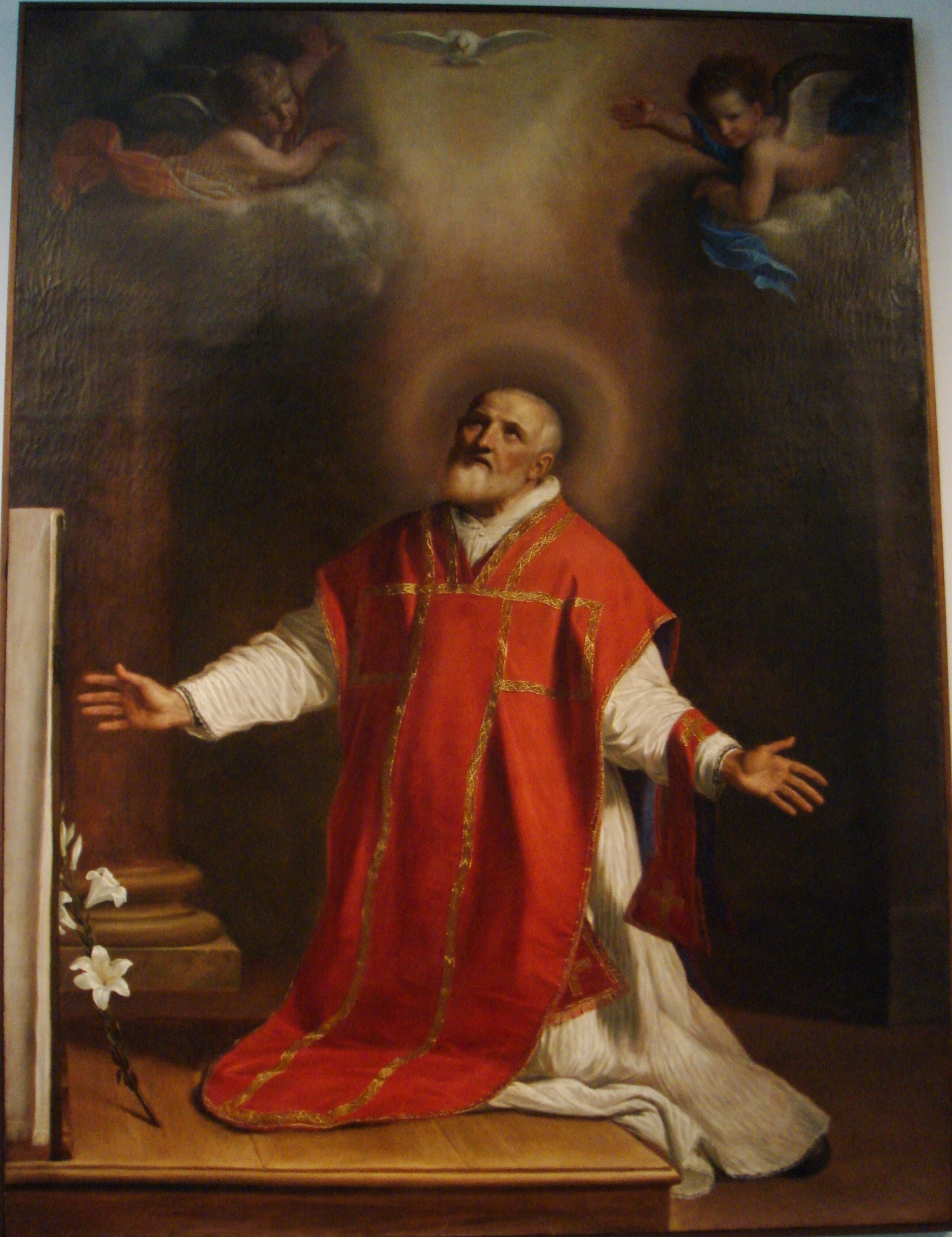
St Philip, with the lily of purity afore him, is shewn at the footpace of the altar in Mass-vestments of red, signifying his priestly focus upon the Mass and his entire devotion to the Holy Ghost, seen (flanked by angels) illapsing upon him

St. Philip, inflamed with the love of God and a desire of praising him worthily, after offering him all the affections of his soul, and the homages of all his creatures, seeing in their poverty and inability nothing equal to his infinite greatness, comforted himself in finding in the Mass a means of glorifying him by a victim worthy of himself.  This he offered to him with inexpressible joy, devotion, and humility, to praise and honor his holy name, to be a sacrifice of perfect thanksgiving for his infinite benefits, of expiation for sin, and of impetration to obtain all graces.  Hence in this sacrifice he satiated the ardent desires of his zeal, and found such an excess of overflowing love and sweetness in the closest union of his soul with his divine Redeemer.
(Taken from Vol. V of “The Lives or the Fathers, Martyrs and Other Principal Saints” by the Rev. Alban Butler, the 1864 edition published by D. & J. Sadlier, & Company)


******

The Postcommunion of this feast is entirely apposite: 

Cælestibus, Domine, pasti deliciis, quæsumus, ut * beati Philippi [confessoris tui, meritis et] imitatione * semper eadem, per quæ veraciter vivimus, appetamus.  Per...
(Fed, Lord, with celestial delicacies, we beseech that * by the imitation [and merits] of blessed Philip [thy confessor] * we may ever desire the same, by which we truly live.  Through...)

Interestingly enough, St Philip himself often prayed this prayer!  For, saving only the insertion of the words "by the imitation [and merits] of blessed Philip [Thy confessor]", which I have enchased with asterisks, it is the Postcommunion of the 6th Sunday after Epiphany – nowadays used in the Ordinary Form for the 6th Sunday in Ordinary Time.  This prayer is thus very ancient and expresses the doctrine of Holy Church with sureness.  At how many altars, for well over twelve hundred years, has this been prayed!

How greatly St Philip's heart dilated at these words of truth... how ought my heart likewise expand.  For in receiving Our Lord in Holy Communion, we partake of the true Manna by which we may expect life without end, beginning even now in this world.  I recall the famed and mysterious Mass of St Philip, celebrated in private as he grew older, that he might without embarrassment give full vent to his mystic love of Christ – a Mass lasting 3 hours, his Communion taking up most of the time; the saint could be heard to whisper in awe when drinking from the chalice, "It's real Blood".

The words in square brackets are omitted in the Novus Ordo, which is usually allergic to the mention of merit, presumably as "unecumenical", meaning, not pleasing to Protestants (thank God the editorial committee didn't remove reference to the saints' merits from the Canon), and which, in the interests of brevity, omits reference to non-martyrs as confessors, especially as the category of "confessor", however ancient, no longer exists as a separate Common.

The History of the Mass

The T of Te igitur, the start of the Canon, 
turned by pious tradition into an image of Christ Crucified, 
picturing the mystery of Sacrifice made present in the Mass

Primitively the priest kissed the altar but twice, at the start and at the end of Mass, greeting it and then farewelling with due and proper reverence – for the altar represents Christ Himself, as the Pontifical states; in the 12th century comes the first evidence for the kissing of the altar during the Canon (initially during the Supplices te, at the mention of "this altar", and later during the Te igitur also); later still, in the Roman Mass – not in the Dominican Rite, which had already been strictly standardized during the 13th century – came a kissing of the altar before each Dominus vobiscum, conveying as it were the Lord's greeting from His holy altar to His holy people.  

Here we see the progressive enrichment of the Liturgy, as it grew from acorn to stately oak; as Tolkien said, it would be mad to chop down the oak to get back to the acorn!  A pity Paul VI was too busy moping around the Vatican to listen to sensible advice rather than the sly wheedlings of a Wormtongue...  (Lest what I write below seem to contradict this, let me say that, while admiring each twig and leaf, in the first place one should regard the trunk and principal branches which give shape to the whole tree in its native growth habit.)

Jungmann points out that the Roman Rite, when brought north of the Alps, progressively replaced the variety of liturgical forms called in retrospect the Gallican Rite, but was also enriched itself.  The Frankish mentality preferred a prayer to accompany each action, whereas the Roman Mass in its ancient form often performed rites in silence (such as the washing of hands): hence the bare solemnity of the Mass had further devotions added to its starkly majestic form.

Of old, back in the first millennium, Mass in the City of Rome was a very sober affair: basically, what prayers, readings and chants are said aloud in the Traditional Mass, plus the Secret, Canon and Libera nos, constituted the whole of the Mass.  Staggeringly, all other prayers in the Mass, whether in what came to be the Traditional Mass, or in now what is the Ordinary Form of the modern Roman Rite, are secondary additions; very beautiful, very significant as many of them are, time was when they were not.

This has important consequences for liturgiology.  While I would be the last to discount, let alone view as "clerical corruptions" the many devout prayers added later, it is vital to realize that the Roman Liturgy is in essentials very concise, even more so than the Novus Ordo!  It is also why, much as I admire the Offertory prayers of the Extraordinary Form over their impoverished equivalents in the modern Mass, I know that both are additions, more or less happy, more or less doctrinally rich, to the essential Action.

What are the variable prayers of the Mass?  The Collect, Secret, Preface (anciently, and still at Milan, one for each proper Mass) and Postcommunion; very early sources often have a second Collect also (still preserved at Milan as the Oratio super sindonem, the prayer "over the corporal" as it is spread out at the start of the Offertory), and quite often an Oratio super populum, the "prayer [of blessing] over the people" after the Postcommunion, as well – for long preserved only on the weekdays of Lent.  These prayers, very rich in doctrine, admirable in their concision (even the Milanese or Ambrosian Rite, brother of the Roman, is not quite so concise; and the other Western and Eastern Rites just go on and on...), are the bedrock of the Liturgy – together with the fixed prayers.

What the variable chants and readings?  The Introit, Gradual, Alleluia or Tract, Offertory and Communion; the Epistle and the Gospel.  As the traditional Easter Vigil testifies, the Offertory came into use later than the other chants, as its more "advanced" music also reveals; this explains the mystery of the  Oremus before the Offertory, by the way: in the earliest period, the Secret was prayed directly after this Oremus, with no chant nor any other prayers intervening.  The traditional liturgy also retains certain days when there is more than one pre-Gospel reading...

What of the Ordinary chants?  The Kyrie was introduced, after the Eastern fashion, by Pope St Gregory the Great in the late 6th century; the Agnus Dei, by the Syrian Pope Sergius in the 7th; the Gloria in excelsis was at first restricted to Papal Mass for Christmas, then progressively extended to other feasts (and likewise gradually extended to episcopal and finally merely presbyteral Masses); the Creed was only introduced at Rome in the 11th century, after much Papal resistance!  Only the Sanctus is of immemorial use.

What are the fixed prayers of the Mass?  Of old, there was no Confiteor nor other preparatory prayers, no Offertory prayers except the Secret, no Communion prayers (the Pax Domini sit semper vobiscum is in fact a blessing imparted to the people to prepare them for a worthy Communion, as the Lord's Prayer is the prayer therefor; Luther of all people recognized this it must be said, and a comparison with other Rites East and West bears this out).  The fixed prayers were but two, and those most sacred: the very Canon of the Mass itself, and the Libera nos or Embolism that follows the Lord's Prayer.  We know that, as still at Milan, before the reign of Pope St Gregory the Great the fraction took place before the Lord's Prayer; he moved it to afterward, and also inserted the name of St Andrew, his patron, into the Embolism.

Given this, I much prefer to participate at Mass, sung Mass, the standard and most traditional form of the Liturgy, by attending to these chants, readings and prayers; other prayers are of great value (I still say the third Confiteor as a private heartfelt plea even when the strict '62 types omit it!), but these primary strata that I have enumerated express the very genius of the Roman Rite.  For this reason, knowing, say, the great variety of forms used in the Middle Ages at the Offertory, I generally use just one – the short Dominican version of the Suscipe sancta Trinitas – as my private prayer during that part of the Mass.

While some prefer to have their noses burrowed in their Missals during High Mass, reading every word muttered in secret by the celebrant while blocking out the singing of the choir (which is not always a bad idea, I know!), I think it obvious that Holy Church intends us to be moved especially by what is chanted aloud, ceteris paribus: so attend to the Introit, not to the sacred ministers saying Psalm 42 and so forth... though of course one may at points quietly pray one's own prayers, as every man's devotion listeth.

I have been interested in the lengthy arguments about liturgical forms (surprise, surprise) still ongoing over at that superb blog, The Anglo-Catholic, devoted to furthering the great and good work of corporate reunion of orthodox Anglicans with the Holy See; and I do prefer the richness of the Traditional Mass over the relative poverty of the Novus Ordo, especially given the devout way the former is celebrated, as against the philistinism so common, alas, in the celebration of the latter.  But I think a certain kind of hyper-orthodoxy, requiring every Mass prayer to be a veritable dogmatic treatise, and daring to fault even the Canon on this point, feeling it must be bolstered by the most emphatic Offertory prayers lest people misunderstand the Sacrifice, is overwrought.

The Roman Canon is most beautiful and august in its expression; its archaic form and structure, its mysterious words (think of the Supplices te rogamus: one mediæval writer advised that its obscurities are more to be feared than probed!) demonstrate what has been more and more emphasised by true students of liturgy: that it is very ancient indeed, and probably only the Assyrian Anaphora of Addai and Mari (itself not uncontroversial!) is of comparable date among Eucharistic Prayers still in use to-day.  

The mere fact that the Canon of the Mass does not contain an epiclesis proves it older than virtually all Eastern and Western forms, since the epiclesis, as an explicit invocation of the Holy Ghost to come down and transform the elements into Christ's Body and Blood, is a later and secondary development: Our Lord consecrated by His blessed words, This is My Body, This is My Blood.  As Dix pointed out, making the Holy Spirit the Agent seems not so consonant with Christ as the Primary Agent, the Priest Whose action makes the Eucharist (though of course, the Three Persons together work the wonder, as all operations of the Trinity ad extra are common to the Three).

(Lest some bright spark say, What about Eucharistic Prayer II?  Isn't that by St Hippolytus, and so therefore older than the Roman Canon?  Well, no!  The latest scholarship indicates that the prayer attributed to Hippolytus is not his work; and when you compare that prayer to the modern E.P. II, only about half of the latter traces back to the former; it was padded out and reworked by Bugnini's cohorts in the sixties, and as it is is hardly traditional.)

I have a book, Theodore Schnitzler's The Mass in Meditation, Volume I (St Louis: Herder, 1959), which is but a devout consideration of the Canon alone (Volume II, not in my possession, considers the rest of the Mass).  Such ought be the meditation of all, priest or layman, who draw near to God's altar in longing and trembling.

Let the last word be with Holy Church, lawfully assembled in the Holy Ghost, at the Council of Trent (22nd Session, 17th of September 1562, Doctrine on the Sacrifice of the Mass, Chapter IV):


And whereas it beseemeth, that holy things be administered in a holy manner, and of all holy things this sacrifice is the most holy; to the end that it might be worthily and reverently offered and received, the Catholic Church instituted, many years ago, the sacred Canon, so pure from every error, that nothing is contained therein which does not in the highest degree savour of a certain holiness and piety, and raise up unto God the minds of those that offer. For it is composed, out of the very words of the Lord, the traditions of the apostles, and the pious institutions also of holy pontiffs.

Tuesday, May 25, 2010

Eve of St Philip's Feast

"Considering my sins, I am a dead man, but having confidence in Father Philip, I hope to be saved" – thus said an early devotee of St Philip Neri while yet the saint lived; thus say I.

Four hundred and fifteen years ago this night, St Philip passed over from this world to the Father.  Glory be to God!

It is strange the attraction he exercises over me, this saint whose character, so different to mine! yet so greatly appeals: in God's mysterious plan, this man totally inflamed by the Holy Ghost, this holy fool-for-Christ, by his example and doctrine and love and prayers sweetly and gently draws me upwards toward things divine.  


How good it was to visit him in his sacred remains last September and in January again...  it will be not so very long until God returns his soul to his body, which appears as if in a gentle sleep, and he will rise again with all the just to live and reign for ever and ever.  God grant I be set on the right with them.

"The best ensue, the worst eschew, my heart is set; all goodly sport, for my comfort, who shall me let" – so all the more appropriately might St Philip have sung, in place of its true author, the terrible Henry VIII!  He was ever active to gently and sweetly draw souls to God.

Here is the Traditional Preface of St Philip Neri, as conceded to his sons, the Oratorians, which sums up much of this:

Vere dignum, et justum est, æquum et salutare nos tibi semper et ubique gratias agere, Domine sancte, Pater omnipotens, æterne Deus.  Qui beatum Philippum gratiæ tuæ muneribus, amoris igne æstuare fecisti: qua ineffabili charitate inflammatus, novam ad animarum lucrum Congregationem instituit, et quæ aliis dedit salutis monita, operum exhibitione complevit.  Quæsumus clementiam tuam ut illius nos festivitate lætifices, exemplo piæ conversationis exerceas, verbo prædicationis erudias, grataque tibi supplicatione tuearis.  Et ideo cum Angelis et Archangelis cum Thronis et Dominationibus cumque omni militia cœlestis exercitus, hymnum gloriæ tuæ canimus, sine fine dicentes: Sanctus...
(Truly it is worthy and just, right and salutary for us always and everywhere to give thanks unto thee, holy Lord, Father almighty, eternal God.  Who hast made blessed Philip by the gifts of thy grace to burn with the fire of love: enkindled by that ineffable charity, he instituted a new Congregation for the gain of souls, and those salutary precepts he gave others, he accomplished by the example of his deeds.  We beseech therefore thy clemency, that thou mayest give us joy by his feast, exercise us by the example of his pious conduct, instruct us by the word of his preaching, and protect us by his thankful supplication unto thee.  And therefore with Angels and Archangels, with Thrones and Dominations, and with every army of the host of heaven, we sing a hymn to thy glory, saying without end: Holy...)

The friend of the Bridegroom well knows that he must decrease, that Christ must increase evermore: St Philip's dictum was amare nescivi, to love to be unknown.  How pleased he must have been with his faithful English son, Cardinal Newman, for accomplishing an amusing disappearing act: in preparation for his impending beatification by the Pope, the English Oratorians prepared a grand reliquary, and went off to disinter their Venerable, only to find – nothing!  Loving to be unknown, Newman managed to rot away entirely, leaving only his shoes...

How entirely appropriate, then, that this year Whit Wednesday (in the 1962 Calendar) takes precedence of St Philip's feast on the 26th of May – St Philip, who lived permanently set on fire by the Holy Spirit, Who miraculously enlarged his heart beyond that of Phar Lap!  The Collect of this day is entirely, marvellously appropriate:

Mentes nostras, quæsumus, Domine, Paraclitus, qui a te procedit, illuminet; et inducat in omnem, sicut tuus promisit Filius, veritatem: Qui tecum vivit... in unitate ejusdem...
(May the Paraclete, we beg, Lord, Who proceedeth from Thee, illumine our minds; and lead us into all truth, as Thy Son hath promised: Who with Thee liveth... in the unity of the same...)

How concisely is the entire Trinity invoked!  We address the Father, asking Him that the Paraclete Who proceeds from Him may enlighten us, and lead us into all truth, as His Son promised us while on earth.

Good St Philip, pray for me, pray for us all: beg of God through Christ that He pour forth into our hearts also the gifts and graces of the Holy Ghost, that we nevermore be parted from the Lord.

Offertories Old and New

The essential difference between the Offertory Rite in the Extraordinary Form of the Mass, and that ("the Preparation of the Gifts")  in the Ordinary Form, is the degree of prolepsis.

Prolepsis - strange word!  What does it mean?  It means a "foreshadowing", a "foretelling", an anticipation (deriving from the Greek verb προλέγω).

We know – as Bishop Elliott reminded us in one of his liturgical handbooks – that the Mass is not a cereal sacrifice.  Furthermore, there is no oblation of bread and wine as such, since clearly such offerings cannot placate the Almighty.  Only insofar as the bread and wine will become the Body and Blood of the One Priest and Victim, Christ Jesus, the Lamb once slain Who lives for ever, do they have value: thus, anticipating their transformation into His Flesh and Blood Most Precious, already at the Offertory they are offered up.

This explains the language used in the Traditional Offertory prayers over the bread and wine and both together – in the Suscipe sancte Pater, the Offerimus tibi Domine, and the Suscipe sancta Trinitas.  The bread and wine are spoken of as already: the "spotless host" offered for all Christians, living and dead, that it profit unto salvation; the "chalice of salvation" whose sweet savour may ascend unto the Lord to avail for the salvation of the whole world; as "this oblation" offered to the Trinity in memory of Christ's saving works, honouring the saints and availing unto our salvation.  It would make no sense to speak of the bread and wine, before the consecration, in such terms except precisely proleptically.

Whence comes this language of prolepsis?  From the language of the Roman Canon itself: at its outset, long before the consecration of the elements by the very Words of the Lord (Verba Domini), the bread and wine are spoken of as hæc dona, hæc munera, hæc sancta sacrificia illibata ("these gifts, these presents, these holy unsullied sacrifices") and as hanc... oblationem, "this oblation".

The Offertory Rite, as the mediævals perceived, is thus already an anticipated doublet of the Canon of the Mass – which is why it was known then as the Canon minor.

The modern Mass, on the other hand, shies away from such full-blooded words.  This reflects the "problem" that theologians of the fifties and sixties had with prolepsis – despite it having been the norm in the Church for many centuries, in the Eastern Rites no less than in the Western.  (Indeed, the Mozarabic Rite is if anything the most proleptic of all, since its elaborate intercessions are offered up, speaking of the sacrifice of the Mass, long before the Preface and Consecration is reached.)

What to substitute for the old prayers?  Bugnini reports in his long apologia for the reform of the liturgy that at one stage, various Scriptural passages were suggested as possible for praying while the bread and wine were readied, such as "Wisdom hath built herself a house, she hath hewn her out seven pillars.  She hath slain her victims, mingled her wine, and set forth her table." (Wisdom ix, 1-2) Then someone had the bright idea of adapting the Jewish table blessings of bread and wine, much as, just perhaps (who can say?), Our Lord did at the Last Supper.  We therefore bless the Lord God of all things for the bread and wine we have to offer (that controversial word "offer" was retained), the produce of plants and of human effort (how didactic!), which will become – what?

It was decided that, unlike in the Ambrosian Rite, to pray directly and in anticipation of the epiclesis that the elements be transsubstantiated would be to anticipate too much (that dratted prolepsis again!), so instead, two poetic phrases were used: "bread of life" and "spiritual drink".  ("Spiritual drink" sounds very meagre, almost risible, in English: whisky is a spirit that we drink, for instance!)  Many commentators have noted that unfortunately (or ecumenically!) these phrases are rather equivocal, neither affirming nor denying the total change of the substance of bread and wine into the Body and Blood.

What has been lost?  There is now, in the Ordinary Form, no prayer in the Preparation of the Gifts offering them for such determinate ends, anticipating the offering up of the Divine Victim to compass our salvation and deliverance from our sins and all other blessings.  What remains?  The Orate fratres and its response, the Suscipiat.  This is a very important prayer: the priest asks the people to pray that the sacrifice that he offers, and that they offer up in union with him, may be acceptable to the Lord, that it may indeed be a true and saving satisfaction and impetration.  The people's response, to the effect that they beg God accept the offered sacrifice, to His praise and glory, and to benefit them and all the holy Church, does teach the truth of the Sacrifice.

The Novus Ordo also, it must be remembered, still retains the In spiritu humilatis, quoting from Daniel iii, 39-40, wherein the priest prays that (as new ICEL puts it), "With humble spirit and contrite heart may we be accepted by you, O Lord, and may our sacrifice in your sight this day be pleasing to you, Lord God."  It is important that sacrificium nostrum... placeat tibi, Domine Deus be read in the strongest sense, as praying that the sacrifice offered – which is Christ – please the Lord, placate Him, appease Him, be a propitiation availing for us men and for our salvation.  Undeniably, however, this is doctrine is deëmphasised in the modern Liturgy relative to the old.

A secondary difference is the degree of what might be called (by moderns) "uncomfortable words", relating to sinfulness and unworthiness.  In the Old Mass, the priest offers the host as a propitiation "for my innumerable sins and offences and negligences" – such a prayer is well-nigh unimaginable in the sunny New Mass!  Yet, strange to say, events of recent times have revealed that priests might well need to beseech forgiveness "for innumerable sins and offences and negligences" - can anyone dispute this, after so many scandals, "so much filth in the Church" as the Pope himself said, yea, as he has just said during his visit to Fatima, the greatest enemies of the Church are the sins of her members!

The Supreme Pontiff formerly known as Cardinal Ratzinger mentioned, while yet in that rank, that Gaudium et spes has passages that sound almost semi-Pelagian in their overconfident view of "modern man".  It is evident that this hubristic spirit is not absent from the liturgy drawn up by those too-optimistic men of the sixties...

Let us be clear, it is worse than foolishness, it is wilful blindness, to speak not of the need to offer God sacrifices in reparation "for... sins and offences and negligences" – are we to continue the pretence that "all is calm, all is bright" and still smile pathetically at Mass, "fiddling while Rome burns"?

Again, though, I must be fair, and note that the priest in the Ordinary Form, while washing his hands, prays the Lava me – "Wash me, Lord, from my iniquity and cleanse me from my sin" (Psalm 50:4) – so the sense of sin is not entirely lacking in the modern Mass.

Note well: throughout this post I have left the Secret or Prayer over the Gifts out of the discussion!  I well know that this ancient prayer is the very soul of the offertory, since it existed before any other offertory prayers at all were developed and added.  But as to whether the emphasis of the doctrine it conveys has changed in the development of the modern Missal, that is a more complex topic, requiring much careful analysis...

A Few Restorations to the Mass

The Mass of the modern Roman Rite could do with some enrichment from its Traditional forerunner.

Most of the suggestions I am about to make simply give the priest a few more short private prayers to say, to help him in his focus and devotion at the altar – for, if the celebrant be devout, this will conduce to edify the laity.

One very simple and small addition would be, when the priest communicates himself, when he says Corpus / Sanguis Christi custodiat me in vitam æternam, he preface each aspiration with the traditional psalm-verses appointed for this purpose in the all the editions of the Roman Missal down to 1962: before receiving the Host, Panem cælestem accipiam, et nomen Domini invocabo; before drinking from the chalice, Quid retribuam Domino pro omnibus quæ retribuit mihi?  Calicem salutaris accipiam, et nomen Domini invocabo.  ("I will take the bread of heaven and call upon the name of the Lord"; "What shall I render to the Lord for all that he has rendered to me?  I will take the chalice of salvation and call upon the name of the Lord" – Psalm 115:12-13, replacing "chalice of salvation" with "bread of heaven" in the first case.)  This is a gracious and delightful meditation.

A second improvement: at present, when performing the ablutions, the prayer Quod ore sumpsimus is to be said; why not provide Corpus tuum, Domine, its traditional partner, as an alternative, just as is done in the Novus Ordo with the two prayers before communion?  Some could conceivably object that the Quod ore is in the plural, while the Corpus tuum is in the singular – but in fact this better accords with the two alternative prayers before communion, Domine Jesu Christe and Perceptio Corporis, since they are both in the singular.

Ought, say, the Veni sanctificator be restored at the offertory, or "preparation of the gifts" as it is called nowadays?  I would argue not, since the new Eucharistic Prayers all have explicit epicleses, which more than substitute for this prayer.  However, something simply must be done about those dreadful Bugnini twins, "Blessed are you, Lord, God of all creation..." – to replace them with some of the many far more devout mediæval offertory prayers would be greatly to be desired.  Certainly, in respect of the chalice, the Offerimus tibi is almost exactly the same length as Benedictus es, Domine... vinum... (65 as against 62 syllables – and if the Amen of the former is made a response, it actually comes in as shorter than the latter with its optional response Benedictus Deus in sæcula, "Blessed be God for ever").

Why not mandate that the priest say privately as he approaches the holy table, "I will go in to the altar of God, to God who gives joy to my youth"?  This small but significant addition would surely help him to focus on what he is doing and the high mysteries he is about to celebrate.

It ought be encouraged that the traditional vesting prayers be said by the priest; and likewise, as was the mediæval custom, that as part of his prayerful preparation – which Canon Law mandates; one wonders how many priests observe this rule! – or even as he goes to the altar, he could pray Psalm 42.  The Missal ought provide Psalm 42 among its selection of prayers for use before and after Mass; similarly, it ought provide the text of the Last Gospel, St John i, 1-14, In principio, as a devout passage warmly commended to be said after leaving the altar.  Our Catholic forebears were so taken with these prayers, one a psalm, the other a Gospel pericope, that insensibly over many generations they came to become de rigueur for use at Mass: surely their devotional value is not spent?

Three Most Untraditional Prayers

Most of the Mass in the Ordinary Form is the same as the corresponding parts of the Mass in the Extraordinary Form, or in an edited version thereof.  

For instance, the modern Confiteor is a shortened and rehashed version of the traditional text; and, given the multiplicity of different versions of the Confiteor since it developed in mediæval times, one more variant is quite reasonable.  Similarly, adding phrases to the Kyrie is a modern revival, albeit in rather different form, of the mediæval practice of adding tropes to the Kyrie.  One could say similar things about having three readings rather than two, changing from a Gradual of two verses to a Responsorial Psalm using more, reviving the mediæval "bidding of the bedes" as the General Intercessions – these forms are related in the broad sense.

The introductory words for the penitential rite seem derived from various mediæval formulæ for the kiss of peace; the Dominus vobiscum is moved from before the Collect to right at the start of the Mass (where two other options are given, one of them being that used in the East at the start of the Anaphora)... more variation!

Many of the prayers at the offertory remain the same or almost so: the prayer at the mixing of the chalice is shortened from its older form and altered in one word; the In spiritu humilitatis and Orate fratres remain unchanged; at the washing of the priest's hands, rather than the psalm verses beginning with Lavabo, instead Ps 50:2, Lava me, is now employed.

But now it is time to reveal my list of three most untraditional prayers:
  • the two offertory prayers "Blessed are you, Lord God of all creation...";
  • the Memorial Acclamation;
  • the doxology "For the kingdom, the power, and the glory are yours..." ending the Embolism after the Lord's Prayer.

Bugnini's twins, the two made-up offertory prayers derived from Jewish table blessings, are totally untraditional, turning some theories dear to liturgists about how the Eucharist first developed into rather lame effusions to be read at Mass.  And why?  Because, as that fellow candidly admitted, it was feared – feared! – that if no new offertory prayers were made up and imposed, priests would just keep on saying the old ones!  Both prayers are terribly didactic; as Bp Elliott joked in a similar regard, their focus on bread and wine being fruit of the earth and vine, the work of human hands, seems to turn the Eucharist into a cereal offering and a libation.  Both do say "we offer" and are careful to state that these elements do arise from God's bounty as the Creator of all (of the earth, of plants, of human hands), for which we bless Him; both do allude to the coming transsubstantiation of the offered bread and wine into the very Bread of life and that which is our spiritual drink.  All that said, they remain in my estimation sorry substitutes for the rich variety of offertory prayers developed during mediæval times.

The Memorial Acclamation is a complete innovation, featuring in no Western Rite; it is found in the Egyptian or Coptic Rite, in the form "Thy death, Lord, we announce and Thy holy resurrection and ascension we confess" – whence evidently comes the first of the three options for this Acclamation in the modern Roman Rite; the other two, one quoting St Paul, and the other seemingly a mediæval antiphon from Holy Week, are utterly new.  (It goes without saying that the old ICEL paraphrase we've been saddled with these forty years renders these very imperfectly, even managing to turn three options into four!)  As one scholar observed, it would be better to insert these Acclamations after the anamnesis, rather than directly after the Consecration.  I would argue that they take away from the proper emphasis on adoring the Lord at the Elevations, and on therefore joining in offering His Sacrifice made present, remembering His saving works: they ought be suppressed.

It is completely unliturgical to delete the already existing doxology of the Embolism, replace it with one customarily used with the Lord's Prayer alone, and then get everyone to say it together.  Frankly, this is the most Protestant-influenced part of the new Mass, and really grates.  It is as if the liturgical reformers realized that they couldn't add this doxology to the Lord's Prayer itself (where it is found in the Byzantine Rite – but said by the priest alone), since then its link with the Embolism would be broken, so in defiance of all rules they appended it to the Embolism instead.  Worst of all, getting the congregation to say this as a response instead of the expected Amen has encouraged the terrible practice of all and sundry joining in singing or saying the doxology at the end of the Eucharistic Prayer, the Per ipsum.

Some may now have noticed that I write not of the modern multiplicity of Eucharistic Prayers as untraditional: yes, for the moment that question is beyond the scope of this article; I would argue that such multiplicity is now a central characteristic of the modern Roman Rite...

Monday, May 24, 2010

Offerimus tibi Domine


This saving chalice too we bring,
receive it graciously, O King;
with fragrant odour may it rise
to your high throne above the skies.

— D. M. Coffey, "Receive, O Father, God of might", v. 2

Jungmann, in his magisterial work The Mass of the Roman Rite, has much to say of the prayer Offerimus tibi, which is used in the Traditional Latin Mass at the offering of the chalice; according to his sources, it first appears as a 9th or 10th century supplement to a manuscript Sacramentary.  There, and in other early records, it did not yet include the stirring and dogmatically significant words pro nostra et totius mundi salute.

The Canon of the Mass, in the oblation after the Consecration, has the words offerimus præclaræ majestati tuæ... calicem salutis perpetuæ.  In these words we find the proximate source of the prayer Offerimus tibi:

Offerimus tibi, Domine, calicem salutaris, tuam deprecantes clementiam: ut, in conspectu divinæ majestatis tuæ, pro nostra et totius mundi salute cum odore suavitatis ascendat.  Amen.
(We offer unto Thee, Lord, the saving chalice, beseeching Thy clemency: that it may go up with an odour of sweetness in sight of Thy Divine Majesty, for our and the whole world's salvation.  Amen.)

In Exodus, and repeatedly through Leviticus and Numbers, are found phrases about offering sacrifice as a sweetest savour to the Lord, just as once the Almighty smelt the odour of sweetness arising from Noë's sacrifice and was appeased (Gen. viii, 20-21).  This finds its true meaning in the New Testament, where we read that "Christ loved us and handed over Himself for us, as an Oblation and Victim to God in the odour of sweetness", in odorem suavitatis (Eph. v, 2).

As Aquinas put it in one of his hymns for Corpus Christi, Christ "gave Himself with His own Hands" when He took the chalice and made the wine within become His Blood, the price of our salvation; and having made His Apostles Priests of the New Testament, well may all the ordained say Calicem salutaris accipiam, et nomen Domini invocabo, "I will take the saving chalice, and invoke the name of the Lord" (Ps 115:4).  This chalice, wherein soon again Christ's Blood will be made present, is therefore seen as lifted up, and giving forth the sweet savour whereby the Deity is propitiated: and we know that "He is the propitiation for our sins, and not for ours alone, but for the whole world's" – pro totius mundi (I John ii, 2).

Originally, this prayer was said by the deacon, not the priest, when the former brought the chalice, already filled with wine, to the altar and said this prayer of offering himself.  It was conceived that the priest offered the chalice through the ministry of the deacon, hence the usual opening word Offerimus, "We offer", not the expected Offero, "I offer" (which was used in some places); in process of time, it became the custom for both to say the prayer together, the deacon touching the chalice and supporting the priest's arm; thus was kept alive in the later Use of Rome the ancient dignity of the Deacon as minister of the chalice, long after Communion under both kinds died out.

One source, an 11th century missal from Hamburg, has, by prolepsis, sanguinem Filii tui ("the Blood of Thy Son") instead of calicem salutaris; another, a Westminster missal from the late 14th century, makes this a formula for offering up both elements with the words calicem et hostiam salutaris, and changing the verb to the plural ascendant.  (It is easy to spot that the words "and host" are added, since normally one would say "host and chalice", not "chalice and host".)

Since my own encounters with priests celebrating the Dominican Rite – which, like most variants of the Roman Rite, does not contain the Offerimus tibi – I have rather neglected this prayer in favour of the Suscipe sancta Trinitas in its short Dominican form, which is one of my customary private prayers at Mass (adding per manus sacerdotis tui, "by the hands of Thy priest", to make it a fit prayer for a layman).  But it is too beautiful to neglect wholly.

One suggestion is that, in some future revision of the Ordinary Form, the rather grand offertory prayers of the Extraordinary Form could be made alternatives to the untraditional formulas that I call Bugnini's bastard twins – "Blessed are you... through your goodness we have this bread / wine to offer..." – which  seem intended to teach 'modern [urban] man' that human hands make bread and wine from the produce of plants; at least it is acknowledged that God, the Lord of Creation, ought be blessed for His goodness in providing that this be so; the prayers also presume to state that they will become "the bread of life" and "spiritual drink", in case anyone is unsure of their purpose; at least the basic verb "to offer" is retained.  

How insufferably didactic!  To take benedictions of God from Jewish table prayers, and then to clumsily adapt them to Christian use at Mass by alluding to the new purpose to which the elements will be put, is a wholly untraditional approach not seen before.  I think Bugnini in his prolix account of the reform of the Roman liturgy rather ingenuously states that it was realized that some new offertory prayers just had to be made up, since otherwise (horribile dictu) the older ones would simply have continued to be said...

Offerimus tibi is only slightly longer than its replacement, and is certainly more poetic, as well as being more Scriptural: I would be delighted to hear it at ordinary Mass –

We offer you, Lord, the chalice of salvation, imploring your mercy, that it may arise with a sweet savour before your divine majesty, for our salvation and that of the whole world.  Amen.

Our Lady Help of Christians, pray for us!

To-day, which in the Traditional Calendar is Whit Monday, in the modern Roman Rite's local Australian Calendar is the Solemnity of Our Lady Help of Christians.  Given the importance of the feast, and the need to pray for a relative undergoing a medical procedure, I went to Mass...

I do wish the celebrant would recall that the Creed ought be read, it being a solemnity!  It is of far greater importance to join the Church in confessing our Holy Faith than to indulge in what was the great time-wasting session that ensued instead: while all sat (meditating on their latter end, as the saying goes), we had tiresomely longwinded extempore prayers of the faithful, one of which, from an over-pious middle-aged female, as well as being inaudible, was longer than the sermon.  I resent turning the Mass into a pathetic prayer-group.

Alas!  I had come to "Lazy Mass", an unfortunately common variant of the Ordinary Form, especially when Mass is celebrated for a small coterie, middle-aged and up, on weekdays.  (The virulent form is such a Mass dominated by foul religious sisters or fouler layfolk of the dissenting variety.)  Note that I write not of Mass for the very aged or frail, since they of course can hardly be expected to sit, stand and kneel in due order: I write of those perfectly able to kneel at Mass on Sunday, but who manifest an aversion to the same on weekdays.

Sitting – apparently this is the acceptable posture in which to worship God.  Or so one not conversant with the actual directions of the Roman Rite might conclude, given the lazy way all but two rested in their chairs during the Preface, when they should have stood (as had done at the start of Mass, and as they did for the Lord's Prayer later on), and, most scandalously, during the entire Eucharistic Prayer (the amply-carpeted floor being too uninviting for most knees).  The rationale seemed to be that if one sat dumbly during the very Consecration, why bother standing for the Preface?  The well-known and reinforced requirement that one must now stand up at the Orate fratres seems not to apply to such Lazy Masses.

I expect that if I had asked why, there would have been horror at the question even being posed: apparently at a weekday Mass this sort of thing reigns in some places.  There is an entire blindness to the scandal of such material irreverence and disobedience to the clear directions given for the Mass, which allow no exceptions for such pretended exceptions.

It is wrong to sit at such times unless one is incapacitated.  If kneeling is not possible, it has been pointed out in Notitiæ, official organ of the Congregation for Divine Worship, that standing is the next best.  But no, ignorance triumphs again.

It particularly offends and upsets me that such a bad custom perverts the proper understanding of what liturgy and due reverence require, and turns the dread mysteries of the Mass into a safe little sit-down.  People even get the wicked idea (Luther I think first gave voice to it) that somehow such an "intimate" little affair is more "authentic" than the norm, when it is in fact a corruption inimical to a true perception of religious respect.

How typical that in backward Tasmania, the notorious coffee-table Masses of the sixties and seventies are still alive and well!  At least those who destroyed the liturgy back then largely drew the logical conclusion and either reformed themselves (as one hopes) or left altogether (as one fears), their innovating irreverence slipping away into indifference and atheism...

Despite the priest (personally devout), who has I know improved matters in the parish to some extent, I discovered anew that I cannot bear the way weekday Mass is arranged, not on his part, but on that of the congregation.  It drives me away every time, and has for years, whenever for any reason have I steeled myself to go again.  But I suppose this would be considered evidence of my having a problem, not those folks in their unthinking laxity, no...

Sunday, May 23, 2010

The New Law is the Grace of the Holy Ghost

The key to Christian life and living, and therefore to all moral theology, is put so well by Aquinas: the New Law is the grace of the Holy Ghost, written on our hearts.  By His power we are enabled to live as we should, thus fulfilling all that Christ taught us.  To quote from the Common Doctor's Summa Theologiæ (I-II, 106, 1, sed contra & resp.):

The New Law is the law of the New Testament. But the law of the New Testament is instilled in our hearts. For the Apostle, quoting the authority of Jeremiah 31:31-33: "Behold the days shall come, saith the Lord; and I will perfect unto the house of Israel, and unto the house of Judah, a new testament," says, explaining what this statement is (Hebrews 8:8-10): "For this is the testament which I will make to the house of Israel... by giving My laws into their mind, and in their heart will I write them." Therefore the New Law is instilled in our hearts.
I answer that, "Each thing appears to be that which preponderates in it," as the Philosopher states (Ethic. ix, 8). Now that which is preponderant in the law of the New Testament, and whereon all its efficacy is based, is the grace of the Holy Ghost, which is given through faith in Christ. Consequently the New Law is chiefly the grace itself of the Holy Ghost, which is given to those who believe in Christ. This is manifestly stated by the Apostle who says (Romans 3:27): "Where is... thy boasting? It is excluded. By what law? Of works? No, but by the law of faith": for he calls the grace itself of faith "a law." And still more clearly it is written (Romans 8:2): "The law of the spirit of life, in Christ Jesus, hath delivered me from the law of sin and of death." Hence Augustine says (De Spir. et Lit. xxiv) that "as the law of deeds was written on tables of stone, so is the law of faith inscribed on the hearts of the faithful": and elsewhere, in the same book (xxi): "What else are the Divine laws written by God Himself on our hearts, but the very presence of His Holy Spirit?"
Nevertheless the New Law contains certain things that dispose us to receive the grace of the Holy Ghost, and pertaining to the use of that grace: such things are of secondary importance, so to speak, in the New Law; and the faithful need to be instructed concerning them, both by word and writing, both as to what they should believe and as to what they should do. Consequently we must say that the New Law is in the first place a law that is inscribed on our hearts, but that secondarily it is a written law.