Showing posts with label Universal Call to Holiness. Show all posts

Thursday, November 1, 2012

Omnes Sancti

Sancti estote, quia ego sanctus sum, Dominus Deus vester
Be ye holy, for I am holy, the Lord thy God. — Leviticus xix, 2.

How can the Lord command the seemingly impossible? How can fallen man be expected to be holy as God is holy? Yet to Moses it was said, Speak to all the group [cœtum] of the children of Israel, and say to them: Be ye holy, for I am holy, the Lord thy God.  This command of holiness is for all the people.  And the Incarnate Son, fulfilling the Old Dispensation in His New and everlasting Testament graven upon hearts by the Holy Ghost, opened His blessed mouth and said, Estote ergo vos perfecti, sicut et Pater vester cœlestis perfectus est – Therefore be ye perfect, as your heavenly Father is perfect (St Matthew v, 48). The Apostle therefore fears not to command the Corinthians, not the most united nor the most likely candidates for holiness given their sins and schisms, "be ye perfect" (II Cor. xiii, 11).

But how can we, mere men, aspire to such perfection, such holiness? Behold, even the angels are not perfect in God's eyes; the Deity, meanwhile, is utterly separated from all profaneness, all corruption and shadow of change, all evil and all sin: while we, sinners that we are, are slaves to the world, the flesh, and the enticing pomps of the devil. The Church sings in the Angelic Doxology at Mass, Tu solus sanctus, Jesu Christe, cum Sancto Spiritu in gloria Dei Patris.  Jesus Christ is alone holy, with the Holy Ghost, in the glory of God the Father; Holy is the very proper name of the Spirit; God the Father is the Holy One of Israel: yes, Holy is the Trinity, One God in three Persons, coëqual and each holy; yet there are not three Holies, but One Holy.  If it were not for the express command of the All-Holy and Almighty and All-Merciful in both Testaments, no one would dare presume to imagine being thus perfected and holy.

However, Christian doctrine reveals that holiness is not restricted to the Godhead, for we reject Calvin's heresy of total depravity: the Church is holy, as the Creed confesses; for she is the Bride of Christ, without spot or wrinkle; again, the Church is the Mystical Body of Christ, in whose essential holiness she participates. She is the Casta meretrix, the chaste harlot (as Rahab of old, who aided Joshua, the type of Christ), sinful in her members but sinless in her body, sharing in the holiness of her Head; and her members can, if they are well pruned and purged, grow up as if choice vines in the Lord's vineyard, rather than deserve to be cut away and burnt, which God avert.

How can we aspire to be holy? The Apostle declares that the Lord predestined us, chose us in Christ before the foundation of the world, to be holy and immaculate before him in love (Eph. i, 4); he everywhere addresses the faithful as saints, or as called to be so; and, moreover, he explains the secret of this predestination to holiness: it is that Christ hath reconciled us to God through the sacrifice of his fleshly body in death, that we might be presented holy and spotless before the Lord (cf. Col. i, 22); and this fruit of Calvary is applied to us by grace, above all in the Sacraments, so, having the hope that, being children of God, we shall be like him, we are truly given the strength to strive to sanctify ourselves, as God is holy (cf. I John iii, 2f). This is our mission in life, to work the works of Him Whose will we ought fulfil, while the day lasts, since night cometh when none can work.

Night cometh: after death cometh judgement.  We read of the heavenly Jerusalem where the souls of just men made perfect (Heb. xii, 22f) ever rejoice, as the Apocalypse reveals, celebrating a perpetual liturgy before the Almighty, Who was, is, and is to come. If at death we are in God's grace, yet not wholly perfected (for nothing unclean may enter heaven), there is a Purgatory, as Trent teaches, where the consuming fire of God's love cleanses away all spot and stain; and whether on earth while alive or there once dead, to our souls may be applied that treasury of merits of Christ, His Divine Mother and the Saints, stored up (as the Apostle teaches) by filling up whatsoever is lacking in the Sacrifice of Christ, and poured forth in grace and mercy by the Church exercising the power of the keys in imitation of Christ's bounty, that our purification from the temporal punishments due to sin may be the speedier, just as Christ in His ministers freely grants peace and pardon, delivering by priestly absolution souls groaning under the threat of eternal punishment should they, alas! fall into sin that is mortal.

On this feast of All Saints, that is, of all who are Holy, who have a real share by adoption in the sanctity of the Lord, which is His and His Father's and Their Spirit's, in the unity of the Trinity, the "universal call to holiness" (that unjustly neglected precept of the last Council) must be recognized for what it is, the upward call in Christ Jesus our Lord. He can accomplish this in us, as He accomplished in Himself the One Offering by which all are sanctified, and accomplished the perfecting by grace unto the awarding of glory in each and every one of His Saints. Yes, Mirabilis Deus in sanctis suis, God is wonderful in His Saints.

Consider a particular gift from the Church-redeemed Anglican Patrimony, worthy to be shared with the whole Church ad mentem summi pontificis, the Collect for All Saints, whether in the version found in the 2012 Ordo of the  English Ordinariate (which simply lengthens the short ending found in the 1662 BCP), or the similarly augmented but also slightly varied form in the US Book of Divine Worship (which above all adds reference to the Saints' prayers for us, while slightly updating the language):
O Almighty God, who hast knit together thine elect in one communion and fellowship, in the mystical body of thy Son Christ our Lord: grant us grace so to follow thy blessed saints in all virtuous and godly living, that we may come to those unspeakable joys, which thou hast prepared for them that unfeignedly love thee; through Jesus Christ thy Son our Lord, who liveth and reigneth with thee, in the unity of the Holy Spirit, one God, now and for ever. Amen. [OLW] 
O Almighty God, who hast knit together thine elect in one communion and fellowship in the mystical body of thy Son Christ our Lord: Grant us grace so to follow thy blessed Saints in all virtuous and godly living, that, through their intercession, we may come to those ineffable joys which thou hast prepared for those who unfeignedly love thee; through the same Jesus Christ our Lord, who with thee and the Holy Spirit liveth and reigneth, one God, in glory everlastingAmen. [BDW]
It is the Omnipotent Who has united as one the scattered children of men in His Son's Body, by the very Sacrifice of that Body, through Him, with Him, in Him; it is for Him to give to those whom He chooses to have the grace to do such things as are good and righteous – Da quod jubes, et jube quod vis, as St Augustine dared pray, "Grant what Thou dost command, and command what Thou wilt" – and thus it is that we may hope and trust to come to the unimaginable joys of heaven, where all is holy, for God shall be all in all.

The Saints, those who have already arrived and are now evermore at home and at peace, are that great cloud of witnesses still spurring us on to victory, to run the great race, to finish the course, to win the crown immarcescible; but it is God who awards the prize and enables our every striving, who is pleased to hear our prayers and those made by our intercessors on our behalf, and from the empyrean heaven stoops down to bless and save us.  The good is diffusive of itself, and the Supreme God, the Summum Bonum, above all: Divinity does not jealously hug holiness to itself, but deigns to share that supernaturalizing grace with the world, which in and of itself could never hope for holiness.  Thus we may be holy as He is holy; and the example of the Saints – the Martyrs who died in imitation of and in testimony to Jesus, the Confessors and Virgins and every class of hallowed soul who despised earthly things, loved heavenly things, and laboured in the vineyard seeking to be all things to all men, that they might save some – serves to shew that such holiness, once and for all exemplified in Christ, the Saint of Saints, is also a possibility for those believing in Him. The Lord does not command impossibilities; what to flesh and blood seems impossible is not so to God, Who hallows, sanctifies, blesses and bestows beatitude on those He draws to heaven, to be exalted and to worship in exultation evermore.

Omnes Sancti et Sanctæ Dei, intercedite pro nobis.
All ye holy men and women, intercede ye for us.

Monday, December 21, 2009

The Universal Call to Holiness

Following on my last posting, I note that, as Advent is not but a sentimental reliving of the long wait of Israel for her Messias to arrive, but a keeping vigil for the Lord to-day, coming every moment in secret grace, and coming soon to judge on the Day of the Lord; so too Christmas is not merely a schmaltzy, let alone kitsch recollection of the Baby Jesus, but a reminder that Christ ought be born in us here and now, and that we ought grow up in Him to full stature, now that the eternal Nuptials are begun in mystery on earth to be consummated at the end of our lives and at the end of time, now God the Word is Incarnate for us.

Christmastide (only four days' away) is and should be as much a season of expectation as Advent.

The universal call to holiness, that great underrated doctrine - neglected at our souls' peril! - is powerfully affirmed as a central theme not just of Advent, but of Christmastide, not least by the lessons Holy Church appoints for us to hear and heed, as a wise and loving Mother. Note and mark well the lesson given by the Epistle of the Midnight Mass (Titus ii, 11-15a), very Advent-sounding, looking to the present and the future, given the past event of Christ's Incarnation and Epiphany:

Brethren:
The grace of God our Saviour hath appeared to all men; instructing us, that, denying ungodliness and worldly desires, we should live soberly, and justly, and godly in this world, looking for the blessed hope and coming of the glory of the great God and our Saviour Jesus Christ, who gave himself for us, that he might redeem us from all iniquity, and might cleanse to himself a people acceptable, a pursuer of good works. These things speak, and exhort:
in Christ Jesus our Lord.

This passage is energetically pressed upon us, by the repetition of its first verses, reminding us of the whole, throughout Christmastide as the capitulum (little chapter) of Lauds and Vespers and Terce (which would be sung before High Mass in the ideal):

The grace of God our Saviour hath appeared to all men; instructing us, that, denying ungodliness and worldly desires, we should live soberly, and justly, and godly in this world.

Hear and heed the Apostle's urgent call. We must live as becomes saints, "as we wait in joyful hope for the coming of our Saviour, Jesus Christ" (ICEL's paraphrasing of the new end to the Libera nos at Ordinary Form Mass).

I Believe in the Communion of Saints

(This began as a comment over on The Anglo-Catholic, and grew like Topsy...)

"The Communion of Saints" - a most consoling article of the Apostles' Creed...

Not for nothing is one of the Four Marks of the Church holiness! The spiritual fecundity of Holy Church is a great proof of her verity, fidelity and vitality.

As the late John Paul II put it, the witness of the saints - that a truly holy Christian life is possible and attractive and wonderful - is almost the greatest testimony to the Gospel for our world: even the most fallen find the beauty of holiness so attractive, giving hope to those who feel they cannot find their way. In these men and women Christ's call to live "in Him" is splendidly shown forth as fruitful for themselves and His whole Church.

This is why the Catholic Church has not hesitated to continue to promote the causes of saints, and to beatify and canonize those proven by rigorous examination to have lived as becomes saints and to have their sanctity signalled by signs from heaven, raising them to the honours of the altar as great examples for the People of God still on their way in this world toward heaven.

The saints are saints "for us" - whether or not they are acclaimed on earth is obviously of secondary interest to them, who love and worship God face to face; but as they love all members of the Church as their brothers and coheirs in Christ, they are glad to be examples, yes, and intercessors, for us still wavering between hope and fear as we work out our salvation, just as we and our fellow Christians here and now are or ought be mutual examples and interceders for each other. No one is a Christian for himself alone.

I would forcefully argue that the most important if not sufficiently emphasised pronouncement of Vatican II was about "the universal call to holiness" - and this is exemplified in the saints, who were men and women compassed by infirmity, but raised up by grace, the weak who were chosen and became strong in Christ our Lord.

Unfortunately, our modern age downplays the need, as the Anglican formularies put it, quoting Scripture, "That we may hereafter live a godly, righteous and sober life" (BCP, Mattins & Evensong, General Confession), "that the rest of our life may be pure, and holy; so that at the last we may come to his eternal joy" (ditto, Absolution).

Too often well-meaning folk, shying away from what seems overly challenging (i.e. the Gospel), substitute vague nonsense about "spirituality" for the upward call in Christ Jesus our Lord.

I note that the traditional Anglican liturgy powerfully reminds its participants of the "serious call to a devout and holy life", called to live as saints in the Communion of Saints - most of these quotations following can also be found in the B.D.W., demonstrating how Catholic they are:

O Almighty God, who hast knit together thine elect in one communion and fellowship, in the mystical body of thy Son Christ our Lord: Grant us grace so to follow thy blessed Saints in all virtuous and godly living, that we may come to those unspeakable joys, which thou hast prepared for them that unfeignedly love thee; through Jesus Christ our Lord. Amen.

(BCP, All Saints' Day Collect)

...to all thy people give thy heavenly grace, and specially to this congregation here present, that, with meek heart and due reverence, they may hear and receive thy holy Word; truly serving thee in holiness and righteousness all the days of their life.

(BCP, Prayer for the Church)

And we yield unto thee most high praise and hearty thanks, for the wonderful grace and virtue declared in all thy Saints, who have been the choice vessels of thy grace, and the lights of the world in their several generations: (and chiefly in the Blessed Virgin Mary, Mother of thy Son Jesus Christ our Lord and God, and in the Holy Patriarchs, Prophets, Apostles, and Martyrs,) beseeching thee to give us grace to follow the example of their stedfastness in thy faith, and obedience to thy holy commandments, that at the day of the general resurrection, we, and all they who are of the mystical body of thy Son, may be set on his right hand, and hear his most joyful voice, Come ye blessed of my Father, inherit the kingdom prepared for you from the foundation of the world.
 Grant this, O Father, for Jesus Christ's sake, our only Mediator and Advocate.

(Scottish BCP, Prayer for the Church, based on the original 1549 formula)

Ye that do truly and earnestly repent you of your sins, and are in love and charity with your neighbours, and intend to lead a new life, following the commandments of God, and walking from henceforth in his holy ways...

(BCP, Invitation)

...grant that we may ever hereafter Serve and please thee In newness of life, To the honour and glory of thy Name; Through Jesus Christ our Lord. Amen.

(BCP, General Confession)

...let us beg of him grace to perform our vows, and to persevere in our good resolutions; and that being made holy, we may obtain everlasting life...

(Scottish BCP, Exhortation after Communion)

...thy favour and goodness towards us;... that we are very members incorporate in the mystical Body of thy Son, which is the blessed company of all faithful people; and are also heirs through hope of thy everlasting kingdom...

And we most humbly beseech thee, O heavenly Father, so to assist us with thy grace, that we may continue in that holy fellowship, and do all such good works as thou hast prepared for us to walk in; through Jesus Christ our Lord...

(BCP, Prayer of Thanksgiving)

O God the King of Saints, we praise and magnify thy holy Name for all thy servants who have finished their course in thy faith and fear, for the Blessed Virgin Mary, for the holy Patriarchs, Prophets, Apostles, and Martyrs, and for all other thy righteous servants; and we beseech thee that, encouraged by their example, strengthened by their fellowship, and aided by their prayers, we may attain unto everlasting life; through the merits of thy Son Jesus Christ our Lord. Amen.

(Scottish BCP, a Collect which may be said after that of the Day or before the Blessing)

Sunday, June 28, 2009

Australian Calendars Old and New

Compare and contrast the particular calendars for the dioceses of Australia - what a topic for an introductory course in liturgical studies!

Here is my take on what a traditionalist would say...

First, it must be observed that three feasts have stayed the same: St Patrick (out of piety toward the Irish origins of our churches here, despite not being a Patron of Australia) and Our Lady Help of Christians (designated Patroness by an early synod, despite there being little devotion to her under this title) are 1st class feasts in the old calendar, and solemnities in the new; and St Peter Chanel (Protomartyr of Oceania, and canonized only shortly before the Council) has the identical feast (3rd class in old, which is a memorial in the new) in both calendars.

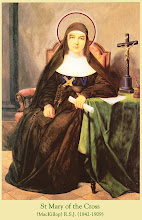
Second, several new saints have been inserted into the new calendar: as optional memorials (to be celebrated if desired), St Bernadette and St Peter To Rot (a native Papuan who was martyred by the Japanese - recall that Papua New Guinea only gained independence from Australia in 1975); and as a feast, Bl Mary MacKillop, "Australia's First Saint" as the media and dear religious sisters like to call her proleptically (a cynic might well ask, why only one blessed after more than 200 years? - whatever has happened in the Antipodes to the universal call to holiness but yesterday reaffirmed by Vatican II?).  To make room for Bl Mary MacK., St Dominic has been transferred to another day in the new calendar - prompting angry ineffectual noises from the Friars Preachers, one of whom rightly noted that "It would never have happened to St Francis!".

Thirdly, several saints have been removed or downgraded, in accordance with postconciliar measures to encourage noble simplicity (such as smashing statues), presumably connected somehow with promoting the universal call to holiness.  Since Australia is no longer a missionary country (!) - in other words, since 1976 its bishops have not been under the jurisdiction of Propaganda Fide - the universal patrons of the missions, St Francis Xavier and St Thérèse of the Child Jesus, no longer have 1st class feasts (solemnities) here, but only 3rd class (memorials).  This does not stop some Traditionalists arguing that the old calendar still applies in their cases, meaning that they are both secondary patrons of Australia, and not, at the same time.  Three saints - all Irish - have been altogether deleted from the new calendar for Australia: St Brigid, St Columba, and St Oliver Plunket.  Presumably it was felt that to fete St Patrick and everything Irish sufficed; surviving Brigidines and Columbans may feel differently.  (If only the Forty Martyrs of England and Wales had been inserted in their place, as an ecumenical gesture.)

Finally, two rather unfortunate new proper Masses have been composed and inserted into the Missal: a Mass for Australia Day, the 26th of January (necessitating transferring SS Timothy and Titus to another day), and a Mass for ANZAC Day, the 25th of April (and therefore moving the feast of St Mark the Evangelist!).  The Australia Day Mass I find downright embarrassing: it seems to be a Mass of thanksgiving for God's benefits received, but is somehow clunky.  As for "the one day of the year", Australia's real national day, ANZAC Day, prior to the Council, a rescript of the Sacred Congregation for Rites had allowed a Requiem Mass for ANZAC Day, when Australia recalls its war dead; now we are subjected to a Mass that doesn't know what its for, as the formulary is a confused mixture of petition for the faithful departed, and sixties-style longings for peace and justice ad nauseam.  Even the entrance and communion antiphons, plus the readings for the Mass can be either suitable for a funeral, or wholly focussed on hopes for peace, and the Preface can be either "of Christian Death" or "of Easter".  What the veterans must make of it I don't know: I find it very unsatisfying, and the civic ANZAC Day services at the cenotaph in every city and town frankly hit the mark better (leaving aside for the sake of argument the Holy Sacrifice truly reënacted at Mass).

What Reform of the Reform is called for?  For a start, an improvement in the texts of the Australia Day and ANZAC Day Masses.  Probably it is not necessary to restore the feasts of St Brigid et al., since with the dilution of the Irish strain in the Australian milieu they are no longer as popular saints as of old.  Arguably, given her great prominence in (remaining) Catholic statuary - and piety - St Thérese could have her feast day upped in importance as formerly.  Similar considerations would apply in having Our Lady of Perpetual Help given a nationwide feast day - dare I suggest Our Lady Help of Christians make way?

Saturday, December 8, 2007

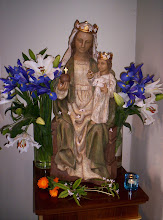
Immaculate, Immaculate

Praying Vespers is beautiful, "like savouring a fine cigar" (as a friend of mine once described the Rosary), tho' strictly speaking I wouldn't know, never having smoked.


I was suddenly struck by the aching beauty of the second antiphon:


Vestimentum tuum candidum quasi nix, et facies tua sicut sol.  
(Cf. Dan. vii, 9; Cant. ii, 14; vi, 9)

I felt something; an echo perhaps of Faber the hymnographer's emotion, as he penned –


O Mother! I could weep for mirth,
Joy fills my heart so fast; 
My soul today is heaven on earth, 
Oh could the transport last!  

I think of thee, and what thou art, 
Thy majesty, thy state; 
And I keep singing in my heart–
Immaculate! Immaculate!


Our Lady's beauty must indeed be as gleaming snow, effulgent as the sun: for she was conceived immaculate, and has never known sin, that which alone makes for true, sad ugliness. 


It is unsurprising that the Church sings thus of the Virgin, she closest by blood and by holiness to her God and Son, who, when transfigured, was revealed, insofar as mortal eyes could stand it, with face blazing as the sun on high, with garments made white as snow: resplenduit facies ejus sicut sol: vestimenta autem ejus facta sunt alba sicut nix (S. Matt. xvii, 2).


Anyone who has met someone really holy, living a saintly life, especially a consecrated virgin, cannot help but recognize a kindred spiritual beauty, gleaming from a pure heart (as when I recently paid a visit to the Carmelite nuns near Bunbury, W.A., and talked with Mother Benedicta in the parlour; or when visiting the Schoenstatt shrine in Armadale, and the sisters there).  Even to the unvirtuous, virtue is attractive and appealing.


What then must be the radiant beauty of holiness in Mary Most Holy, the Theotokos Panagia, who alone of mortals has never sinned, no, nor even ever been stained with the primal sin of our First Parents?


It came to me (an illumination of the intellect, one may piously and humbly conjecture, vouchsafed by God the Holy Ghost) that in this way Our Lady is truly the spotless mirror of God's countenance (Speculum justitiæ), reflecting purely His radiance, unstained, fairer than the moon, marked alas though it reflect down through earth's night the brightness of the sun.  So many sapiential texts of the Old Testament are rightly applied to the Blessed Virgin, precisely because in their fullest sense they apply to the Eternal Word, Incarnate as truly her Son.  For she in her state as humble woman, yet by grace the highest of all creatures, is, after her Son in His sacred humanity, the fairest mirror of the Divine:


For she is a vapour of the power of God, and a certain pure emanation of the glory of the almighty God: and therefore no defiled thing cometh into her.
For she is the brightness of eternal light, and the unspotted mirror of God's majesty, and the image of his goodness.
...
For she is more beautiful than the sun, and above all the order of the stars: being compared with the light, she is found before it.
(Wisdom vii, 25. 26. 28)


A sometime fellow student of earlier years, now ordained (Fr Paul Newton), long time ago drew my attention to that wondrous sentence of St Paul: [Deus] elegit nos in [Christo], ante mundi constitutionem, ut essemus sancti et immaculati in conspectu ejus in caritate (Ephesians i, 18) – God chose us in Christ before the foundation of the world, that we should be holy and spotless, immaculate, in his presence in charity.  This is the call to all who have been brought out of the kingdom of darkness into the Church, the Ekklesia, "the assembly of those called forth" as the Greek indicates.  


This is the universal call to holiness, arguably the most important yet practically neglected emphasis of the Second Council of the Vatican (Lumen Gentium, chapter 5).  For as St Paul elsewhere says, the Church is to be presented chaste, holy, and spotless – immaculate – to Christ, as his perfected Spouse (Ephesians v, 27); and we as members thereof must be washed whiter than white in His the Lamb's Most Precious Blood (cf. Isaias i, 18; Apoc. vii, 14), entailing purification – purgatory – for us, whether in this vale of tears, or in the Intermediate State in the next life, that we may be found worthy to stand at the right hand of the Lord in the life of the world to come.  Prayer, penance, confession, Holy Mass, good works...


But alone of all mankind, Our Blessed Lady, in consideration of her most august predestination to be the Mother of God, was redeemed in a more excellent manner than all others, not merely restored to innocence after actual sin, not just cleansed of original sin and sanctified in the womb (as is piously held to have occurred to Jeremias the Prophet, John Baptist, and St Joseph), but preserved even from that ancestral stain, in consideration of the foreseen merits of the most bitter passion and death of her most blessed Son.


Far from being, as Anglican divines of the time declared, the last madness of corrupt Rome, the definition by Blessed Pius IX of the dogma of the Immaculate Conception in 1854 was indeed a cardinal moment in the resurgence of the Church in the 19th Century.  A while back I purchased a lovely old book of Marian meditations, rhapsodies in purple prose, by the Oratorian Fr Kenelm Digby Best (intituled Rosa Mystica): it's not at hand, having been again borrowed by my parish priest for sermon preparation, but I recall how struck I was with its constant reversion to the praises of the Immaculate Conception as the acme of Marian devotion and Church triumphalism* (it being published on the golden jubilee of the definition).  


*And yes, I regard triumphalism as a good thing, especially as we've had so little of it for so long; the election of His Holiness Benedict XVI, and his declaration recognizing the non-suppression of the Traditional Mass, were two triumphal occasions to savour in the midst of so much bagging of the Church, so much exposure of the filthiness of her skirts, so much sadness to see paraded her faults real and imagined.

Wordsworth was right: She is indeed our tainted nature's solitary boast.  Behold the Immaculata! arising as the dawn, fair as the moon, elect as the sun  (Cant. vi, 9): like a new, and true, and perfect 
Venus (I make bold to say), whose beauty is entirely chaste, virginal and pure (unlike that pretended goddess of the pagans), and yet fertile beyond all human expectation, bringing forth without loss to her virginity no merely human son, but He who is at once God and man; and who has become the mother of all the faithful in the order of grace, the mother of an immense progeny, represented by St John, as given to her by dint of her Son's agony on the Cross.  She is the Immaculate Conception: and Ever-Virgin; because Mother of the True God; and therefore assumed into Heaven body and soul, for how could the grave hold her whom the stain of sin's corruption never did?


And may we make bold to say with Holy Mother Church, repeating now the fifth antiphon of Vespers of this holy day:


Trahe nos post te, Virgo immacula, post te curremus in odorem unguentorum tuorum.


Yea, draw us after thee, O Virgin, O Immaculate, O Spotless One!  Indeed we shall run after thee, drawn by the perfume of thy manifold graces, with which the Holy Ghost hath anointed thee as with unctions of sanctity.


... And Vespers concluded thus:


Deus, qui per immaculatam Virginis Conceptionem dignum  Filio tuo habitaculum præparasti: quæsumus; ut, qui ex morte ejusdem Filii tui prævisa, eam ab omni labe præservasti, nos quoque mundos ejus intercessione ad te pervenire concedas.  Per eundem Christum Dominum nostrum.  R/.  Amen.


This, today's festal collect, together with so concisely including the dogmatic definition of 1854 (such the concision of the collects of the Roman liturgy!), draws upon the more ancient collect appended to the Salve Regina: ...Deus, qui gloriosæ Virginis Matris Mariæ corpus et animam, ut dignum Filii tui habitaculum effici mereretur, Spiritu Sancto cooperante præparasti... – whose phrase emphasises that the Holy Ghost, Uncreated Grace, prepared our Lady in both body and soul for her sublime Divine Maternity, which is to speak of the Immaculate Conception implicitly, since He "abhors not the Virgin's womb" since alone of all humanity she is entirely full of grace, and therefore entirely kept from sin.  In Suarez' lauded phrase, she "touched the hem of the Divinity" and was raised to heights beyond which no creature can pass: only the human nature of the Lord, enhypostatised in the Divine Person of the Son, is higher, because joined in one person to God.


To paraphrase, then, the Collect: 


Lord our God, as it is thy will that we be holy and spotless before thee, grant unto us to come unto thee cleansed of our filthiness: at the intercession of she who was ever spotless in thy sight, preserved from sin by Christ's all-meritorious death, that she might be prepared as a spotless Virgin shrine wherein He might take our flesh, her Son and thine, evermore.