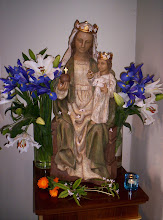
In Hobart, in North Hobart - just past the end of the restaurant strip there with its scattering of Italian and other eateries - is the little church of San Carlo, built for the use of the Italian migrant community by the Scalabrinians, I believe, who initially manned that apostolate. There is no longer an Italian Mass there, as owing to the shortage of clergy in Tasmania, let alone of those able to speak Italian, the Cathedral Administrator had to bring it to an end a few years back. The church itself features a kitsch interior, with light bulbs arrayed in haloes around statues of Our Lady and the Sacred Heart, and potplants of the large- and waxy-leaved variety in the very sanctuary - plus a most alarming statue of San Carlo, St Charles Borromeo that is, complete with absolutely enormous nose!
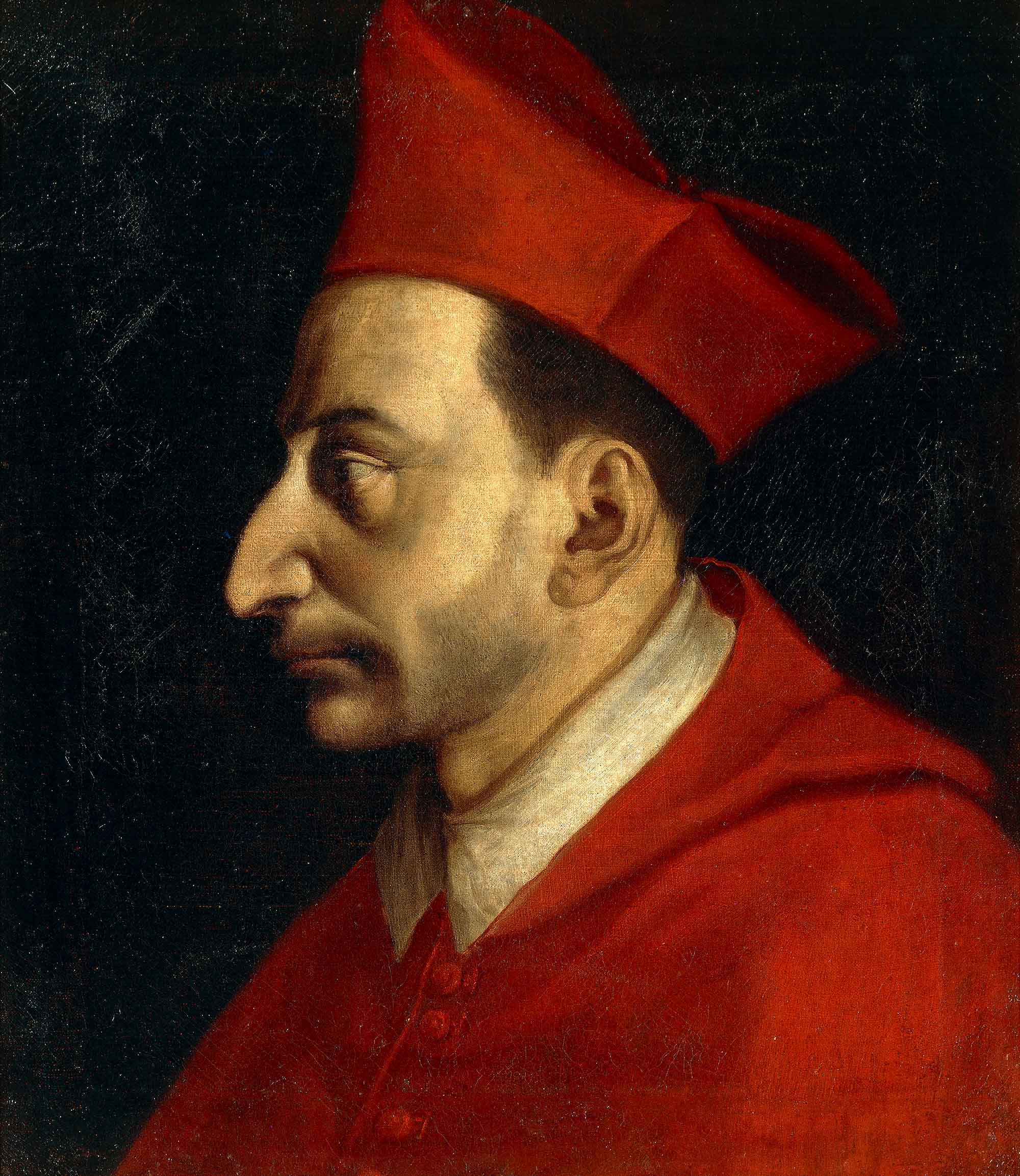
St Charles, of course, is notable not for his proboscis (which was indeed huge, as all portraits of him and his very
deathmask confirm) but for his life (1538-1584). At the very period when the Protestant Reformers were destroying the Church and men's souls - including their own - by spreading heresy, schism and degrading moral license, St Charles and others like him launched the Counter-Reformation that saved the Church and won the salvation of souls - including their own - by preaching orthodoxy, true reform and uplifting moral rectitude, following the clarion call of Trent.
He was intially almost a caricature of a nepotistic appointment - his uncle was the Pope, and a Medici Pope at that (Pius IV), he was made Archbishop of Milan at a very young age, and amongst other things presided over a session of the Council of Trent while still only a deacon! But he "got religion" and, to the consternation of his Catholic but still not quite reformed relative the Supreme Pontiff, insisted on actually taking up residence in his archdiocese, rather than living off its revenues in Rome. Once he arrived in Milan, his indefatigable labours there so restored and improved every aspect of the Church in that city that he became her most influential Pontiff since St Ambrose, and won the admiration of all hearts, even his detractors.
St Charles was the friend of many saints (such as St Philip Neri, to whose care he commended his nephew Frederick, who himself became Archbishop of Milan after his decease, founding there the famous Ambrosian Library). As the friend of saints, he lived and died a saint himself, possessed of heroic virtue: he confessed twice a day, and during plague outbreaks did not merely stay in the city to assuage the needs of the suffering, but even went in procession supplicating God's mercy, even scourging himself as a victim to appease the outraged Divine Justice.
Borromeo revised (not altogether happily) the native liturgy of Milan, the Ambrosian Rite, giving it the form it held until recent reforms in imitation of the unfortunate changes made to the Roman; happily the Traditional Ambrosian Rite is still used in some places. He held many synods and issued pastoral letters for the reform of the Church and clergy, and the propagation of good doctrine and morals as Trent demanded; the modern Divine Office twice gives extracts from his pronouncements as second readings - for to-day, his feast, the 4th of November (on which day his feast has been held since its introduction to the general calendar in 1613, only three years after his canonization and less than three decades after his holy death); and for Monday of the first week of Advent. Both passages are first-rate; I subjoin extracts from the first of them, leaving the other for the 1st of December:
We are all morally weak, I admit it. But God has given us the means by which we can easily find the help we need, if we want to be helped. ...
Shall I tell you how to go from strength to strength (Ps 83:8)? You have managed, let us say, to be attentive for once in choir: how are you going to be more attentive next time and make your service more pleasing to God? I will tell you. The tiniest fire of divine love has been lit in you, has it? Then do not rush to make a parade of it. Do not take it out into the icy blast. Keep the furnace door shut on it so that it does not die out. In other words, fly from avoidable distractions, keep your mind fixed on God, keep away from idle gossip.
...
Brothers, do understand this: there is nothing quite so necessary to all churchmen as mental prayer, prayer that paves the way for every act we do, that accompanies it and follows it up. The psalmist says: 'I will sing and I will understand.' (Ps 100:1-2) Brother, when you administer the sacraments, try to understand what it is you are doing. When you celebrate Mass, consider what it is you are offering. And, singing in choir, remember to whom you are speaking and what you are saying to him. ... Let all that you do be done in love (I Cor. xvi, 14). In this way we shall easily overcome the thousand and one difficulties that necessarily beset us every day (such is the world we live in). And, lastly, in this way we shall find the strength to bring forth Christ in ourselves and in others.
(Sermon of St Charles at his last synod)
A bishop of my acquaintance once told the tale of how, while yet a student in Rome, and in great distress about an impending exam, he (being the sacristan for the time being, and so having a key to the safe) went to the sacristy at his Roman college, and with devout boldness took out a prize reliquary containing the heart of San Carlo, and, in his own words, "venerated the pastoral heart of St Charles Borromeo". This confessed act of relic-worship greatly stunned and I think secretly impressed his hearers: and it is one reason why I consider him a good bishop, because in his piety he has at once such a supernatural outlook and a true devotion to what is actually pastoral, not just seemingly so, after the model of this light of the Counter-Reformation, ornament of the Council of Trent, and examplar bishop of his age.
And so, finally, to the collect, so apt in the light of all these considerations:
Ecclesiam tuam, Domine, sancti Caroli Confessoris tui atque Pontificis continua protectione custodi: ut, sicut illum pastoralis sollicitudo gloriosum reddidit; ita nos ejus intercessione in tuo semper faciat amore ferventes. Per...
(Thy Church, Lord, by St Charles Thy Confessor and Pontiff's continual protection guard: that, as by his pastoral sollicitude glorious Thou didst render him, so may we by his intercession be ever made fervent in Thy love. Through... )
The Seminary here in Perth is named after St Charles, as his was one of the first model seminaries to be established in accord with the Tridentine decrees; while this local establishment appears rather run-down and ill-run (compared, say, with those in Melbourne, Sydney or Wagga Wagga), with so great a patron one may have confidence in all its inmates who seek the Lord (fides quærens intellectum) and attend to the illuminations and inspirations of the Holy Ghost - they are, in the words of the late great Pope John Paul II, the principal agents of their own formation (cf. Pastores dabo vobis, n. 69), but ever in obedience to the same Holy Spirit, the true Agent Who seeks to create a new and pastoral heart in His chosen instruments as shepherds after the Good Shepherd and His Sacred Heart (cf. ibid., nn. 1, 33 & 69).