Showing posts with label Christmas Novena. Show all posts

Wednesday, December 12, 2012

Advent Baroque Canticle III

The Baroque, and Advent – what more could you want?  (I am reminded of Bach's Christmas Oratorio, Lutheran though it be, with all its joyful exhuberance and high art, consummating the hoped-for longings of Advent, and of the earlier but just as joyful – and Lutheran – church music of Prætorius.)
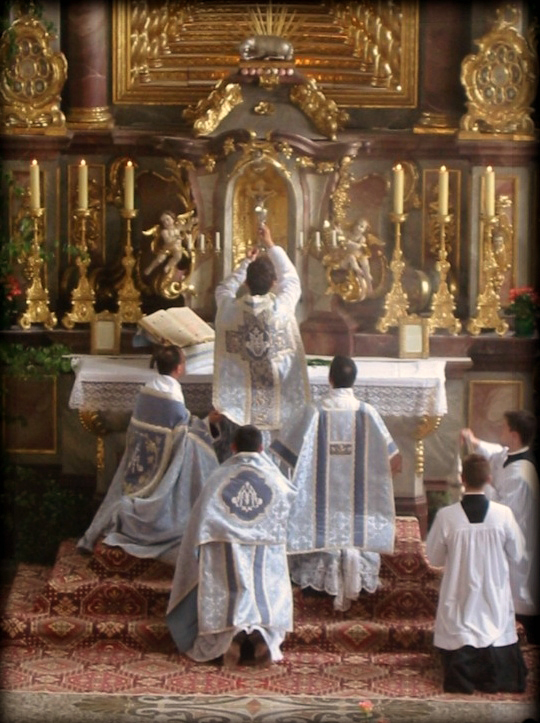

The elevation of the chalice, in Baroque style, at a first Mass (note assistant priest in cope);
by the Priestly Fraternity of Saint Peter, available from http://fssp.org.

The Christmas Novena first sung in Turin in 1720 began with the following canticle; then came the Lætentur cæli and Little Chapter, before the hymn En clara vox (itself consisting of stanzas 1 and 3 of the Advent Lauds hymn, stanzas 2, 3 and 4 of the Christmas Lauds hymn, and a doxology) and the Magnificat with the appropriate O Antiphon (but on the 16th, the Magnificat antiphon Ecce veniet Rex, from the 2nd Monday of Advent, and on the 24th, that day's Magnificat antiphon Cum ortus fuerit). I visualize the whole sung coram Sanctissimo, as would be most fitting. It is clearly a sort of reënvisioning of Vespers, but incorporating many treasures from throughout the Office.

This Canticle is in fact a combination of the Advent Invitatory antiphon of Advent Matins, combined with many Old Testament texts, "prophecies", as digested and recombined to form antiphons and responsories in the Breviary during Advent. I have highlighted any slight modifications made to these texts in order to fit.  (I have appended a hasty translation.)

******

INVITATORIUM

Antiphona. “Regem venturum Dominum, venite adoremus.”[1]
et repetitur antiphona: Regem venturum Dominum, venite adoremus.

PROPHETIÆ
[Composed by Fr Antonio Vacchetta, 1720]

1. “Jucundare, filia Sion, et exulta satis, filia Jerusalem”[2]: “ecce Dominus veniet, et erit in die illa lux magna”[3] et “stillabunt montes dulcedinem, et colles fluent lac et mel,”[4] quia “veniet Propheta magnus, et ipse renovabit Jerusalem.”[5]   R/.

2. “Ecce veniet Deus, et homo de domo David sedere in throno,”[6] “et videbitis, et gaudebit cor vestrum.”[7]           R/.

3. “Ecce veniet Dominus protector noster, Sanctus Israël, coronam regni habens in capite suo, et dominabitur a mari usque ad mare, et a flumine usque ad terminos orbis terrarum.”[8]      R/.

4. “Ecce apparebit Dominus, et non mentietur: si moram fecerit expecta eum, quia veniet et non tardabit.”[9]          R/.

5. “Descendet Dominus sicut pluvia in vellus: orietur in diebus ejus justitia, et abundantia pacis, et adorabunt eum omnes reges” terræ, “omnes gentes servient ei.”[10]          R/.

6. “Nascetur nobis parvulus, et vocabitur Deus fortis, ipse sedebit super thronum David patris sui, et imperabit, cujus potestas super humerum ejus.”[11]            R/.

7. “Bethlehem, civitas Dei summi, ex te exiet Dominator Israël, et egressus ejus sicut a principio dierum æternitatis, et magnificabitur in medio universæ terræ, et pax erit in terra nostra dum venerit.”[12]      R/.

[24 Dec.] 
8. “Crastina die delebitur iniquitas terræ, et regnabit super nos Salvator mundi.”[13]        R/.

R/. “Prope est jam Dominus, Venite adoremus.”[14]


******


R/. The Lord is the King soon to come, O come, let us adore him.

1. Be glad, O daughter of Sion, and rejoice heartily, O daughter of Jerusalem: behold, the Lord shall come, and there shall be in that day a great light, and the mountains shall drop down sweetness, and the hills shall flow with milk and honey, for the great Prophet shall come, and He will renew Jerusalem.
R/. The Lord is the King soon to come, O come, let us adore him.

2. Behold, He shall come, God, and man from the house of David, to sit upon the throne, and ye shall behold, and your heart shall rejoice.
R/. The Lord is the King soon to come, O come, let us adore him.

3. Behold the Lord our protector shall come, the Holy One of Israel, having the crown of the kingdom on his head [i.e. the Crown of Thorns He shall wear when going forth to save us by His Passion], and He shall rule from sea to sea, and from the river to the ends of the round world.
R/. The Lord is the King soon to come, O come, let us adore him.

4. Behold, the Lord will come, and will not disappoint: if He delay, wait for Him, for He shall come, and will not be late.
R/. The Lord is the King soon to come, O come, let us adore him.

5. The Lord shall come down as rain on the fleece: justice shall dawn in His days, and abundance of peace, and all the kings of the earth shall worship Him, all nations shall serve Him.
R/. The Lord is the King soon to come, O come, let us adore him.

6. For us shall be born a little One, and He shall be called mighty God, He Himself shall sit upon the throne of David His father, and rule, whose power is upon His shoulder [i.e. the Cross He shall bear, the instrument of man's salvation].
R/. The Lord is the King soon to come, O come, let us adore him.

7. Bethlehem, city of God Most High, from thee shall go forth the Ruler of Israel, and His going forth shall be as from the beginning of the days of eternity, and He shall be magnified in the midst of the earth, and peace shall be in our land when He comes.
R/. The Lord is the King soon to come, O come, let us adore him.

8. To-morrow the iniquity of the earth shall be washed away, and the Saviour of the world shall reign over us.
R/. The Lord is now very near, O come, let us adore him.


[1] Invitatorium, a Dominica I usque ad sabbatum ante Dominicam III Adventus.
[2] Aña 2 ad V. & L., Dominica I Adventus (excl. “alleluja”).
[3] Aña 3 ad V. & L., Dominica I Adventus (excl. “et omnes Sancti ejus cum eo” & “alleluja”).
[4] Aña 1 ad V. & L., Dominica I Adventus (excl. “In illa die” & “alleluja”).
[5] Aña 5 ad V. & L., Dominica I Adventus (excl. “Ecce” & “alleluja”).
[6] Aña ad Bened., Feria VI infra hebdomadam I Adventus (excl. “alleluja”).
[7] *, Responsorium ii, Feria VI infra hebdomadam II Adventus (excl. V/.).
[8] Responsorium i, Feria VI infra hebdomadam II Adventus (incl. V/.).
[9] Aña 3 ad V. & L., Dominica II Adventus (excl. “alleluja”).
[10] Responsorium iii, Feria III infra hebdomadam III Adventus (incl. V/.).
[11] Responsorium i, Feria III infra hebdomadam IV Adventus (excl. V/.).
[12] Responsorium ii, Feria II infra hebdomadam III Adventus (excl. V/.).
[13] Aña 3 ad L., Vigilia Nativitatis Domini.
[14] Invitatorium, a Dominica III usque ad ultimam diem ante vigiliam Nativitatis Domini.

Saturday, December 8, 2012

Another Baroque Canticle


To my own satisfaction at least, I have traced the Advent Prose Rorate cæli to a French Oratorian in the early 16th century; here is another Baroque composition, the Lætentur cæli, part of a Christmas Novena first composed and celebrated in Turin in 1720.  This is a pleasant collection of Advent antiphons, versicles and responsories, some drawn directly from Scripture no doubt, but nearly all dependent upon their use in the Roman Breviary during Advent.  

Apparently it was chanted, as if a psalm, before a "little chapter" – itself taken from the text of a responsory, being an amalgam of Scriptural passages – and then a hymn, leading up to the singing of the Magnificat: it was preceded by another such cento canticle, which I will post about later.  The whole Novena is reminiscent of the usual format of Vespers, but if anything paralleling the Greek tradition of composing troparia, kontakia and the like, based upon Scriptural themes.

I subjoin an English version below.

LÆTENTUR CÆLI
[Fr Antonio Vacchetta, 1720]

1. “Lætentur cæli et exultet terra, * jubilate, montes, laudem.”[1]
2. “Erumpant montes jucunditatem * et colles justitiam.”[2]
3. “Quia Dominus noster veniet, * et pauperum suorum miserebitur.”[3]
4. “Rorate, cæli, desuper, et nubes pluant justum: * aperiatur terra, et germinet Salvatorem.”[4] (Is 45:8a)
5. “Memento nostri, Domine, * et visita nos in salutari tuo.”[5] (Ps 105:4a,c)
6. “Ostende nobis, Domine, misericordiam tuam: * et salutare tuum da nobis.”[6] (Ps 84:8)
7. “Emitte Agnum, Domine, dominatorem terræ, * de petra deserti, ad montem filiæ Sion.”[7] (Is 16:1)
8. “Veni ad liberandum nos, Domine, Deus virtutum: * ostende faciem tuam, et salvi erimus.”[8]
9. “Veni, Domine, visitare nos in pace, * ut lætemur coram te corde perfecto.”[9]
10. “Ut cognoscamus, Domine, in terra viam tuam, * in omnibus gentibus salutare tuum.”[10] (Ps 66:3)
11. “Excita, Domine, potentiam tuam, et veni, * ut salvos facias nos.”[11] (Ps 79:3b)
12. “Veni, Domine, et noli tardare: * relaxa facinora plebis tuæ.”[12]
13. “Utinam dirumperes cælos, et descenderes: * a facie tua montes defluerent.” (Is 64:1)
14. “Veni, et ostende nobis faciem tuam, Domine, * qui sedes super Cherubim.”[13]
Gloria Patri et Filio* et Spiritui sancto.
Sicut erat in principio et nunc et semper* et in sæcula sæculorum amen.

Capitulum

“Præcursor pro nobis ingreditur Agnus sine Macula, secundum ordinem Melchisedech, Pontifex factus in æternum, et in sæculum sæculi.  Ipse est Rex justitiæ cujus generatio non habet finem.”[14] R/. Deo gratias.

******

LÆTENTUR CÆLI


1. Let the heavens rejoice, and the earth be glad, * cry out praise, ye mountains.
2. Let the mountains break forth in cheerfulness, * and the hills, justice.
3. Because our Lord shall come, * and will have mercy on his poor ones.
4. Drop down dew, ye heavens, from above, and let the clouds rain the Just One: * let the earth be opened, and bud forth the Saviour.
5. Remember us, O Lord, * and visit us with thy salvation.
6. Shew us, O Lord, thy mercy: * and grant us thy salvation.
7. Send forth, O Lord, the Lamb, the Ruler of the earth, * from Petra of the desert to the mount of the daughter of Sion.
8. Come to deliver us, Lord, God of hosts: * shew us thy face, and we shall be saved.
9. Come, Lord, visit us in peace, * that we may rejoice before thee with a perfect heart.
10. That we may know, Lord, thy way on earth, * among all nations, thy salvation.
11. Stir up thy might, O Lord, and come: * that thou mayest save us.
12. Come, Lord, do not delay: * forgive the sins of thy people.
13. O that thou wouldst rend the heavens, and wouldst come down: * the mountains would melt away at thy presence.
14. Come, and shew thy face to us, O Lord, * who sittest upon the Cherubim.
Glory be to the Father, and to the Son: * and to the Holy Ghost.
As it was in the beginning, is now, and ever shall be: * world without end. Amen.

Little Chapter:

The forerunner doth enter for us, a Lamb without blemish, according to the order of Melchisedech made a high priest for ever, and for ages of ages. He himself is the king of justice, whose generation hath no end. R/. Thanks be to God.


[1] ex Resp. ii, F. II infra hebd. I et II Adventus.
[2] ex Resp. ii, F. III infra hebd. I et II Adventus.
[3] ex Resp. ii, F. II infra hebd. I et II Adventus.
[4] Introitus, F. IV Quatuor Temp. Adv. & Dom. IV Adv.; Aña 1, Feria III ante vigiliam Nativitatis; V/. ad Vesp., Temp. Adv.; V/. ex Resp. i, F. III infra hebd. I et II Adv.; ex Resp. ii, F. VI Quatuor Temp. Adv.
[5] abbrev. V/. ad Sextam, Temp. Adventus; abbrev. V/. ex Resp. ii, F. IV infra hebd. IV Adv.
[6] All. V/. Dom. I Adv.; ex Grad., F. VI Quatuor Temp. Adv.; R/. br. ad Sextam, Temp. Adventus; V/. ex Resp. i, F. VI Quatuor Temp. Adv.; ex Resp. ii, ibid.
[7] Aña 2, Feria III ante vigiliam Nativitatis; V/. ad Mat., Dominica, F. II et V, Temp. Adv.
[8] R/. br. ad Tertiam, Temp. Adventus.
[9] Aña ad Magn. ad I Vesp. Dom. II Adventus.
[10] Aña 3, Feria III ante vigiliam Nativitatis.
[11] All. V/. Dom. III Adv.; V/. ex Resp. iii, Sabbato Quatuor Temp. Adv.; V/. ex Grad. iii, Sabbato Quatuor Temp. Adv.; ex Grad. iv., Sabbato Quatuor Temp. Adv.; V/. ex Tractus, Sabbato Quatuor Temp. Adv.
[12] V/. ad Nonam, Temp. Adventus; abbrev. Aña 3, F. VI ante vigiliam Nativitatis; ex Resp. iii, Sabbato Quatuor Temp. Adv.; abbrev. All. V/., Dom. IV Adv. (NB “plebis”, not “plebi”.)
[13] Introitus, Sabb. Quatuor Temp. Adv.
[14] Resp. ii, Feria V infra hebd. III Adventus.