Wednesday, January 28, 2009

More on the Little Office


The Little Office seems to be making a comeback, I'm glad to say.

Amusingly, it is if anything slightly longer than the present-day Divine Office!  (A friend of mine acidly refers to the latter as "the Little Office of Vatican II" - but don't get me wrong, I used the modern Liturgy of the Hours for over a decade with much profit.)

Why, then, is it termed the "Little" Office?  Well, for a start, it is in large part invariable, as opposed to having many changeable texts.

In place of the nine psalms of Matins in the Breviary, it takes the three Nocturns of Matins of the Common of feasts of the Blessed Virgin, and ordains that only one Nocturn, that is, three psalms, shall be said each day.  This is the biggest difference between the Little Office and the Daily Office.  Now, on average, Matins in the Breviary has 115 psalm-verses (exclusive of the Invitatory Psalm), and Matins for feasts of Our Lady has 108, so that there is virtually no difference in length until it is realized that only one-third of this is read on any given day in the Little Office, so Matins therein has only 36 psalm-verses on average.  I must say that praying one's way through nine psalms is no joke, and that three only is a real relief.

As for the lessons at Matins in the Little Office, well, they are taken from Ecclesiasticus xxiv; now, during the fifth week of August the Breviary takes its Matins Lessons from Ecclesiasticus, and on average reads 16 verses of a chapter each day.  The Little Office only reads the whole or part of nine verses of Scripture (Ecclus xxiv, 11b-13 then 15b-16 and 17-20) in its three Lessons, except in Advent and on the 25th of March, when it reads the thirteen verses of the Gospel of the Annunciation (St Luke i, 26-38).  Thus it is that the Lessons read are shorter than their counterparts in the Breviary, perhaps even 50% shorter.  Otherwise, Matins has the same structure and contents in both forms of the Hours.

Lauds in the Little Office is identical in psalmody of Sunday in the Breviary (Psalms 92, 99 and 62, the Benedicite from Daniel iii, and Psalm 148), since for all feasts, including Marian ones, the Sunday psalms are used: and the tally of 56 psalm-verses is virtually that of the daily Office at Lauds (which has 58 on average).  The structure of Lauds is otherwise preserved exactly as in the Breviary, just as one would expect for a feast of Our Lady.  Here it is well to note that until the reforms under St Pius X, three more psalms were read at Lauds: Psalm 66 was added to Psalm 62 under one Gloria Patri, and Psalms 149 and 150 were likewise added to Psalm 150 - indeed, these three last were used daily at Lauds, and gave it its very name from their continual repetition of Laudate.  These three psalms had an additional 20 psalm-verses, but they were deleted from the Little Office also, presumably to keep it closely parallel to the main Office as in the Breviary, lest the Little be longer!

The Little Hours (in this usage, Prime, Terce, Sext, None and also Compline) are about the same in structure in both the Daily and the Little Office, to a first approximation, but remembering always that Prime de Beata (of Our Lady) lacks the so-called chapter office, that is, the second part of Prime also named after its versicle Pretiosa., and likewise Compline de Beata lacks the prefatory officium collationis, which is the short reading (I St Peter v, 8-9) then Confiteor and so forth acting as a penitential rite.  (There would be nothing to stop someone prepending and appending these if they desired and had the relevant texts, of course; if ever the Breviary and the Little Office are read together, one reads Prime down to before Pretiosa, then inserts Prime of the Blessed Virgin, then the Martyrology if used, and then continues with Pretiosa and the succeeding prayers.)  However, none of the Marian versions of the Little Hours contains a short responsory (though they do in the Dominican Rite Little Office, of which more anon), and, in a curious parallel to the Benedictine Rite, Compline of Our Lady has no antiphon for the psalms (again, the Dominican version does have one).  Furthermore, the number of psalm-verses read at the Little Hours of the Little Office is as one would expect less than those read on average at the Little Hours in the great or ordinary Office: 
  • Prime of Our Lady has 23 psalm-verses, as opposed to 40 on average in the Breviary;
  • Terce of Our Lady also has 23 psalm-verses, as opposed to 32 on average in the Breviary;
  • Sext of Our Lady has 18 psalm-verses, as opposed to again 32 on average in the Breviary;
  • None of Our Lady has 21 psalm-verses, as opposed to 36 on average in the Breviary;
  • Compline of Our Lady has 20 psalm-verses, as opposed to 32 on average in the Breviary.
It will be seen that these Little Hours de Beata have in aggregate 105 psalm-verses, the equivalent in the Breviary, 172 - so the former is only about 60% of the latter in length.

Finally, Vespers: in the Little Office, the Vespers provided is the same as Vespers for a Marian feast in the Breviary, and so has 40 psalm-verses, as opposed to the 47 or so that occur on average each ferial day in the main Office.

In sum, the psalmody of Our Lady's Office has about 237 verses each day, while one reading the psalms of the Roman Breviary gets through an average of 392: so the Little Office is only 60% of the Daily Office in length - hence its name.  Even if (as pro pia devotione one could augment the appointed Nocturn at Matins with the other two) there were all nine psalms read daily at Matins of the Blessed Virgin, the total would still fall short of the Breviary and have only 309 psalm-verses, about 80% of the latter's tally.  (And the three former psalms at Lauds make little difference if included also.)

While beyond the scope of what I've written here, it is noteworthy that the older religious orders had their own recensions of the Little Office; the Carthusians still retain in use the Office of the Blessed Virgin Mary, which is certainly not "Little" - containing all the pre-Pius X psalmody of Lauds, and at Prime through to None praying first Psalm 53, then all of Psalm 118!  Their Marian Compline, too, is longer, being the same length as ordinary Compline.  

Indeed, all the dioceses of mediæval Europe had varying local forms of Our Lady's Hours...

Baronius Press Little Office Misprints

I say at the outset that Baronius Press has produced a handsomely bound, gilt-edged volume of The Little Office of the Blessed Virgin Mary, noteworthy especially for supplying the Gregorian chants proper to it.

That said, it does have a large number of misprints...

(I also have a reprint edition, issued by Carmel Books in 1997, of the 1914 R. & T. Washbourne version that Baronius Press seems to have made use of - although in ways the Carmel Books reprint is, I would argue, superior, at least in having far fewer mistakes.)

To be fair, they themselves noted two of the worst misprints, since they supplied an insert which substitutes for pages 67 and 114, as these pages had the wrong hymns supplied.

If only they had done the same for pages 86-8 and 112f, since they have stuffed up the last psalm at Lauds for Advent and Christmastide by substituting the Christmas antiphon Ecce Maria for the Advent antiphon Ecce ancilla, and vice versa!  This is a really flagrant and serious fault, which I am sorry to find.

At Matins (p.3), no rubric is supplied to say that one kneels for the words venite, adoremus, et procidamus ante Deum - though in the text with chant on page 136, these words are in small capitals as if to allude to this.

Speaking of the chant, the publishers have thoughtfully supplied much - but not the psalm-tones needed for chanting the psalms themselves: so a Liber or such would still be needed.  Similarly, the chants for the Absolution, Benedictions, Lessons and Little Chapters are needed (probably just a model formula for the last three items, as they've supplied for the Collect).

Very annoyingly, and most incorrectly, the collect at Lauds on pages 25, 37 and 91 has been supplied with the short ending Per Christum... instead of the long ending Per Dominum...; and indeed it is frustrating to see how throughout the Little Office, the long endings are hardly ever spelled out - to find the full version of Per Dominum..., one must turn to page 159f, and to page 117 for Qui tecum..., while Qui vivis... seems completely missing (except in the short version, for a collect in honour of St Joseph in an appendix).  Through long attendance at Mass and long use of the Office, I know these forms; but someone coming new to this book would find it stressful and confusing to have to search endlessly for these conclusions.

To pick further, on page 71 in the English ", &c" is superfluous; and ditto for "Who liveth, &c." and "Qui vivit, &c." on page 74, since the collect Deus qui salutis has a nonstandard short ending, or rather no normal ending at all.  Conversely, on pages 50 and 103 the abbreviation ", &c" ought be inserted at the end of the collects.

(There is also a very minor misprint on page 152: pulehra instead of pulchra.)

I think I should email Baronius Press about this - they will need to fix these mistakes in the second edition.

UPDATE

Another set of very annoying misprints!

Baronius Press has confused the little chapter, versicle and collect at None during Advent with that of None during Christmastide, so the little chapter, versicle and collect on page 94f are really those for page 120f, and vice versa.

And unforgiveably, their errata insert has its own erratum! - the little chapter supplied for Lauds on page 114 and on the substitute page 114 is wrong, and should be that on page 34.

Books, Books, Books

I'm sitting looking out over the city, with two piles of books in front of me, books that I acquired in Melbourne.  It worries me to think how much I've spent, but I think I ought tote it up:
  • Compton Mackenzie, Sinister Street [a good novel that a certain bishop first lent me a copy of many years ago] - $7;
  • Ordo 2009 [Australian, for the Ordinary Form] - $10;
  • The Little Office of the Blessed Virgin Mary [Baronius Press, with lots of misprints about which I'll blog!] - $42.95;
  • Stephen Wang, A Way of Life for Young Catholics - $6.95;
  • The Coronation Service Westminster Abbey 12 May 1937 - a gift;
  • Christopher Knetes, Service for the Consecration of an Eastern Orthodox Church (Sydney, 1927) - $14;
  • The Essential Erasmus - $7.50;
  • W.H.C. Frend, Martyrdom and Persecution in the Early Church - $6;
  • Butler's Lives of the Saints, Volume XII (December) [handsomely bound, with an inscription dated 1894] - $30;
  • Irma Zaleski, The Way of Repentance - $8 (plus another copy given to a friend);
  • Richard Harries, Art and the Beauty of God - $12;
  • George Maloney, Mary: The Womb of God - $7;
  • Frederick Faber, The Blessed Sacrament or the Works and Ways of God (London, 1856) [I'll have to get this book seen to: the front cover is loose; the inside page, also loose, has the inscription "Presented to his Grace the Archbishop by his grateful and dutiful Daughters of Subiaco Feast of the Dolours of the Bd Virgin April 15th 1859" - and there is also a stamp in the book "Library Sydney Society of Jesus", which makes me surmise that this book was presented to Archbishop by the religious sisters he founded, and later was given to the Jesuit Fathers] - 50¢;
  • Adam Cooper, Life in the Flesh: An Anti-Gnostic Spiritual Philosophy - $99 [I had to buy it, especially as this was its sale price at the booklaunch, a substantial discount!];
  • St Thomas Aquinas, Summa Theologiæ, Volume 40 (2æ2æ. 92-100): Superstition and Irreverence [part of the prized Gilby Summa] - $14;
  • Lancelot Sheppard, Barbe Acarie: Wife and Mystic [about Bl Mary of the Incarnation, O.C.D.] - $10;
  • Denis Murphy, The Sacristan's Manual (London, 1950) - a gift;
  • St Thomas Aquinas, Summa Theologiæ, Volume 9 (1a. 50-64): Angels [another part of the prized Gilby Summa*] - $20;
  • St Alphonsus Liguori, The History of Heresies and Their Refutation (Dublin, 1847) - $7;
  • Stainer, The Crucifixion [full music edition of this sacred oratorio, the CD of which I already have] - $20;
  • The National Eucharistic Congress, Melbourne 1934 [includes photograph of the final Eucharistic Benediction given outdoors to a crowd of over half a million] - $20;
  • The Spectator, 17 January 2009 [Australian edition; I read this at the airport and while flying home] - $6.95.
[* The same bookshop had volumes VIII and X also, but I'm not so interested at present in the niceties of Creation ex nihilo nor in Cosmogony according to the classic schema of the Hexaëmeron, the work of the Six Days, plus I had a feeling that I was getting low on money.]
Well, there's $347.85 spent! - but on 22 books and suchlike; none of which, barring Dr Cooper's learned work, and to a lesser extent that Baronius Press Little Office, was as dear as a new book ordinarily is these days; so the average cost was only about $16 each.  Now, to reading...

It's a worry, being a bibliophile - and to think that Camberwell Books were closed, and I didn't manage to find my way back to a good bookshop in Nicholson Street late yesterday, nor did I visit the John XXIII Fellowship Co-op (if it still exists).

Of making many books there is no end - Ecclesiastes xii, 12.

******

I must also record special thanks to my friend, and sometime lecturer and employer, Dr Rowland at the J.P. II Institute, who kindly gave me some photocopies of recent articles she's written:  "A Catholic Appropriation of Romantic Themes" in How Balthasar Changed My Mind (pp. 191-208); "Variations on the Theme of Christian Hope in the Work of Joseph Ratzinger/Benedict XVI" in Communio 35 (Summer 2008), pp. 200-220; and "Una Fragile Icona: L'Amore tra Uomo e Donna" in Il Logos dell'Agape (pp. 89-98) - Tracey very flatteringly said, Well, you can read Latin, so ditto for Italian!  Gulp.

******

On an allied note, I've also been looking about in antique shops here and just recently in Melbourne for a nice standing metal crucifix, of the sort one used to find on sacristy benches, scholars' desks, and altars - but where now to find one?

Monday, January 26, 2009

Quick Melbourne Update

My Melbourne friends and acquaintances tell me that sometimes they fear catching up, since I may report all too much of their goings-on and gossip on this blog!

Well, if I were so anodyne that I said nothing, I can't see why I'd bother to write anything, nor why anyone would bother reading whatever I did write... upon beginning this blog, I resolved to write whatsoever I pleased, without regard to human respect (well, maybe not entirely) or literary style; so take it or leave it.

Enough of apology. I'll proceed with a quick posting en passant. To summarize:

I've done a bit of secondhand bookbuying, which has turned up some interesting items; I've met up with friends, gone up-country to Hanging Rock (which I'm told in its rocky fantasia bears some resemblance to Mt Sinai in miniature), and attended liturgies and speeches; and have had a very pleasant time.

In particular, it was good on Sunday morning, having made my customary weekly confession at the Burke Hall chapel, to attend the Divine Liturgy for Sunday in the Octave of the Theophany at the Russian Catholic chapel of St Nicholas, Alexandra Parade, Fitzroy. Since it was the last Sunday of the month, the liturgy was in English (but for some litanies), and the singing, icons, sacrament and ritual lifted me up into the heavenly realm: I'm a Roman Rite person, but find the Byzantine wonderful and powerful. Archpriest Cross preached with deep insight; I particularly liked his opening point, not to leave aside a text of Scripture till one has grasped its ethical content (the tropological sense, I think). More on his sermon later...

Dr Adam Cooper's booklaunch, and Bp Prowse's two speeches, one to launch it, the other previous to open the national colloquium of Catholic bioethicists, were really noteworthy. Again, hopefully I'll say a bit about it when I have more time.

I hear (scary, isn't it, to have been away from the computer for four days and so not to know what's going on) that His Holiness the Pope has quashed the excommunications of the four Lefebvrite bishops, and that - predictably, but rather missing the point of the reason for doing so, that is, to try and persuade the SSPX to be reconciled to the Church - some interested parties among our friends the Jews are annoyed that one of them is a Holocaust denier, striking them not unsurprisingly as being distastefully anti-Semitic, and yet has received this Papal indulgence; as if it's any of their business to comment on this, as this is being undertaken to heal a schism or suchlike rather than to give any credence to eccentric and unpleasant views, although of course they can hardly be delighted at the news from their perspective.

Many thanks to a pious Anglican, who I believe wishes to remain anonymous, for her very generous gift to me of a liturgical manual: may you be rewarded a hundredfold!

Wednesday, January 21, 2009

Off to Marvellous Melbourne

The Glorious See of Melbourne, most populous bishopric of Oceania, is my destination: unfortunately I fly thence perforce on the 6.15 am flight to-morrow, and will return late Tuesday.

Friends and fellow bloggers, don't forget that David Schütz and I invite all to a get-together on Sunday at 5.30 pm at the statues of SS Francis and Clare by the Cathedral before dining at a still to be announced destination, and then attending Dr Adam Cooper's booklaunch at A.C.U.

I'll be attending Mass at St Aloysius, North Caulfield, especially on Sunday of course, and also for the Solemn Requiem on Monday in supplication for the soul of Fr Tattersall's recently-departed father.  (Please pray for him.)

On Saturday, I'm planning to drive up country to Kyneton and Hanging Rock, a favourite spot of mine...


Spare a prayer for safe travel.

Dominican Breviary: Smaller but Longer!

While going for a walk into town, having some coffee and chocolates over the newspaper, and then doing the circuit of the Gorge, and going to the gym, I was idly thinking about whether it would be more convenient to take my 1962 Dominican Breviary with me on my impending trip to Melbourne, rather than my bulky F.S.S.P. reprint of the 1962 Roman Breviary.

However, upon reflection, I realize that, though the Breviarium S.O.P. is a nice small volume in comparison with my Breviarium Romanum, the Office given in the former is actually slightly longer than that in the latter!

How so?

Well, these items are either special to the Dominican Rite Office, or are longer than their Roman equivalents:
  • The last, that is, the 3rd (or 9th) Responsory of Matins, immediately before the Te Deum, which is absent from the Roman (since the Te Deum is considered to take its place)*;
  • The so-called versus sacerdotalis immediately before the opening Deus in adjutorium of Lauds*;
  • When the ferial Office is said outside of Christmastide and Paschaltide, at Lauds, Terce, Sext, None, and Vespers, the preces are read - a triple Kyrie, and the Pater noster (said secretly until the last versicle and response) - which in the 1962 Roman Office were only said rarely at Lauds and Vespers, albeit with about twenty added versicles;
  • At Pretiosa, the reading (either from the Gospel of the day, or from the start of St John's Gospel, or from the Rule of St Augustine) is somewhat longer than the Roman lectio brevis, and it is followed by a curious combination of a short  versicle in commemoration of the dead, followed by Psalm 116 (Laudate Dominum omnes gentes) with doxology, versicles Ostende nobis and Dominus vobiscum, then the collect Actiones nostras (with the short ending), plus - if the anniversary of the death of a Master of the Order, or a general anniversary occur - Psalm 129, the De Profundis, with versicles and Collect;
  • At Prime, after the versicle Exsurge, the proper Dominican short Confiteor and longer Misereatur;
  • At first Vespers of a feast, or of a Sunday when a new series of historia (Matins responsories) is to begin, after the capitulum a long responsory follows*;
  • At Compline, after Our Lady's Salve Regina, versicle and collect, likewise the O lumen Ecclesiæ with versicle and collect are next included in honour of Holy Father Dominic, the Apostolic Patriarch of his Order.
Whereas these items are missing from the Office of the Friars Preachers, or exist only in a shorter form therein:
  • The Dominican Breviary lacks the so-called Absolution(s) inserted in the Roman Office after the Lord's Prayer between the Psalms of Matins and the Blessing before the first Lesson of (each, or the only) Nocturn*;
  • The Lessons at Matins are slightly shorter than the Roman, though it would take too long to quantify this;
  • On feasts at Vespers, and even sometimes at Lauds, all the psalms are said under only one antiphon (which only happens in the Roman Office at Eastertide);
  • At Pretiosa (the capitular or chapter Office, which the Dominicans could read after either Lauds or Prime), the Gloria Patri before the prayer Dirigere is absent (though it occurs further along, see above), that prayer is shorter, and there is no Benedicite nor Dominus nos benedicat...æternam;
  • At Compline, the shorter Dominican Confiteor and longer Misereatur are read - but there is no Indulgentiam, nor even its Dominican equivalent the Absolutionem.
(* These marked points were quite common in mediæval versions of the Office throughout Europe.)

In conclusion, weighing up the pros and cons, it would seem that, contrary to what one would imagine, the daily Office according to the Dominican Rite is slightly lengthier than the equivalent according to the Roman!

(The Dominican tradition is instead to sing the Office with quite some dispatch, unlike the more drawn-out Benedictines, let alone those deep- and slow-chanting Carthusians.  St Dominic, in order to encourage the brethren, used to run from one side of the choir to the other, crying Fortiter, fratres, fortiter.)

I think I will take with me my Breviarium Romanum after all...

Tuesday, January 20, 2009

SS Fabian & Sebastian

I was delighted - having visited an old retired priest I know, had a good chat with him, and made my confession since he's a wise and experienced and consoling confessor - to read in Matins of this feast the hymn Christo profusum sanguinem, especially its last stanza:

Te nunc, Redemptor, quæsumus,
Ut Martyrum consortio
Jungas precantes servulos
In sempiterna sæcula.  Amen.

(Thee, now, Redeemer, we beseech,
That to the consort of Martyrs
Thou join Thy praying servants least
Throughout sempiternal ages.  Amen.)

I was also taken by the lessons at Matins (from II Corinthians v, 1-15) which says so much about our hope in Christ, that our mortality put on immortality, that after our earthly tabernacle be dissolved, we find a heavenly one, that death be swallowed up in life, and so whether we live or die, we seek to please the Lord, for before His dread tribunal we shall all appear, to give an account of all we have done in the flesh, whether it be good, or bad.  Therefore, we hope to have a right fear of the Lord, and are persuaded that, since One died for all, all are dead, so to speak, meaning that we who live ought live no longer for ourselves, but for Him who died for us and rose again.

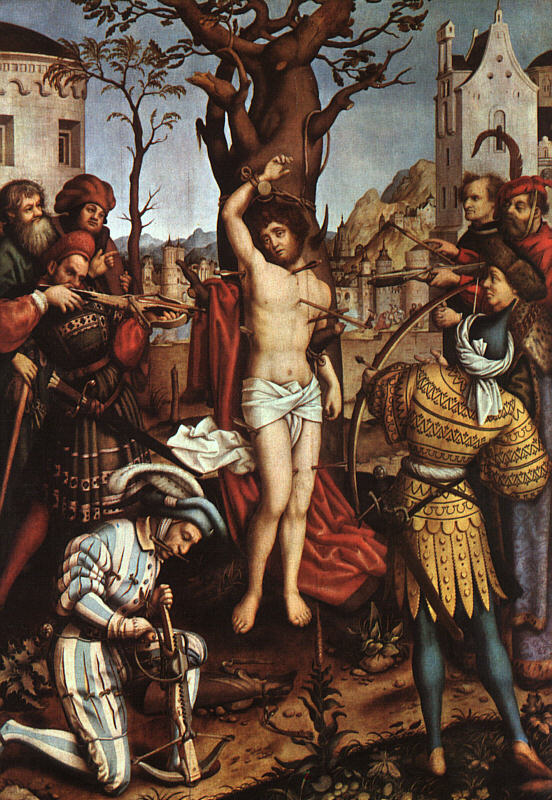
This day we commemorate two more heroes of the Faith, two more champions of the persecuted Church, Pope Fabian - crowned with martyrdom in the persecution of Decius - and that noble soldier Sebastian, invincible even to the arrows shot into him, which he bore unstintingly for the love of Christ, to the confutation of wicked Diocletian.


(Since the surname of my fellow-blogger David Schütz signifies "an archer", perhaps he ought hold St Sebastian the Martyr as a patron saint?  As a blogger hosting - or is it being parasitized by? - many commenters, he may sometimes feel like St Sebastian...)

Finally, the Collect caught my attention:

Infirmitatem nostram respice, omnipotens Deus: et, quia pondus propriæ actiones gravat, beatorum Martyrum tuorum Fabiani et Sebastiani intercessio gloriosa nos protegat.  Per...

(Look upon our infirmity, almighty God: and since we are weighed down by our own acts, may the glorious intercession of Thy blessed Martyrs Fabian and Sebastian protect us.  Through Our Lord Jesus Christ, Thy Son, Who with Thee liveth and reigneth in the unity of the Holy Ghost, God, world without end.  Amen.)

I thank God for His saints, who are such by His grace, for He is pleased by their intercession before His Face, He is pleased to grant their prayers, which He had resolved to grant, whom He had resolved to save, since before the foundation of the world.  All glory to Him for ever: God is glorified in His saints.  And we make this prayer, and hope for its granting only through our Mediator, Christ Jesus, the Saint of Saints because the Holy One, the Son of God, Who is both Man and God, and alone reigns with the Father and the Holy Spirit in perfect Trinity.

Matins were said late to-day, as I've alluded; and in fact only ended in the midst of my efforts at cookery: to-night, I'd resolved, we were to have roast duck, in fact duck à l'orange; what a pity the gravy didn't turn out!  The duck was nice, though, with well-crisped potatoes roasted in goose fat and some plain silver beet to accompany it.  It's been a hot day, and I've been in the kitchen for hours!  At least the bottle of shiraz (a $7 cleanskin bought for cooking) washed everything done - for as is the chef's prerogative, I drank every drop except for the half-glass actually needed for the dish...

Furthermore, there's soup for to-morrow (made of leftover celery plus some leeks) and a quarter of duck too.  So we won't starve.

Monday, January 19, 2009

A Slip at Sext

When the Sunday Psalms are appointed for Prime and the Little Hours, that means in large part - literally - the reading of Psalm 118 (Beati immaculati in via), that hymn to righteous obedience, divided into eleven parts*.  Now, for some time now I've been making what seemed a mysterious mistake: at Sext, once I'd read the first verse of Psalm 118 part viii, I'd turn the page, expecting to say Septies in die laudem dixi tibi... (Ps 118:164) but find a different verse instead - for that line doesn't crop up till None, when it is the fourth verse of Psalm 118 part xi.  

Why this weird error?  Well, it wasn't until I'd been tripped up by this confusion several times that afterward I went back to see why this was tricking me, and found that the verse I'd just read at Sext was Iniquos odio habui: legem tuam dilexi (Ps 118:113), whereas at None the verse actually preceding Septies is Iniquitatem odio habui, et abominatus sum: legem autem tuam dilexi (Ps 118:163) - it turns out the verse at Sext is almost identical to the one at None, hence my mistake.

(* At Sunday Prime, the first psalm to be said is Psalm 117, appropriately enough of course, whereas at festal Prime it is Psalm 53, and thereupon one begins Psalm 118 parts i and ii; I've long thought that, owing to its twin themes of sunrise and of love for God's Law, it would be good to instead begin Prime with Psalm 18, as has in fact been used at Prime on Monday since St Pius X's reform of the distribution of the Psalms in the Breviary.  I remember when making a retreat at Tarrawarra Abbey taking a very long walk, with a psalter in hand, and reading Psalms 18 and 118 in one go...)

The White-robed Army of Martyrs Praise Thee

To-day we make commemoration of yet another group of martyrs - SS Marius, Martha, Audifax and Abachum - who bravely confessed the Faith even unto death under Diocletian (whose name is on every page of the Martyrology - but he is no saint: Mors peccatorum pessima).  

Some time ago I mentioned these noble saints, and I'll repeat what I said: they were a Christian Persian noble family who perhaps unwisely took a holiday in Rome during the persecutions and were nabbed when they went to visit and succour the Christians already languishing in prison!

Furthermore, to their memory is added that of St Canute, King of Denmark and Martyr, slain while praying in church by those who could not abide his zeal for the extension of true religion, and his justice.  His son, Blessed Charles the Good, Count of Flanders, likewise died a martyr under very similar circumstances.  Pretiosa in conspectu Domini mors sanctorum ejus.

Sunday, January 18, 2009

2nd Sunday in Boring Time

Ever since an old acquaintance explained to me the concept of Boring Time, I've never felt like referring to it by any other name.

In any case, by a happy coincidence that even Bugnini didn't efface, the Collect this Sunday is the same as that for the 2nd Sunday after the Epiphany, so I felt rather at home when at early Mass at Carmel to-day; again, Fr Kene was the celebrant, again the nuns sang the Kyrie and Gloria, Sanctus and Agnus Dei in Latin plainchant, and I was able to hear a solid homily, assist at the tremendous Sacrifice, and receive its fruits in Holy Communion.

The other orations of the Mass were also noteworthy; the oratio super oblata was the Secret for the 9th Sunday after Pentecost in the old Missal, and the post communio was the Postcommunion for Friday after Ash Wednesday in the same (changing only tua to una).

In order to the better pray the Mass, I read along in the Latin of Eucharistic Prayer III, which I find orthodox and acceptable, though I wish for the Roman Canon and not some recent composition based on a suggested model by Dom Cipriano Vaggagini, however learned.

Fr Kene preached quite well on the universal vocation to holiness, which is God's perpetual call to each one of us in our state here and now to do His Will by living a moral life and acting as His instruments to call others also to heed the same still, small Voice, just as we ourselves have heard His Call through intermediaries deployed in our path by Divine Providence that we may be saved.  Thus he expatiated on the call of Samuel in I Kings (I Samuel) iii, and its more perfect image in the call of the first Apostles by Our Lord in St John i, 35-42.  In particular, he exhorted us to fly fornication, as St Paul so counsels in I Corinthians vi, 13-20.  

I was amused, let us say, to note that - as Paul VI desired - the passages for the Lesson and the Epistle have been edited to remove the more earthy and distressing verses; which of course are just the lessons we really need!  So God's judgement upon the iniquitous house of Eli are omitted (I Kings iii, 11-18), and the stark words of the Apostle (I Cor. vi, 15b-16):

Shall I therefore take the members of Christ and make them members of a prostitute?  Never!  Do you not know that he who joins himself to a prostitute becomes one body with her?  For, as it is written, "The two shall become one".

The much-vaunted ultra-copious lectionary of the Novus Ordo is I think foolishly bowdlerized.  How stupid, in our oversexed shameless culture!

8th Wonder

On Sunday, the Lord's day, we ought contemplate the magnalia Dei - what great works God hath wrought.

For this reason (amongst others), I paid a visit to that marvel of Van Diemen's Land, the Kimberley Warm Springs - which at 24-25°C may be said to be the last gasp (quite literally) of the vulcanism that has down the ages left its mark all down the Eastern seaboard of Australia, in such relics of past eruptions as the Glasshouse Mountains and lava tubes in Queensland, Mt Gambier with its associated blue lake in South Australia, and mysterious Hanging Rock in Victoria.

Behold the elegant porticos erected for the comfort of weary pilgrims!


For some reason, these springs are not widely known, nor frequented...


... despite the attractive if unusually labelled facilities (note signage to the right).


Their curative properties are legendary, it seems.


I'm afraid my very amateurish action shot does not sufficiently illustrate the roiling cauldron of bubbling sand that lies in the very depths of these springs...


...nor can the lens capture (thankfully), the rather pungent odour (note the pond scum, and see if you can spot the flies hovering).

Those still curious may consult its official entry (and status) in the Australian Heritage Database.

I gave thanks as I departed, once more, the Warm Springs at Kimberley.

Saturday, January 17, 2009

Natural and Supernatural Goods

In the natural realm, my Dad's pleased he's just sold his car for a good sum, and my sister's happy since she's just bought a new house - please pray that she sells her old one!

(It's probably also a natural good that I've resumed gym membership, and having worked out now feel muscles I didn't know I had...)

In the supernatural realm,  I'm glad since I've been to confession this morning, as is my custom now on Saturdays, and feel much the better for it - though I still need to work on my short temper, which let me down as soon as I came home.

Another supernatural good to be celebrated to the glory of God is the graced sanctity of St Anthony the Great, that famous father of monks, about whom I blogged last year...