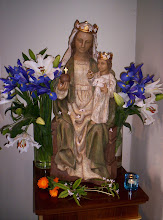
"Nothing rattles the gates of hell / So much as the sound of the Angelus bell.” If for no other reason, then, it must be an excellent devotion! I thoroughly recommend the Angelus, which I've stedfastly prayed for years, thrice daily: morning, noon and night, as the custom is, even when (be scandalized) I've left out my Rosary again. To paraphrase the collect at the end of the Rosary, may we imitate what it contains, and obtain what it promises, for it is a powerful prayer to advance one along the road to salvation.
These following reflections are a kind of lectio divina of the amalgam of Scriptural texts and themes that comprise this beautiful devotion, based on my own consideration of the Angelus over the years.
******
The Riches of the Angelus
Themes of the Angelus
The Angelus is a concentrated summary of the Catholic Faith, for it has many aspects: Marian, Christological, Incarnational, Paschal and Trinitarian.
1. The Angelus is quite obviously a Marian devotion: it consists in large part of three Hail Mary’s, whereby we venerate the Blessed Virgin Mary and ask her to help us by her powerful prayers – first we salute her, then petition her aid. Our Lady appears in her splendid character as the chosen and freely cooperating human agent of God’s saving will: she made possible the incarnation of Christ to save us all, and she still prays for us, that we might attain the salvation He promised.
2. Since Our Lady can never be considered apart from her Son, the devotion of the Angelus is necessarily also Christological in character, because it is centred so fully on the admirable works of Christ our Saviour, Who chose to be born of His beloved Mother the Virgin, and to win man’s salvation through the mysteries of His Life, Death, and Resurrection (and most particularly by His Cross). Because it is Christological, it is necessarily both (a) Incarnational and (b) Paschal, for these two terms sum up the main elements of His saving dispensation.
(a) The Incarnational focus of the Angelus links together its Marian and Christological concerns. It meditates on the wonderful truth that God the Son, the Eternal Word, took on our human nature at the moment of the annunciation, when Our Lady assented to the message that the angel brought her. Just as she conceived Christ within her, so spiritually ought we to do the same, to our great and endless comfort. This prayer, then, is a spiritual communion that unites us to Our Lord when it is prayed in faith, and is a real recollection of the presence of God dwelling spiritually within us.
(b) Furthermore, this great prayer of the Angelus is Paschal in its ultimate aspect, because its concluding collect asks God the Father to lead us, who have prayed in honour of the incarnation of His Son our Saviour, to be brought to the glory of that same Son’s Resurrection by His Passion and Holy Cross. The incarnation is the beginning of the saving work of Christ, the God-man, and is consummated in the Paschal mystery – hence this prayer draws us to contemplate the whole of Christ’s act of redemption.
3. One final characteristic of the Angelus is its Trinitarian focus: it is suffused with the mention and presence of the three Divine Persons, Father, Son, and Holy Spirit. This reminds us that the great mysteries of the incarnation of Christ, and all that He accomplished, occurred in the context of the Trinitarian dispensation and action.
Prelude to the Prayer: the Sign of the Cross
It is appropriate, because of this Trinitarian context, to precede the Angelus proper with the Sign of the Cross and its accompanying words, which already contain in gesture and meaning all that the Angelus will proclaim. From the Father comes the Son and from both the Holy Spirit, eternally. As the immanent Trinity is the economic Trinity, the same motion of hand in union with voice affirms that the Son came forth from the Father to become incarnate by the Holy Spirit. Furthermore, we make this sign and use it to represent the Cross, to affirm that the Son was crucified for us in order to draw us into the life of the Trinity. One of the Trinity was crucified for us! The words accompanying the sign also recall that, according to the Son’s command, we are baptised into the Trinity’s glorious name, to be drawn through His Passion and Cross to the life of His glorious resurrection, to live forever in the presence of the divine majesty.
+ In nomine Patris, et Filii, et Spiritus Sancti. R/. Amen.
+ In the name of the Father, and of the Son, and of the Holy Spirit. R/. Amen.
The Angelus Itself
Now the Angelus begins. It consists of three Ave’s, each preceded by a versicle, and a final collect, itself preceded by a fourth versicle. Here we find a finely developed liturgical structure, well-suited to public or private recitation, not too short, nor too long, easily committed to memory, and rewarding close study, prayer, rumination, and contemplation.
The First Versicle: By the Power of the Holy Spirit
V/. Angelus Domini nuntiavit Mariæ.
R/. Et concepit de Spiritu Sancto.
V/. The Angel of the Lord declared unto Mary.
R/. And she conceived of the Holy Ghost.
The first versicle (based upon Luke 1:11,26-28,31,35) reminds us that Our Lady conceived by the power of the Holy Spirit. It is a short summary of the whole mystery of the annunciation, and so fittingly begins the Angelus.
The Virgin heard the message of St Gabriel the Archangel, God’s ambassador, and assented to the divine invitation, and conceived the Word made flesh, precisely by the inspiration and secret grace of the Spirit. With these thoughts, the first Hail Mary can be prayed in special remembrance of the Third Person of the Trinity.
The First Hail Mary: in Remembrance of the Holy Ghost
V/. Ave Maria, gratia plena, Dominus tecum. Benedicta tu in mulieribus, et benedictus fructus ventris tui, Jesus.
R/. Sancta Maria, Mater Dei, ora pro nobis peccatoribus, nunc et in hora mortis nostræ. Amen.
V/. Hail, Mary, full of grace, the Lord is with thee. Blessed art thou among women, and blessed is the fruit of thy womb, Jesus.
R/. Holy Mary, Mother of God, pray for us sinners, now and at the hour of our death. Amen.
The first words of this prayer are those spoken in salutation of Our Lady by the Archangel Gabriel when he reverenced her, as related in Luke 1:28. They reveal that Mary is always full of grace, by the power of the Holy Spirit, her well-beloved Spouse, of Whom she, among all created beings, is the pre-eminent temple and shrine. He is Uncreated Grace, the Divine Gift of the Father and the Son. Truly He is the Lord Who is with her always, from the very moment of her immaculate conception, without any separation from Him due to any spot of sin whatsoever.
The next sentence repeats the joyful exclamation of St Elizabeth when, upon hearing Mary’s greeting, she was filled with the Holy Spirit and inspired by Him to prophesy concerning Our Lady, as we read in Luke 1:42. Mary is blessed by Him, Who is the Sanctifier of all, and is always so greatly blessed that she is the holiest of all women, and indeed of all creatures. All generations shall, indeed must call her blessed, as Our Lady herself prophesied (see Luke 1:48); let Protestants consider whether they are obedient to this prophecy. Furthermore, Christ, the blessed fruit of her womb, is supremely blessed, for “in him dwells the Holy Ghost with such a fulness of grace that greater cannot be conceived” (Pius XII, Mystici Corporis).
The Blessed Virgin is holy, and is God’s Mother, precisely because of the operation of the Holy Spirit, Who is the Lord and Giver of Life (Nicene Creed). Just as at Mass the Spirit is invoked to effect the change of the bread and wine into Christ’s Body and Blood, and also to bless those who receive them, so the Spirit effected the incarnation of Our Lord and filled Our Lady with every heavenly blessing and grace. She prays for us, poor sinners, now and at the hour of our death, as she is both continually inspired by and totally obedient to the promptings of God the Holy Spirit, in Whom she prays.
The Second Versicle: The Handmaid of the Lord
V/. Ecce ancilla Domini.
R/. Fiat mihi secundum verbum tuum.
V/. Behold the handmaid of the Lord.
R/. Be it done unto me according to thy word.
The second versicle (taken from Luke 1:38) reveals to us the profound humility and the eager obedience of Mary Most Holy. She speaks of herself – she, the Queen of Heaven and Earth – as the lowly handmaid of the Lord, who desires with desire that God’s will may be done in her, that His word be fulfilled, that His Word may be enfleshed (cf. Jn 1:14). God’s word never goes forth from Him without achieving His purpose (cf. Isaiah 55:10-11); God’s Word proceeds eternally from Him in infinite power.
This versicle, then, leads us to contemplate the Father eternal of the eternal Word: therefore, this second Hail Mary is fittingly prayed in worship of God the Father.
The Second Hail Mary: in Remembrance of God the Father
V/. Ave Maria, gratia plena, Dominus tecum. Benedicta tu in mulieribus, et benedictus fructus ventris tui, Jesus.
R/. Sancta Maria, Mater Dei, ora pro nobis peccatoribus, nunc et in hora mortis nostræ. Amen.
V/. Hail, Mary, full of grace, the Lord is with thee. Blessed art thou among women, and blessed is the fruit of thy womb, Jesus.
R/. Holy Mary, Mother of God, pray for us sinners, now and at the hour of our death. Amen.
Our Lady is full of grace because she was predestined from before all worlds by the loving will of the Father. He ordained that she would be faultless, completely just and holy, not a child of wrath, but a vessel of election (cf. Ephesians 1:4;2:3; Acts 9:15; Romans 8:22-23), exempted from the ancestral guilt of Adam, that He might dwell in her from her first moment of existence. She is His favourite and most blessed daughter, the highest of all created beings. Her predestination is prior to all others, for she is predestined in one and the same divine decree as that of her infinitely blessed Son, Jesus Christ the Incarnate Word (Bl Pius IX, Ineffabilis Deus).
What Eve ruined by her disobedience, Mary restored through her obedience. She freely assented to God’s divine plan, and so God, knowing her free consent from all eternity, chose to send His Son in the fulness of time to be born in her, the new Eve, to save us and enable us to be adopted as sons (cf. Galatians 4:4-5). Holy because so conformed to the image of God, she is Mother of God the Son according to His human nature, as God the Father is father of the Son according to His divine nature. Thus she is in a most special manner conformed to God the Father — no one can have God for Father who has not Mary as Mother. Our Lady prays for us sinners to God the Father through Christ, His Son and hers, in the Holy Spirit, now and at our death.
The Third Versicle: The Word Made Flesh
V/. Et Verbum caro factum est.
R/. Et habitavit in nobis.
V/. And the Word was made flesh.
R/. And dwelt amongst us.
The third versicle (taken from John 1:14) describes that supreme moment in the history of the world, when the invisible and incomprehensible God, God the Word, the eternal Son of the everlasting Father, took our nature upon Him and consented to assume the condition of a servant (cf. Philippians 2:7).
At these sacred words it is customary to genuflect in awe.
The infinite condescension of the Son, Who became man to die for us, and so to save us, by being the sacrifice that takes our sins away, should fill us with love for Him, Who pitched His tent among us in the Virgin’s womb. “Behold the tabernacle of God with men!” (Rev 21:3) It is right, then, to contemplate Jesus Christ our God and Lord at the third Hail Mary.
The Third Hail Mary: in Remembrance of the Incarnate Son
V/. Ave Maria, gratia plena, Dominus tecum. Benedicta tu in mulieribus, et benedictus fructus ventris tui, Jesus.
R/. Sancta Maria, Mater Dei, ora pro nobis peccatoribus, nunc et in hora mortis nostræ. Amen.
V/. Hail, Mary, full of grace, the Lord is with thee. Blessed art thou among women, and blessed is the fruit of thy womb, Jesus.
R/. Holy Mary, Mother of God, pray for us sinners, now and at the hour of our death. Amen.
As St Augustine says, Mary conceived the Lord in her heart by faith before she conceived Him in her womb. The Lord Who comes in the name of the Lord, Jesus Who is Emmanuel, God-with-us (cf. Matthew 21:9;22:44;1:23), was with her, dwelling in her heart by grace, and filling her with all grace, from the moment of her conception without stain of sin. He preserved her from all taint, and made her from the first instant of her existence to be just and holy, by a most excellent mode of redemption, in view of the merits He was to gain upon the Cross. Therefore, she is most blessed among all women, and among all men too, being “our tainted nature’s solitary boast”; but she is most chiefly blessed in being made the Holy Mother of God the Son, Jesus our Saviour, Who became the fruit of her womb.
She is the star that heralds the sun, Christ the sun of justice, Who comes to save mankind, with healing in His wings (cf. Malachi 4:2). He it was Who said upon coming into the world, “Behold I come to do your will, O God” (cf. Heb 10:5a,7a), Who by His obedient endurance even to dying upon the Cross would become for all who obey Him the source of eternal salvation (cf. Heb 4:8-9; Phil 2:8). We, unlike Our Lady, are sinners, and in need of God’s forgiveness of our sins. Only at our baptism were we redeemed by the application of Christ’s merits, unlike Mary; and we still retain our sinful tendencies, and still sin daily (cf. Prov 24:16), whereas she never did. If we have fallen into grievous sin, we have required further ministrations of Christ’s forgiveness (in holy confession) to restore us to grace.
How fitting then it is, to pray to her that she may deign to pray for us, now, to be ever delivered from sin, and especially at the hour of our death, that we may be granted the most precious and utterly gratuitous grace of final perseverance, and be saved at the last. At the end of our life, what great and earnest prayers will not Mary make for us, who have asked her countless times for her aid at that hour of decision, when we shall meet our doom.
As we pray on earth, so too the saints pray in heaven, and supereminently does Mary pray; and in this prayer we can have great confidence; for God delights in the prayers of His saints, and has predetermined from all eternity to grant superabundant graces at their intercession.
The Fourth Versicle: Pray for Us
V/. Ora pro nobis, sancta Dei Genitrix.
R/. Ut digni efficiamur promissionibus Christi.
V/. Pray for us, O Holy Mother of God.
R/. That we may be made worthy of the promises of Christ.
God alone is Holy in Himself – but He makes others holy by His grace. We turn once more to Mary, whom God made to be All-Holy, whom He made truly the Mother of God Incarnate, to beg her prayers. We beg her prayers that we might be made worthy, who are all unworthy, to inherit the promises of Christ, which promise more than we can ask or imagine (cf. 1 Cor 2:9).
The Call to Prayer
Oremus.
Let us pray.
That we might supplicate the more reverently and fully for the bestowal of these blessings, we now make bold to address God the Father Himself, praying to Him in the collect following, and making this prayer though our supreme mediator and advocate, Jesus Christ.
First we recollect ourselves still further, considering that it is God the Father Almighty that we dare to approach in prayer, and remind ourselves to pray, as if hitherto we have not prayed and are only now to begin. We are about to address God the terrible and great, the Father of lights, from Whom every good and perfect gift comes down to us from on high (cf. James 1:17). Our God is a consuming fire (Hebrews 12:29), and yet very merciful and kind withal to the children of men, for He knows of what we are made, He remembers that we are as dust, and how frail we are (cf. Ps 102(103):8-14). Let us therefore with humble confidence and godly awe (cf. Heb 12:28b) speak to our loving Father.
The Collect: Incarnation – Passion – Resurrection
Gratiam tuam, quæsumus, Domine, mentibus nostris infunde: ut qui, Angelo nuntiante, Christi Filii tui incarnationem cognovimus, per passionem ejus et crucem, ad resurrectionis gloriam perducamur. Per eumdem Christum Dominum nostrum. R/. Amen.
Pour forth, we beseech Thee, O Lord, Thy grace into our hearts, that we, to whom the incarnation of Christ, Thy Son, was made known by the message of an angel, may, by His Passion and Cross, be brought to the glory of His resurrection: through the same Christ our Lord. R/. Amen.
This collect, originally used in the Advent Liturgy, is an admirable summary of the whole orientation of the Angelus, indeed of the whole Christian life. It is Trinitarian, and Christological, and Incarnational, and Paschal, for it is addressed to the Father, alludes to the Spirit – for is it not He Who is poured forth in our hearts (cf. Romans 5:5) to fill us with grace? – and speaks of Christ, God’s Son, of His incarnation, and of the sacred mysteries of His Life, Death, and Resurrection.
We might wonder why the Blessed Virgin is not explicitly mentioned in this prayer. Perhaps the best explanation is that after having implored her prayers in the three Ave’s and the versicle preceding this collect, her intercessory aid continues to support our devotion. We pray this collect through Christ our Lord, through Whom prayer goes up, and mercy comes down – and she prays for us to Him to receive this prayer, that we may be worthy of His promises.
In the versicles and Hail Mary’s we have contemplated the incarnation, which was announced to Our Lady by the angelic messenger, and in Holy Scripture is announced to all believers through the record of his message. Now, in the collect, we ask that the power of Christ’s Cross, of His sacrificial death upon the altar of the Cross at the climax of His bitter Passion, might give us such grace, poured forth in us by the Holy Spirit, that we, saved and forgiven and redeemed by the blood of the Cross, may be made partakers of the glory of Christ’s Resurrection.
As Christians who share in the Christ-life through our Baptism, through the Sacraments – above all the Eucharist – and through prayer, even in this age we have a certain foretaste of the life of the world to come, when, transformed from glory into glory (cf. 2 Cor 3:18), we shall be raised up, transfigured in Christ, and divinized by him. To this we add a heartfelt Amen – so be it Lord, so let it be.
Postlude to the Prayer: the Concluding Versicle
It is customary to add a final versicle to the Angelus proper, so as to linger, as it were, in prayer, and to make a more leisurely conclusion. (Many also add the Sign of the Cross as they did before the Angelus; but it is better, I think, to retain the old liturgical custom of making the Sign of the Cross while reciting the following versicle itself.) The versicle begs the continual assistance of God; its response begs the granting the souls of the faithful departed rest and peace, which one day, we hope, we too will be granted by the almighty and merciful Lord.
V/. Divinum auxilium maneat semper nobiscum.
R/. Et fidelium animæ, per misericordiam Dei, requiescant in pace. Amen.
V/. May the divine assistance remain always with us.
R/. And may the souls of the faithful departed, through the mercy of God, rest in peace. Amen.
Postscript: Pope Paul VI on the Angelus
In 1974, Pope Paul VI wrote the following words about the perennial value of the Angelus (Marialis Cultus, 41):
“What we have to say about the Angelus is meant to be only a simple but earnest exhortation to continue its traditional recitation wherever and whenever possible. The Angelus does not need to be revised, because of its simple structure, its biblical character, its historical origin which links it to the prayer for peace and safety, and its quasi-liturgical rhythm which sanctifies different moments during the day, and because it reminds us of the Paschal Mystery, in which recalling the Incarnation of the Son of God we pray that we may be led “through his Passion and Cross to the glory of his Resurrection”. (109) These factors ensure that the Angelus despite the passing of centuries retains an unaltered value and an intact freshness. It is true that certain customs traditionally linked with the recitation of the Angelus have disappeared or can continue only with difficulty in modern life. But these are marginal elements. The value of contemplation on the mystery of the Incarnation of the Word, of the greeting to the Virgin, and of recourse to her merciful intercession remains unchanged. And despite the changed conditions of the times, for the majority of people there remain unadulterated the characteristic periods of the day – morning, noon and evening – which mark the periods of their activity and constitute an invitation to pause in prayer.”
109 “Roman Missal, IV Sunday of Advent, Collect. Similarly the Collect of 25 March, which may be used in place of the previous one in the recitation of the Angelus.”
When Paul VI refers to “certain customs” concerning the Angelus that “have disappeared” or “continue only with difficulty”, he probably refers to such practices as the ringing the Angelus bell from all churches, which was linked to the expectation that all the people would stop and pray it aloud, and also to the former custom of kneeling to say the whole Angelus, except on Saturday evening and on Sunday, when it was said standing.
The alternative Collect that Paul VI mentions in the footnote given above is the following prayer, which is used for the Solemnity of the Annunciation on the 25th of March. The translation of this in the Missal is rather paraphrased, so therefore, to better cull its meaning, with the Latin original I have paired my own English rendering:
Deus, qui Verbum tuum in utero Virginis Mariæ veritatem carnis humanæ suscipere voluisti, concede, quæsumus, ut, qui Redemptorem nostrum Deum et hominem confitemur, ipsius etiam divinæ naturæ mereamur esse consortes. Per Christum Dominum nostrum. R/. Amen.
O God, Who willed Thy Word to take on true human flesh in the womb of the Virgin Mary, grant, we beg, that we, who acknowledge our Redeemer to be both God and man, may deserve to be sharers even of His divine nature. Through Christ our Lord. R/. Amen.
(To my knowledge, no more recent official collections of prayers – such as the Enchiridion Indulgentiarum – have included this option, nor have any other prayer books. This prayer certainly emphasises the reality of the Incarnation, and its ultimate fruit – union of redeemed humanity with God (cf. 2 Peter 1:4b) – but doesn’t mention the whole redemptive economy as does the traditional prayer. Perhaps this suggestion of the Pope didn’t catch on.)
The Solemn Recitation of the Angelus
According to the recent Directory on Popular Piety and the Liturgy (n.195), taking up a suggestion made in the Guidelines and Proposals for the Celebration of the Marian Year (n.61), “It is… desirable ‘that on some occasions, especially in religious communities, in shrines dedicated to the Blessed Virgin, and at meetings or conventions, the Angelus be solemnly recited by singing the Ave Maria, proclaiming the Gospel of the Annunciation’ and by the ringing of bells.”
The normal manner of ringing the Angelus is to sound the bell thrice, then pause (to allow time for the first Ave to be prayed), to again sound it thrice and pause, to do so a third time and pause, and then to ring the bell nine times in quick succession, at which time the collect is prayed.
The Ave Maria can either be sung in Latin according to its proper Gregorian melody, or in English – get ready, gentle reader, for a shock! – according to the well-known setting by Carey Landry (cf. Gather Australia, 544, ‘Hail Mary: Gentle Woman,’ omitting the refrain and verses).
Furthermore, the versicles and collect of the Angelus can be easily sung in the various ways customary at Mass and Office, such as by chanting them on one note, and dropping the voice at the end.
Presumably the intention behind mention of the reading of the Gospel of the Annunciation is that it would be recited before the Angelus, so as to help those praying it to better focus on the meaning of the prayer. This proclamation could be done in solemn fashion, as at Mass, by having a deacon or priest read or even sing it from a suitable lectern, flanked by candle-bearers, and given a thurible with which to cense the Gospel-Book, which could have been carried in in procession. All would stand to hear the holy Gospel, bearing witness by their posture to its glad tidings of great joy (cf. Lk 2:10). The Gospel of the Annunciation is given below; perhaps as an alternative John 1:1-18 could be used.
The Gospel of the Annunciation (Lk 1:26-38)
In the sixth month the angel Gabriel was sent from God to a city of Galilee named Nazareth, to a virgin betrothed to a man whose name was Joseph, of the house of David; and the virgin’s name was Mary. And he came to her and said, “Hail, full of grace, the Lord is with you!” But she was greatly troubled at the saying, and considered in her mind what sort of greeting this might be. And the angel said to her, “Do not be afraid, Mary, for you have found favour with God. And behold, you will conceive in your womb and bear a son, and you shall call his name Jesus. He will be great, and will be called the Son of the Most High; and the Lord God will give to him the throne of his father David, and he will reign over the house of Jacob for ever; and of his kingdom there will be no end.” And Mary said to the angel, “How shall this be, since I have no husband?” And the angel said to her, “The Holy Spirit will come upon you, and the power of the Most High will overshadow you; therefore the child to be born will be called holy, the Son of God. And behold, your kinswoman Elizabeth in her old age has also conceived a son; and this is the sixth month with her who was called barren. For with God nothing will be impossible.” And Mary said, “Behold, I am the handmaid of the Lord; let it be to me according to your word.” And the angel departed from her.
Conclusion
For the advancement of the Catholic Faith, for the salvation of souls, for the love of the Mother of God, in worship of our Saviour Christ, and to the greater glory of God in Trinity, may the Christian people rediscover the rich contents of the Angelus.