It is truly right and just, our duty and our salvation, always and everywhere to give you thanks, Lord, holy Father, almighty and eternal God, through Christ our Lord. For he revealed his glory in the presence of chosen witnesses and filled with the greatest splendor that bodily form which he shares with all humanity, that the scandal of the Cross might be removed from the hearts of his disciples and that he might show how in the Body of the whole Church is to be fulfilled what so wonderfully shone forth first in its Head. And so, with the Powers of heaven, we worship you constantly on earth, and before your majesty without end we acclaim:
Showing posts with label Transfiguration. Show all posts
Showing posts with label Transfiguration. Show all posts
Saturday, August 6, 2011


Friday, September 4, 2009
St Moses

(Moses in Western art is always portrayed with horns,
following Jerome's literal translation of
Exodus xxxiv, 29, 30 and 35 - "his face was horned":
wherever the verb qaran otherwise appears,
it means "to have horns",
but as a noun in post-biblical literature it can mean "ray of light";
St Paul wrote of how Moses' face shone after meeting with the Lord,
in II Corinthians iii, 7 and 13,
following the Septuagint paraphrase "his face was glorified".)
Fairly obviously, of all the saints remembered on this day, Moses, par excellence "the man of God" (Ps 89, superscription) is the one of signal importance in the whole history of salvation. Since his deeds at the Lord's command are so well-known, I'll not go over them here; rather, here is the encomium of Moses found in Ecclesiasticus xlv, 1-6:
Moses was beloved of God, and men: * whose memory is in benediction.He made him like the saints in glory, † and magnified him in the fear of his enemies, * and with his words he made prodigies to cease.He glorified him in the sight of kings, † and gave him commandments in the sight of his people, * and shewed him his glory.He sanctified him in his faith, and meekness, * and chose him out of all flesh.For he heard him, and his voice, * and brought him into a cloud.
And he gave him commandments before his face, * and a law of life and instruction,That he might teach Jacob his covenant, * and Israel his judgments.
The great lesson of Moses, as of all true saints, is found in his meekness and humility. As the Baptist later declared, He must increase, I must decrease.
Moses even in his death was a prophet, for he died in sight of, yet outside the Promised Land, revealing how the Law he taught would not of itself suffice to save. "Did Moses not give you the law, and yet none of you keepeth the law?" (St John vii, 19) It required a new Prophet like himself to arise, to bring the people into their rest (and Him Joshua foreshadowed). "For the law was given by Moses; grace and truth came by Jesus Christ." (St John i, 17) "We have found him of whom Moses in the law, and the prophets did write, Jesus the son of Joseph of Nazareth." (St John i, 45b) "There is one that accuseth you, Moses, in whom you trust. For if you did believe Moses, you would perhaps believe me also; for he wrote of me." (St John v, 45b-46)
Moses, after long centuries of waiting in the Limbo of the Fathers, was, with Elijah (who like him had fasted forty days and forty nights that he might behold God face to face on the mountain), brought to bear witness to the Transfiguration of Christ, our God Incarnate, and to speak with Him (St Matthew xvii, 3; St Mark ix, 3) of the exodus, of the passing-over, that He was to accomplish in Jerusalem (St Luke ix, 30f), thus fulfilling the Old Testament figure of the Passover, and opening the gates of heaven to Moses, Elijah, the righteous of the Old Testament, and all men to come who should believe.
Moses led the people through the Red Sea waters, trusting in the power of God to save them and drown their rabid foes; and this again was a secret showing forth of what was to come: the waters of baptism - "all in Moses were baptized, in the cloud, and in the sea" (I Cor. x, 2) - whereby we are delivered from spiritual darkness and captivity. Likewise, by his stretching forth his arms in prayer (cf. Ex. xvii, 8-16), he foreshadowed the power of the Cross in overcoming all enemies of the chosen people of God. Likewise (cf. I Cor. x, 3f), the spring of water opened in the desert (Ex. xvii, 1-7), and the manna sent down from heaven, foreshadowed the Holy Eucharist, the true bread from heaven (cf. St John vi, 32), the true drink, which feeds us, not only for a time like the water and manna of old, but unto everlasting life.
It interests me to note parenthetically that, while in English we call him Moses, his name in the Hebrew is rendered something like Moshe, but was processed into Greek as Μωϋσῆς and thence into Latin as Moyses. In all these languages, it sounds really strange - because it is an Egyptian name, given him by Pharoah's daughter. Very interestingly, many Egyptians had names ending with a similar pair of syllables: Thutmoses, Rameses, etc.; but in these cases, the first part is the name of a pagan deity, Thoth, Ra, or whatnot, and therefore the full name meant "son of", "begotten of", "provided by" the god. It may be that Moses had such a theophoric name, but got rid of the embarrassingly pagan first half!
Thursday, August 6, 2009
Weekday Mass for the Transfiguration

Due to a combination of laziness, pressures of work and disinclination to bear with the Novus Ordo - sad but true! - I don't make weekday Mass as often as I used to, nor as often as I should; but to-day I felt it right and proper to attend the Holy Sacrifice, it being the feast of Our Blessed Lord's Transfiguration, a singularly important feast, as the Fathers knew and the Orthodox staunchly confess.
While in the West the accent has been on this revelation of the glory of Christ's Sacred Humanity (indissolubly united in one hypostasis to His Divine Person) to strengthen the faith of His disciples to face the ignominy of His approaching Passion, and upon the eschatological dimension of this feast as a presage of what glory is stored up for the children of God as co-heirs with Christ, in the East this feast is par excellence the feast of theosis, of divinization and deification: for what Our Lord manifests in His splendour, the glories of a human nature assumed by the Godhead, points to what God's Holy Spirit works in the faithful by His grace - their supernaturalization, Christification, and adoption as sons of God, nay, as very gods (by adoption, not absorption) as the Psalmist dared to suggest.
With these thoughts in mind, and reflecting upon what I read a learnèd High Church Anglican blogger wrote some time ago about the staggering truth and implications of the Incarnation, I went to Mass, first reading over the Traditional Propers of the day. Mass was to be in the side chapel at Church of the Apostles; only five layfolk (one a woman) were in attendance. I was asked to read - every so often I surprise myself by recalling I am an instituted lector, having been made such by the Archbishop of Melbourne - and so I did. What surprised me after devoutly hearkening to the Mysteries of the Mass, and receiving all unworthily the Same, was that, having after the Sacrifice read Vespers of the Blessed Virgin, and then lit some candles before her sacred images and said a few prayers more, I'd still only been in church only half an hour! The Mass (with sermon) hadn't seemed rushed, but in the modern Rite it can be got through rather quickly (especially as Eucharistic Prayer II, the "quickie Canon", had been used).
Having read over the old Proper beforehand, I noticed that the Collect is the same, albeit given at English, I mean, vernacular, Mass in the current impoverished ICEL translation.
Deus, qui fidei sacramenta, in Unigeniti tui gloriosa Transfiguratione, patrum testimonio roborasti, et adoptionem filiorum perfectam, voce delapsa in nube lucida, mirabiliter præsignasti; concede propitius, ut ipsius Regis gloriae nos coheredes efficias et eiusdem gloriae tribuas esse consortes. Per eundem...(O God, Who in the glorious Transfiguration of Thine only-begotten Son didst confirm the mysteries of faith by the witness of the Fathers, and in wondrous wise didst fore-token the perfect adoption of sons by the voice descending from the shining cloud; mercifully grant unto us to be made coheirs with the very King of glory and bestow upon us a partaking of His glory. Through the same...)
I was a bit cheeky, too; reading the First Reading, which referred to One of great age clad in white garments, I didn't quite restrain myself when the inevitable distraction came, and I did slightly tilt my head toward poor Father, rather aged himself, sitting there wearing a fairly vile cheap white chasuble... Confiteor vobis fratres!
Friday, August 8, 2008
Happy Feast Days
The press of business has prevented me doing much posting, unfortunately.
(And it has been nice to kick back after work on cold evenings keeping toasty before the blazing fire, with a good bottle of wine and a pile of books...)
I am awaiting the response to some interview questions...
Best wishes to all for that most glorious feast of Our Lord's Transfiguration, revealing to His chosen three somewhat of the effulgence of His Divinity, strengthening them against the scandal of the Cross, and by His metamorphosis shewing how His elect shall shine like the sun in the Kingdom of His Father.
Best wishes, too, for the Feast of St Sixtus and Companions, Pope and Martyrs - a forefeast, as it were, of that martyred Pontiff's most saintly deacon, Lawrence, whose feast approaches.
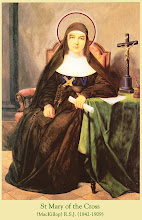
And for today, let us celebrate Bl Mary MacKillop, praying that her good works be not extinguished, but may continue to bring forth fruit for the Church.
(And it has been nice to kick back after work on cold evenings keeping toasty before the blazing fire, with a good bottle of wine and a pile of books...)
I am awaiting the response to some interview questions...
Best wishes to all for that most glorious feast of Our Lord's Transfiguration, revealing to His chosen three somewhat of the effulgence of His Divinity, strengthening them against the scandal of the Cross, and by His metamorphosis shewing how His elect shall shine like the sun in the Kingdom of His Father.
Best wishes, too, for the Feast of St Sixtus and Companions, Pope and Martyrs - a forefeast, as it were, of that martyred Pontiff's most saintly deacon, Lawrence, whose feast approaches.
And for today, let us celebrate Bl Mary MacKillop, praying that her good works be not extinguished, but may continue to bring forth fruit for the Church.
Sunday, February 17, 2008
Metamorphosis
The promise of heaven as reward for our labours in Christ is put before us today.
Of course, no natural works can ever merit a supernatural reward, but as members of the Body of Christ, His merits are our own, if we are indeed supernaturally united to Him, and so our good deeds, done for God's glory, inspired by His grace and perfected by the same, become supernaturally meritorious, and earn for us the immarcescible crown (I Peter v, 4) - an endless reward, to be ever with the Lord, a prodigal recompense for our sorrows, labours, and trials here in this passing life.
 Our Lord's Transfiguration is not only His manifestation of His glory and majesty, to arm His disciples against despair at the sight of his fast-approaching Passion: it is His promise of what believers shall attain, if only, persevering to the end, they are saved.
We ought (as Fr Rowe preached today) frequently to repeat the prayer of St Peter, "Lord, it is good to be here" - that is, Lord, it will be good to be with Thee in heaven: grace me to attain it.
Just as last Sunday we were shown Satan's machinations, and forewarned of Hell, so today we glimpse Heaven, that last of the Last Things, toward which we should strive. As the first postulate of practical reason informs us - Eschew Evil, Seek after Good.
It is not for nothing that, besides the Synoptic Gospellers (St Matthew xvii, 1-9; St Mark ix, 1-9; St Luke ix, 28-36), St John alludes to this great theophany: "And we have seen His glory, the glory as of the Only Son of the Father, full of grace and truth" (i, 14), in words repeated at the end of every classical Roman Mass. St Peter, too, in his second "encyclical", speaks of this sacred doctrine, in words linking the Transfiguration (II St Peter i, 16-18) to our own deification (II St Peter i, 4):
II St Peter
1:1 Simon Peter, servant and apostle of Jesus Christ, to them that have obtained equal faith with us in the justice of our God and Saviour Jesus Christ.
2 Grace to you and peace be accomplished in the knowledge of God and of Christ Jesus our Lord:
3 As all things of his divine power which appertain to life and godliness, are given us, through the knowledge of him who hath called us by his own proper glory and virtue.
4 By whom he hath given us most great and precious promises: that by these you may be made partakers of the divine nature: flying the corruption of that concupiscence which is in the world.
...
10 Wherefore, brethren, labour the more, that by good works you may make sure your calling and election. For doing these things, you shall not sin at any time.
11 For so an entrance shall be ministered to you abundantly into the everlasting kingdom of our Lord and Saviour Jesus Christ.
...
16 For we have not by following artificial fables, made known to you the power, and presence of our Lord Jesus Christ; but we were eyewitnesses of his greatness.
17 For he received from God the Father, honour and glory: this voice coming down to him from the excellent glory: This is my beloved Son, in whom I am well pleased; hear ye him.
18 And this voice we heard brought from heaven, when we were with him in the holy mount.
On a somewhat lesser note, I close with mention of today's beautiful Introit, which we sang at Mass: "Reminiscere miserationem tuarum Domine..." (Remember Thy mercies, O Lord...), with its beautiful intonation and swelling notes. It reminds me of that other sentence of Scripture: "In all thy works remember thy last end, and thou shalt never sin" (Ecclesiasticus vii, 40). Would that I would! Thank God for confession and absolution, recently given and received, but always needed again... This life is a warfare: Remember thy mercies, O Lord.

After the end of Mass, we sang (perhaps more appropriate to last Sunday!) "Forty days and forty nights", whose words and stirring Germanic tune may be accessed here.
Of course, no natural works can ever merit a supernatural reward, but as members of the Body of Christ, His merits are our own, if we are indeed supernaturally united to Him, and so our good deeds, done for God's glory, inspired by His grace and perfected by the same, become supernaturally meritorious, and earn for us the immarcescible crown (I Peter v, 4) - an endless reward, to be ever with the Lord, a prodigal recompense for our sorrows, labours, and trials here in this passing life.
Our Lord's Transfiguration is not only His manifestation of His glory and majesty, to arm His disciples against despair at the sight of his fast-approaching Passion: it is His promise of what believers shall attain, if only, persevering to the end, they are saved. We ought (as Fr Rowe preached today) frequently to repeat the prayer of St Peter, "Lord, it is good to be here" - that is, Lord, it will be good to be with Thee in heaven: grace me to attain it.
Just as last Sunday we were shown Satan's machinations, and forewarned of Hell, so today we glimpse Heaven, that last of the Last Things, toward which we should strive. As the first postulate of practical reason informs us - Eschew Evil, Seek after Good.
It is not for nothing that, besides the Synoptic Gospellers (St Matthew xvii, 1-9; St Mark ix, 1-9; St Luke ix, 28-36), St John alludes to this great theophany: "And we have seen His glory, the glory as of the Only Son of the Father, full of grace and truth" (i, 14), in words repeated at the end of every classical Roman Mass. St Peter, too, in his second "encyclical", speaks of this sacred doctrine, in words linking the Transfiguration (II St Peter i, 16-18) to our own deification (II St Peter i, 4):
II St Peter
1:1 Simon Peter, servant and apostle of Jesus Christ, to them that have obtained equal faith with us in the justice of our God and Saviour Jesus Christ.
2 Grace to you and peace be accomplished in the knowledge of God and of Christ Jesus our Lord:
3 As all things of his divine power which appertain to life and godliness, are given us, through the knowledge of him who hath called us by his own proper glory and virtue.
4 By whom he hath given us most great and precious promises: that by these you may be made partakers of the divine nature: flying the corruption of that concupiscence which is in the world.
...
10 Wherefore, brethren, labour the more, that by good works you may make sure your calling and election. For doing these things, you shall not sin at any time.
11 For so an entrance shall be ministered to you abundantly into the everlasting kingdom of our Lord and Saviour Jesus Christ.
...
16 For we have not by following artificial fables, made known to you the power, and presence of our Lord Jesus Christ; but we were eyewitnesses of his greatness.
17 For he received from God the Father, honour and glory: this voice coming down to him from the excellent glory: This is my beloved Son, in whom I am well pleased; hear ye him.
18 And this voice we heard brought from heaven, when we were with him in the holy mount.
On a somewhat lesser note, I close with mention of today's beautiful Introit, which we sang at Mass: "Reminiscere miserationem tuarum Domine..." (Remember Thy mercies, O Lord...), with its beautiful intonation and swelling notes. It reminds me of that other sentence of Scripture: "In all thy works remember thy last end, and thou shalt never sin" (Ecclesiasticus vii, 40). Would that I would! Thank God for confession and absolution, recently given and received, but always needed again... This life is a warfare: Remember thy mercies, O Lord.
After the end of Mass, we sang (perhaps more appropriate to last Sunday!) "Forty days and forty nights", whose words and stirring Germanic tune may be accessed here.
Subscribe to:
Posts (Atom)