Showing posts with label St Bonaventure. Show all posts

Saturday, March 20, 2010

Opera Christi non deficiunt, sed proficiunt

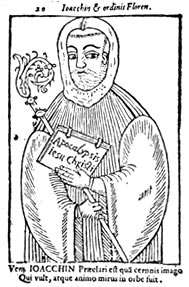
I recommend readers to attend to the inestimable Fr Z's reading of good Pope Benedict's third General Audience address about St Bonaventure, in which the Supreme Pontiff, referring to Bonaventure's theology of history, demonstrates how Joachimism is false, and how, just as Bonaventure's wisdom defeated the Franciscan spirituals of his day, so we should avoid the error of those who ceaselessly invoke the "spirit of the Council" while pretending that what we need is to sweep away all hierarchy and doctrine.

Joachimism, of course, is the belief that history is divided into three eras, and that, just as the era of the Father and of the Old Testament and of the Jewish Church is over and gone, so too the era of the Son and of the New Testament and of the Catholic Church is past, and (heralded by St Francis) what has now come is the third and final era, that of the Spirit and of the "Eternal Gospel" and of spiritual men, with no Church anymore.

The parallels between Joachimism and the nonsense dissenters promulgate about the "spirit" of Vatican II and even Vatican III (their hoped-for, fondly imagined future Council at which everything restrictive will be abolished and everything forbidden be allowed) are obvious.  Even the way that self-styled progressives have hijacked Bl John XXIII, who was no liberal, parallels the Joachimite belief in a Papa Angelicus who would drastically change the Church.

Consider the dismissive way that "progressives" consider everything in the Church from the age of Constantine (when allegedly she was corrupted by power - already a current debate in the time of Dante) till 1965 to be clericalist, obscurantist and corrupt... consider their hope for a future Utopia (indeed, a No-Place), when their project of mocking and rejecting all Catholic truth and practice will be complete.
But the Pope repeats forcefully what Bonaventure so rightly said: Opera Christi non deficiunt, sed proficiunt – the works of Christ fail not, but they prosper.  Indeed new good things arise, and old things are revitalized: the wise steward brings forth things both old and new from the garner.  Christ's work will never fail, but in every age flourish anew, just as St Francis and St Dominic were raised up in their day, revitalizing the Church, ancient but ever-new, with their own innovative charisms, yet in substantial continuity with the past.  

Here is the philosophical rejection of the hermeneutic of rupture, and the affirmation of the hermeneutic of continuity.  Here is one central message of this Papacy, guided by the thought of St Bonaventure that the young Ratzinger diligently studied long years before.  It would be mad and self-contradictory to imagine building a new Church, and condemning the old: in such a case, Christ's promises would have failed, and we'd be better off being Jews.

After all, the theology of history presented by Abbot Joachim of Fiore smacks of Tritheism not orthodox Trinitarianism: there are not three gods, each better than the next, but one God in three Persons, Whose final Word is Christ, and Whose Holy Spirit reveals to us the depths of Christ's message without changing it.  Similarly, all newfangled attempts to reject 1600 years of Church history as evil are frankly laughable, and evidently self-contradictory: and to work for a wholesale rejection of doctrine and practice is just to be another Protestant, five hundred years too late.

The Pope speaks:

We know, in fact, how after the Second Vatican Council, some were convinced that everything should be new, that there should be another Church, that the pre-conciliar Church was finished and that we would have another, totally "other" Church. An anarchic utopianism! And thanks be to God, the wise helmsmen of Peter’s Barque, Pope Paul VI and Pope John Paul II, on one hand defended the novelty of the council and on the other, at the same time, defended the uniqueness and continuity of the Church, which is always a Church of sinners and always a place of grace.

The Church is one and the same, always both ancient and new: as Hermas wrote in the subapostolic age, in The Shepherd, she appeared to him a beautiful woman, the spotless Spouse of the Lord, appearing both young and old, for such she is:

For she had appeared to me, brethren, in the first vision the previous year under the form of an exceedingly old woman, sitting in a chair. In the second vision her face was youthful, but her skin and hair betokened age, and she stood while she spoke to me. She was also more joyful than on the first occasion. But in the third vision she was entirely youthful and exquisitely beautiful, except only that she had the hair of an old woman; but her face beamed with joy, and she sat on a seat.   (3rd Vision, Chapter X)

He notes further that she appeared to him at first as old and frail, not because she was, but because he was mired in sin; then she appeared old but partly young as he gradually sloughed off his spiritual blindness and folly; only when he had regained righteousness did he perceive her truly.  Let fools attend!  It is our faults that make us spurn the Church of the Living God, to our peril.

Sancta Mater Ecclesia is beautiful, without spot or wrinkle, but she has the white hair of the old, betokening her age, which yet not makes her frail, but rather the Lord renews her youth as the eagle's.  The works of Christ do not fail, but prosper.

Wednesday, May 6, 2009

Fly Curiosity

From the Commentary of St Bonaventure on the Book of Ecclesiastes (I, 27. 28-34 (On Eccles 1:12-14)):

Curiosity – the prostitution of the mind to any chanced-on truth. 

I, Ecclesiastes, was king in Jerusalem. [(Eccles 1:12)] He has shown the vanity in things. Now from a reflection on the changeableness of reality he reprimands his curiosity. 

In this section he describes curiosity about works of nature or about reflection on divine works. First, he looks at the suitability of the one studying. Second, the curiosity of this person. Third, the severity of divine judgement. Fourth, he concludes with vanity

(Verse 12). So first, on the suitability of the person studying, he says: I, Ecclesiastes. And since he had wisdom, he calls himself Ecclesiastes, that is, preacher. He also had power. So he says: I was king. He also had peace. So he adds in Jerusalem, a word meaning a vision of peace. Sirach 47:15 says: “Solomon ruled in the days of peace.” 1 Chronicles 22:9 reads: “The son, who shall be born to you, shall be peaceful.” Because he had all these qualities, he did not refrain from study. 

(Verse 13). And I proposed in my mind [to seek and search out wisely concerning all things that are done under the sun]. Here in a second point he treats of his own curiosity, because he wanted to know and subtly investigate everything. So he says: And I proposed in my mind to seek, that is, from someone else, and search out wisely, by myself. And this is curiosity. Romans 12:3 has: “Do not be more wise than it behooves to be wise, but be wise unto sobriety.” Thus Proverbs 25:16 states: “You have found honey. Eat what is sufficient for you, lest, being glutted with it, you vomit it up.” – Concerning all things that are done under the sun. This is excessive curiosity because it is about everything. Sirach 3:24-25 reads: “In unnecessary matters be not over curious, and in many of his works you will have been inquisitive. For many things are shown to you above human understanding.” 

This worst occupation [God has given to men and women to be exercised therein]. He treats here of the third point, namely, the severity of divine judgement, because this condition comes from the divine judgement on the sin of the first parent. The sentence is that our rational ability may so freely run riot in the knowledge of earthly matters. So he says: this worst occupation, because it is not only culpable, but also a punishment. God has given to men and women, that is, allowed it to be given or gave it justly as a punishment. To be exercised therein, and so become forgetful of their own salvation. 

Note that an occupation is bad, because it comes from weakness. Sirach 40:1 states: “Great labour is created for all men and women, and a heavy yoke is upon the children of Adam, from the day of their coming out of their mother’s womb until the day of their burial into the mother of all.” – An occupation is worse, because it comes from ignorance. About this Job 3:5 says: “Let darkness and the shadow of death cover it. Let a mist overspread it, and let it be wrapped in bitterness.” – A third occupation is from curiosity, and this is worst. And it is of this that the author is speaking here. 

Note what Hugh [of St Victor] says: “An occupation is a distraction of the mind that turns away, distracts, and traps a soul from being able to think of what concerns salvation.” [(In Ecclesiasten, Hom. 5)] [And Hugh of St Cher says: “]Curiosity, however, is a wilful prostitution of a human mind, embracing any truth it chances on and being adulterous with it, because the first truth is the soul’s only spouse.[” (In lib. Ecclesiastæ, ad loc.)] 

(Verse 14). I have seen all things that are done [under the sun. And behold, all is vanity and vexation of spirit]. Here in a fourth place he treats of the vanity he has found, because he makes no further progress except that in his consideration he has found vanity. And so he says: I have seen all things that are done under the sun, that is, I have reflected on everything. And behold, all is vanity, that is, vanity is clearly evident in them because according to the Apostle in Romans 8:20: “All creation was made subject to vanity, but not willingly.” Indeed, not only subject to vanity, but also vexation of spirit

– But Thou, O Lord, have mercy upon us.  R/.  Thanks be to God.

RESPONSORY (Cf. Ecclus 3:22a,23,22b,24,26 (Vulg.))

R/. Seek not the things that are too high for you, and search not into things above your ability. For it is not necessary for you to see with your eyes those things that are hid. * But the things that God has commanded you, think on them always, and in many of his works be not curious. 
V/. In unnecessary matters be not over curious, and in many of his works be not inquisitive. The investigation of them has deceived many, and has detained their minds in vanity. * But the things that God has commanded you, think on them always, and in many of his works be not curious. 


******

My source for this scholastic exegetical text is  St Bonaventure's Commentary on Ecclesiastes, translated by Campion Murray & Robert J. Karris, in the "Works of St Bonaventure" series, Volume VI, (St Bonaventure, New York: Franciscan Institute Publications, 2005) 29,118,119-121. 

In quoting this, the quotations of Eccles 1:12-14 have been filled out from the translation of Ecclesiastes given on page 29 thereof, and appropriate citations from nn. 93-94 on page 119 have been inserted. All such additions are given in square brackets. 

The responsory is a new composition, based on the citation of Ecclus 3:24-25 in the quoted text (I,30). 

The slightly longer original text of St Bonaventure’s quotation from Hugh of St Cher is: “Curiosity, however, is nothing other than the wilful prostitution of the human mind, embracing any truth it chances upon, and fornicating with it, or to speak more truthfully, being adulterous with it. For the first truth, which is God, is human mind’s only spouse.” (In lib. Ecclesiastæ, ad Eccles 1:13.) 

For an analysis of the virtue of studiousness [studiositas] and the opposing vice of curiosity [curiositas], I would recommend recourse to St Thomas Aquinas' Summa Theologiæ, II-II, 166-167.