Showing posts with label Our Lady of Ransom. Show all posts

Friday, September 24, 2010

Morning Prayer: Judith

Thinking to pray with and for those Anglicans and Catholics (in both senses) who, God willing, will decide to enter the Ordinariates soon to be set up, I read Morning Prayer from my copy of the Book of Divine Worship, which is the already-existing first draft of the Anglican Use.  In its lectionary, I noted that there are alternative readings for this, the week of the Sunday closest to the 21st of September: either from Esther, or Judith.  Going on a hunch, remembering that to-day the 24th is kept in memory of Our Lady of Ransom, I chose Judith as an apt type of Our Lady: for in hewing off Holofernes' head, she foreshadowed Holy Mary treading Satan underfoot, as the Protoëvangelium long ago first predicted.

How to deal with unwelcome brutes

Herewith, the first lesson: Judith 13:1-20 (the whole chapter), which is the climax of the book, as herein shrewd Judith, having rendered Holofernes dead drunk, now strikes him dead with his own sword, and returns in triumph to her people, the Israelites beseiged at Bethulia, whereupon she wins their highest praise for saving them all (I quote from the R.S.V., which is what I use with the B.D.W., as closest to the K.J.V. and also being approved for Catholic use):
When evening came, his [Holofernes'] slaves quickly withdrew, and Bagoas closed the tent from outside and shut out the attendants from his master's presence; and they went to bed, for they all were weary because the banquet had lasted long. So Judith was left alone in the tent, with Holofernes stretched out on his bed, for he was overcome with wine. 
Now Judith had told her maid to stand outside the bedchamber and to wait for her to come out, as she did every day; for she said she would be going out for her prayers. And she had said the same thing to Bagoas. So every one went out, and no one, either small or great, was left in the bedchamber. Then Judith, standing beside his bed, said in her heart, "O Lord God of all might, look in this hour upon the work of my hands for the exaltation of Jerusalem. For now is the time to help thy inheritance, and to carry out my undertaking for the destruction of the enemies who have risen up against us." 
She went up to the post at the end of the bed, above Holofernes' head, and took down his sword that hung there. She came close to his bed and took hold of the hair of his head, and said, "Give me strength this day, O Lord God of Israel!" And she struck his neck twice with all her might, and severed it from his body. Then she tumbled his body off the bed and pulled down the canopy from the posts; after a moment she went out, and gave Holofernes' head to her maid, who placed it in her food bag.
Then the two of them went out together, as they were accustomed to go for prayer; and they passed through the camp and circled around the valley and went up the mountain to Bethulia and came to its gates. Judith called out from afar to the watchmen at the gates, "Open, open the gate! God, our God, is still with us, to show his power in Israel, and his strength against our enemies, even as he has done this day!"
When the men of her city heard her voice, they hurried down to the city gate and called together the elders of the city. They all ran together, both small and great, for it was unbelievable that she had returned; they opened the gate and admitted them, and they kindled a fire for light, and gathered around them. Then she said to them with a loud voice, "Praise God, O praise him! Praise God, who has not withdrawn his mercy from the house of Israel, but has destroyed our enemies by my hand this very night!"
Then she took the head out of the bag and showed it to them, and said, "See, here is the head of Holofernes, the commander of the Assyrian army, and here is the canopy beneath which he lay in his drunken stupor. The Lord has struck him down by the hand of a woman. As the Lord lives, who has protected me in the way I went, it was my face that tricked him to his destruction, and yet he committed no act of sin with me, to defile and shame me."
All the people were greatly astonished, and bowed down and worshiped God, and said with one accord, "Blessed art thou, our God, who hast brought into contempt this day the enemies of thy people."
And Uzziah said to her, "O daughter, you are blessed by the Most High God above all women on earth; and blessed be the Lord God, who created the heavens and the earth, who has guided you to strike the head of the leader of our enemies. Your hope will never depart from the hearts of men, as they remember the power of God. May God grant this to be a perpetual honor to you, and may he visit you with blessings, because you did not spare your own life when our nation was brought low, but have avenged our ruin, walking in the straight path before our God." And all the people said, "So be it, so be it!"
(Comparing the K.J.V. rendering, I find the R.S.V. to be just that, a revision; the only interesting textual difference is in verse 11, where the K.J.V. has "Jerusalem", not "Israel".  Two other differences are merely interesting: instead of the common word "sword", "fauchion" - more commonly, "falchion" - which is a curved broadsword, similar to a scimitar; and Uzziah is instead called Ozias.

(By comparison, the Douay has more phrasal differences, albeit none of any great consequence, encompassing the same tale in 26 verses.)

May the Anglicans coming into full communion with the Church, the new Jerusalem, likewise prove not to have been shamed by their dallying with Holofernes (or Henry VIII) - but rather to have taken up the sword of the spirit, the word of God, and with it confounded the enemy who entrapped them, before hieing themselves back to the camp of the true Israel.  Amen, amen.

Wednesday, September 24, 2008

Ember Wednesday; Our Lady of Ransom

I've been back at the day Hours of the Roman Breviary for a while now, altho' (to save time) I'm still reading the Office of Readings from the modern Office (Matins being too long for me at present), and it has been good to-day to have the Preces at Lauds and Vespers; good too to recite Lauds II, with the Canticle of Anna.  Of course, as a private addition I still say the once-prescribed Paters and Aves, etc., before and after each Hour, and have been using the Preces (including those formerly for Prime, the Little Hours, and Compline) as another addition, but to-day they were there as an integral part of the cursus and pensum.

To-day is also the commemoration of Our Lady of Ransom, originally to venerate her as the authoress of the Mercedarians, those daring and chivalrous religious who (together with their holy and zealous competitors, the Trinitarians) yearly ransomed Christian men from the Mussulman; but for England she has a special place as her to whom the Catholics of that realm pray for the return of their home to be once more her Dowry.  There in England still exists The Guild of Our Lady of Ransom, and this is their prayer (composed by Cardinal Wiseman):

Prayer for England

O Blessed Virgin Mary, Mother of God and our most gentle Queen and Mother, look down in mercy upon England, thy dowry, and upon us who greatly hope and trust in thee.

By thee it was that Jesus, our Saviour and our hope was given unto the world; and He has given thee to us that we might hope still more.

Plead for us thy children, whom thou didst receive and accept at the foot of the cross, O Sorrowful Mother.  Intercede for our separated brethren, that with us in the one true fold, they may be united to the Chief Shepherd, the Vicar of thy Son.

Pray for us all, dear Mother, that by faith, fruitful in good works we may all deserve to see and praise God, together with thee in our heavenly home.

AMEN.


It was good to-day also to make my confession; and while waiting in line for some time, somewhat perturbed, I was able to "redeem the time" and pray the Litanies of the Saints, of the Holy Name, of the Sacred Heart, and of the Precious Blood; and afterward, seven Ave's for a penance, and a grateful Te Deum.

How fitting, on this Ember Day, to pray this Collect, asking for the mediation of the Most Blessed Virgin that we be freed from the only true slavery, the degradation of sin, which is enchainment to the devil:

Deus, qui per gloriosíssimam Fílii tui Matrem, ad liberándos Christi fidéles a potestate paganórum nova Ecclésiam tuam prole amplificáre dignátus es: præsta, quæsumus; ut, quam pie venerámur tanti operis institutricem, ejus páriter meritis et intercessióne, a peccátis ómnibus et captivitáte dæmonis líberemur. Per eúmdem...

O God, who through the most glorious Mother of thy Son didst vouchsafe to increase thy Church with a new offspring for the redemption of thy Christian people from the power of the heathen: grant, we beseech thee, that like as we on this day do honour her for the work of her institution, so by her merits and intercession, we may be delivered from all our iniquities and the bondage of the devil. Through the same...

Saturday, February 9, 2008

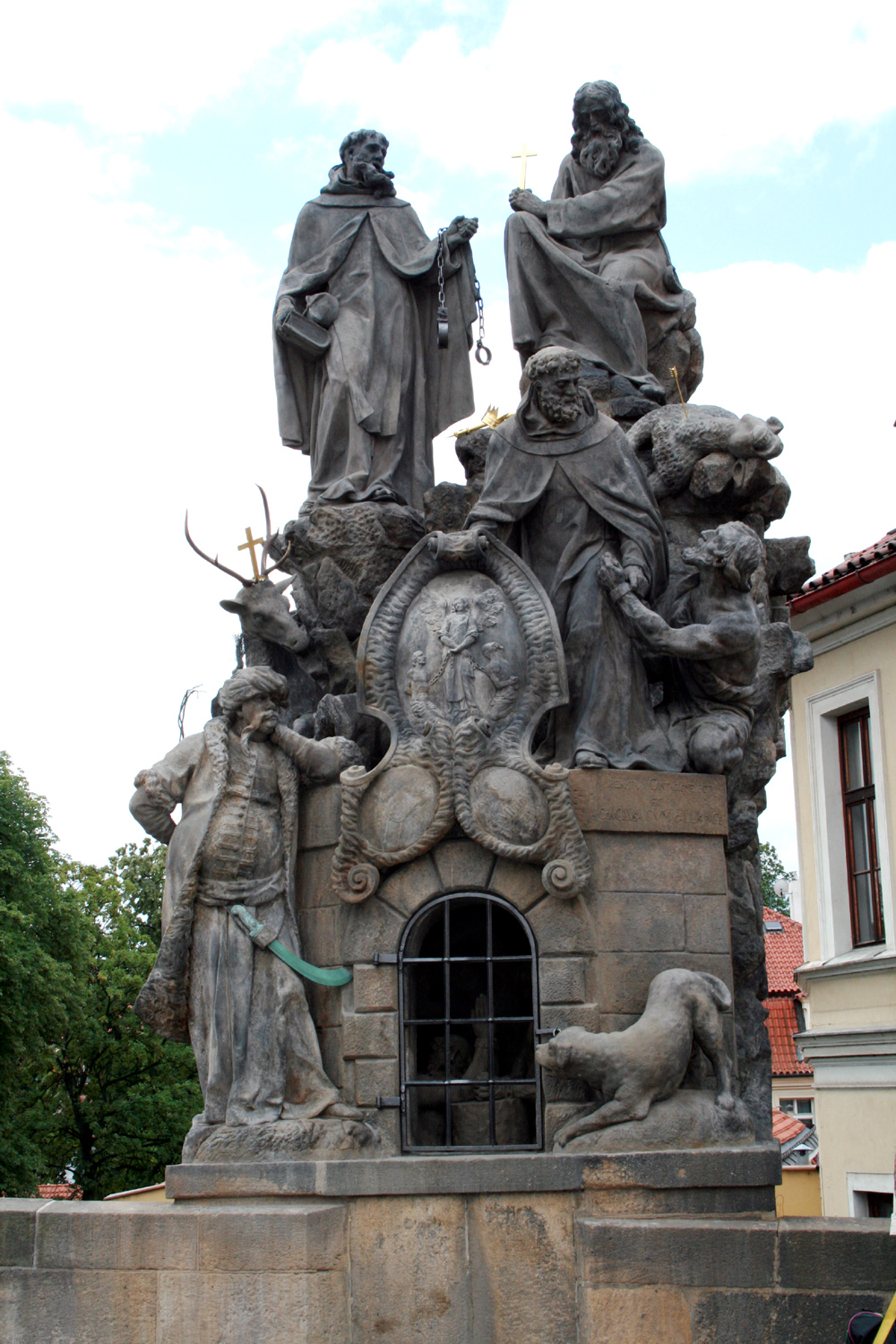
Trinitati Gloria, Captivis Libertas

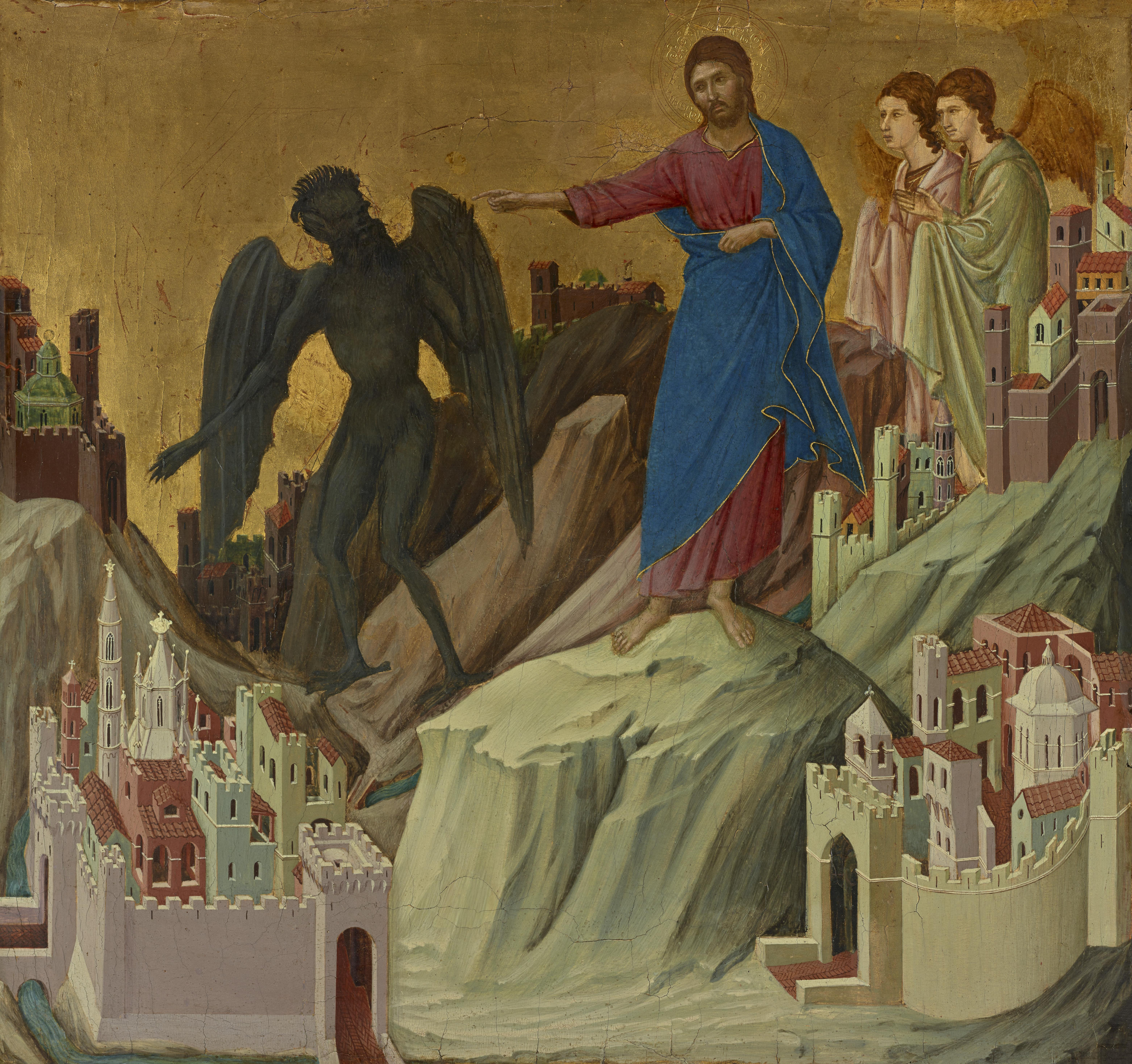
Christ's Triumph over Temptation

While having my confession heard by my ghostly father this day, he advised me to seek God's grace to conquer temptation, and in so doing imitate Our Lord God, Jesus Christ, Who remained night and day in prayer to His heavenly Father: for, though tempted by Satan forty days in the wilderness, He sinned not, but overcame all trials owing to His steadfast adherence [as man] to the Will of the Father [Whose Will is also His as God, since in the Trinity there is only one Divine Will]. Therefore, as penance he bade me read and reflect upon the Gospel of this the First Sunday of Lent (identical in both old and new rites, or rather forms of the one Roman Rite) - St Matthew iv, 1-11.


St Thomas Aquinas, I recalled while reading and thinking on the sacred text, avers that in this pericope we see how the machinations of the Devil are laid bare, for our instruction and forewarning. (The Common Doctor's own commentary on this passage can be found, in Latin, here; and of course he discusses the Temptation of Christ in the Summa Theologiae, III, 41 - most especially, in art.4, resp.)

First - as we know in our own lives - the crafty tempter proposes some seeming good within our power, such as, in our Lord's case. to turn stones into bread: which would seem innocent of harm, but in fact would have been incorrect, as a prostitution of wonderworking for menial and base ends conducing not to the furtherance of the Kingdom (whereas the miracles of the multiplication of the loaves and fishes were aimed at not so much sating the hunger of the many as shewing them Who it was that preached conversion to them). Second, the Evil One suggests some secretly prideful and presumptuous act, as to tempt God by calling for divine aid on the pretext of a twisted scripture. Third - here Satan uncloaks himself - he shamelessly calls us to do that which is most vile and base, as to commit devil-worship for the sake of filthy lucre and temporal sovereignty, or for whatever wrongful end.

Our Lord, however, defeats him who is a liar and murderer from the beginning by the force of the truth of God's word, in each case proving from the five books of Moses that the action proposed is contrary to faith and morals. Thus ought we depend more on God's word than on any fleshly food; thus ought we never place ourselves in some occasion of sin whereby we vainly put God to the test to see if He will save us from ourselves and our inclinations to evil;thus ought we above all remember at all times "The Lord thy God shalt thou adore, and Him only shalt thou serve".

Redemption from the Slavery of Sin

I also reflected today on two Orders, their saints, and the liturgical collects thereof, being very pertinent to the theme of being loosed from the slavery of sin and made God's children and free: those relating to the Trinitarians and Mercedarians. Both religious societies were set up, in answer to heavenly insinuations, within a few decades of each other (in 1198 and 1218/1235 respectively), and for the same object, the ransoming and rescue of Christian men held captive by the Moors and Saracens.

The former was founded by SS John of Matha and Felix of Valois, upon reception of various signs and revelations from heaven, also shared by the great Pope Innocent III, who clothed them in their white habit marked with the red and blue cross previously shewn them between the antlers of a stag, and named them the Order of the Most Holy Trinity by reason of their tricolour vesture; their Order's motto is Trinitati Gloria, Captivis Libertas ("Glory to the Trinity; to Captives, Liberty"), or, as a prayer, Gloria tibi Trinitas, et captivis libertas ("Glory to Thee, O Trinity, and to captives, liberty!").

The latter, named in honour of Our Lady of Ransom or of Mercy, she who manifested the will of heaven to her chosen instruments St Peter Nolasco (together with, it is said, his confessor, St Raymond of Peñafort, O.P.) and King James of Aragon, was co-founded by these men; one of its first and most famous members was St Raymond Nonnatus, so called because delivered by caesarean section after his mother's death. St Peter Nolasco died while praying the 110th Psalm, at the verse Redemptionem misit Deus populo suo ("God hath sent redemption unto His people" ).

These saints are commemorated in the 1962 Missal with very apposite prayers, as follows:

St Peter Nolasco, Confessor, Mercedarian - 28th January:
Deus, qui in tuæ caritátis exémplum, ad fidélium redemptiónem sanctum Petrum Ecclésiam tuam nova prole fœcundáre divínitus docuísti : ipsíus nobis intercessióne concéde ; a peccáti servitúte solútis, in cælésti pátria perpétua libertáte gaudére: Qui vivis et regnas...

(O God, Who for an ensample of Thy charity, didst divinely teach holy Peter to make fruitful Thy Church with a new offspring, for the redemption of the faithful: by his intercession grant unto us, being delivered from the bondage of sin, to rejoice in the endless freedom of our heavenly fatherland. Who livest and reignest...)
St John of Matha, Confessor, Trinitarian - 8th February:
Deus, qui per sanctum Joánnem órdinem sanctíssimæ Trinitátis ad rediméndum de potestáte Saracenórum captívos cælitus institúere dignátus es: præsta, quæsumus; ut, ejus suffragántibus méritis, a captivitáte córporis et ánimæ, te adjuvánte, liberémur. Per Dóminum...

(O God, Who through saint John didst deign in heavenly manner to institute the Order of the Most Holy Trinity for the redemption of captives from the power of the Saracens: grant, we beseech Thee, that at the intercession of his merits, we may by Thee be delivered from all bondage both of body and soul. Through...)
St Raymond Nonnatus, Confessor, Mercedarian - 31st August:
Deus, qui in liberandis fidelibus tuis ab impiórum captivitáte beátum Raymundum Confessórem tuum mirábilem effecísti: ejus nobis intercessióne concéde; ut a peccatórum vínculis absoluti, quæ tibi sunt placita, liberis méntibus exsequámur. Per Dóminum...

(O God, Who didst effect Thy blessed Confessor Raymond marvellous in the deliverance of Thy faithful from the capitivity of the impious: by his intercession grant us that, the bonds of sin being dissolved, with free minds we may perform those things which are pleasing unto Thee. Through...)
Our Lady of Ransom, or, of Mercy - 24th September:
Deus, qui per gloriosíssimam Fílii tui Matrem, ad liberándos Christi fidéles a potestate paganórum nova Ecclésiam tuam prole amplificáre dignátus es: præsta, quæsumus; ut, quam pie venerámur tanti operis institutricem, ejus páriter meritis et intercessióne, a peccátis ómnibus et captivitáte dæmonis líberemur. Per eúmdem Dóminum nostrum...

(O God, Who by the most glorious Mother of Thy Son didst vouchsafe to increase Thy Church with a new offspring for the redemption of Christ's faithful from the power of the heathen: grant, we beseech Thee, that as we piously revere the Institutrix of so great a work, by her equal merits and intercession, we may be delivered from all sins and the bondage of the devil. Through the same...)
St Felix of Valois, Confessor, Trinitarian - 20th November:
Deus, qui beátum Felícem Confessórem tuum ex erémo ad munus rediméndi captívos cælitus vocáre dignátus es: præsta, quæsumus; ut per grátiam tuam ex peccatórum nostrórum captivitáte, ejus intercessióne, liberáti, ad cæléstem pátriam perducámur. Per Dóminum...

(O God, Who by a heavenly inspiration didst deign to call blessed Felix Thy Confessor from the desert to the work of the redeeming of captives: grant, we beseech thee, that, by Thy grace, at his intercession, delivered from the captivity of our sins, we may be brought to our heavenly fatherland. Through...)