Showing posts with label Elevation. Show all posts

Saturday, November 7, 2015

Cistercian Elevation Chants

UPDATE: I have made a more accurate transcription of all three elevation chants.

The Cistercian Rite retained down to the liturgical changes of the 1960's the mediæval practice of singing an elevation motet after the elevation of the Host; and presumably all EF Masses in the Cistercian Rite still retain this laudable and pious custom. At Mass, after the chanted Sanctus, but before the Benedictus, the O salutaris Hostia is sung after the elevation; however, if it be Mass in honour of the Blessed Virgin, the Sanctus and Benedictus are sung first, and then the Ave verum after the elevation. The Cistercian version of the Ave verum includes a slight change in wording (fudit aquam cum, not fluxit aquam et), an additional last phrase (Tu nobis miserere, set to the same notes as fili Mariæ) and a few minor variants in the assignment of notes to syllables (for in exa- and …li Mari…).

At Requiem Masses, the Sanctus and Benedictus are sung first, then the Pie Jesu after the elevation. This last chant is particularly interesting, as it is clearly based on a variant tune for the last lines of the Sequence Dies iræ, which is not sung in the Cistercian liturgy. The invocation Pie Jesu Domine, dona eis requiem is sung thrice, then sempiternam (from the Agnus Dei melody) is appended, with a final Amen. 

Herewith, the Cistercian O salutaris Hostia (whose melody is a slightly more elaborate variant of the Roman), Ave verum, and Pie Jesu:


At present, I like to silently pray these three in succession after the Elevation, during the silent Canon of the Mass.

Saturday, April 17, 2010

Easter Treasures

At the Sunday Vigil Mass this evening (after going for an afternoon drive to Bridport, coming back via Scottsdale), I was moved as always by the Easter Vespers hymn (the Hour I'd just finished before the Liturgy), Ad cenam Agni providi, which I know by heart in English as "At the Lamb's high feast we sing" – I prayed over it at Communion time, just as I made two of its verses, O vera digna hostia and Quæsumus Auctor omnium, my Eastertide aspirations at the Elevation of the Host and Chalice.  These two Easter treasures, together with others, I blogged on two years back: if interested further, read my posting...

Monday, December 21, 2009

Hooray for Doubting Thomas


Happy feast of St Thomas to all who follow the older Calendar! (Why is it, by the way, that Anglicans of a certain spikiness spell it "Kalendar"?)

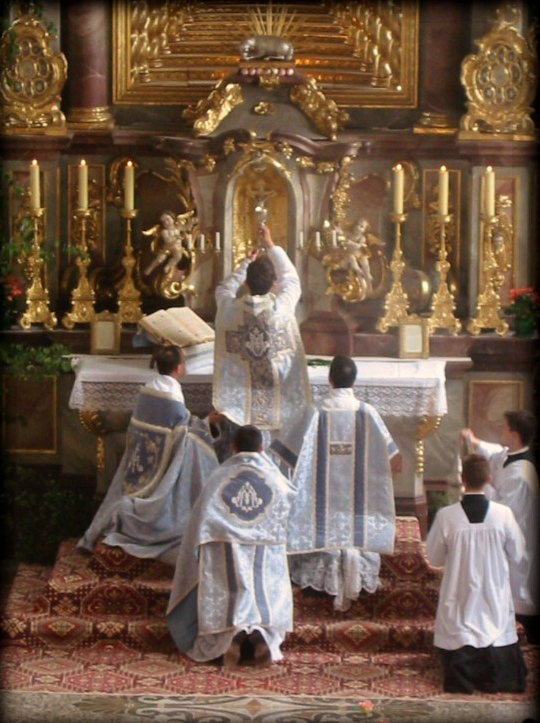
His doubts, by the providence of God, were permitted that he, coming to touch the Risen Christ's Sacred and Glorious Wounds, would thereby strengthen our faith, by confessing the invisible Godhead having touched the Word Who is Life, saying: "My Lord and My God" - which should be every man's prayer at the Elevation at Mass, when the Divine Victim is lifted up that He draw all men unto Him.


DOMINUS MEUS ET DEUS MEUS!


[Image of the Elevation of the Chalice of Christ's Precious Blood at a priest's first Mass - hence the assistant priest in cope - courtesy of the Priestly Fraternity of Saint Peter, available from http://fssp.org.]

Sunday, April 12, 2009

Easter Elevation Aspiration

Si consurrexistis cum Christo, quæ sursum sunt quærite, ubi Christus est in dexteram Dei sedens; quæ sursum sunt sapite, non quæ super terram.  Mortui enim estis, et vita vestra abscondita est cum Christo in Deo.  Cum Christus apparuerit, vita vestra, tunc et vos apparebitis cum ipso in gloria. - "If ye be risen with Christ, seek ye the things that are above, where Christ is, sitting at the right of God: savour the things that are above, not those that are upon earth.  For ye are dead, and your life is hidden with Christ in God.  When Christ appears, who is your life, then you also will appear with Him in glory."  (Col. iii, 1-4)

This is a favourite text of mine, being the Easter Vigil Epistle in the Old Rite, and the Easter Day Epistle in the New!  I know it (in Latin) by heart; the above English is my translation.  (The whole of Colossians iii could well form a complete rule of life.)

But why this?  Because it leads into my change of Elevation aspiration; normally, adoring the Host and Chalice as they are successively elevated, I pray the Ave verum; but during Eastertide, the following verses of Ad cenam Agni providi instead:

O vera, digna hostia,
Per quam franguntur tartara,
Captiva plebs redimitur,
Redduntur vitæ præmia.

(O true, worthy Victim, / By Whom Tartarus is smashed, / A captive people redeemed, / The rewards of life restored.)

Quæsumus, Auctor omnium,
In hoc paschali gaudio,
Ab omni mortis impetu
Tuum defende populum.  Amen.

(We beg, Author of all, / In this paschal joy, / From all motions of death / Defend Thy people.  Amen.)

[St Pius V breathed forth his pure soul to God while praying the last-quoted verse of this hymn.]

Sunday, January 20, 2008

Prayers for Mass - II

At Mass itself I add certain devotions, depending on whether I'm at the Traditional Mass, and if it's Low or High, if I'm serving or singing or whatnot, or whether instead I'm at ordinary Mass.

I tend to pay special attention to the orations of the Mass, the collect, secret, and postcommunion. Sometimes at the Offertory I may use the Dominican form of the Suscipe sancta Trinitas:


Suscipe, sancta Trinitas, hanc oblationem, quam tibi offero per manus sacerdotis tui, in memoriam passionis Domini nostri Jesu Christi; et praesta, ut in conspectu tuo tibi placens ascendat, et meam et omnium fidelium salutem operetur aeternam.


Passing over my particular direction of prayer and attention during the Canon, the consummation of the Mass, I always say the following, secretly of course! during the Elevations after the Consecration, sometimes in Latin, sometimes in English, usually some in each:


Omnis gloria tibi, Domine altissime.

Dominus meus et Deus meus, salva nos.

(For the Host)

Ave verum Corpus natum
de Maria Virgine,
vere passum, immolatum
in Cruce pro homine.

O Jesu dulcis,
O Jesu pie,
O Jesu Fili Mariae.

(For the Chalice)

Cujus latus perforatum
fluxit aqua et sanguine,
esto nobis praegustatum
mortis in examine.

O Jesu dulcis,
O Jesu pie,
O Jesu Fili Mariae.

Pie Jesu Domine, dona eis requiem.

In te, Domine, speravi, non confundar in aeternam.