Showing posts with label Chair of St Peter. Show all posts

Wednesday, February 22, 2017

Foundation Day

I headed off bright and early this morning to drive the 150 km south to Colebrook, arriving at 9:45 am. Gradually more and more familiar faces arrived. For we were all assembled with our Archbishop, well over a hundred laity and clergy together, to celebrate the foundation today of Notre Dame Priory at St Patrick’s, a beautiful Pugin-designed church that has waited 160 years for this great day, when, as we all remarked afterward, it was finally used for what it was built for: the full traditional liturgy of Solemn High Mass coram archiepiscopo in the late morning and Solemn Vespers mid-afternoon. The servers were the five young men who are the first candidates for the monastic life to arrive and begin the foundation, for the present in temporary accommodation in Lindisfarne; more will arrive in due course. 

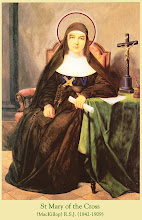
The Mass Propers of the Chair of St Peter were expertly sung by Ronan and friends, as was the Ordinary of the Mass (Mass IV and the little-used Credo V), all sensitively accompanied by Stephen Smith on the church’s recently-installed organ. His Grace preached, and, the sacred mysteries consummated and received, Fr Prior gave a speech of thanks after the Last Gospel, before a final Sub tuum at the Lady Altar together with prayer to St Joseph and invocations of St Mary of the Cross, secondary patroness of the new monastery, and of St Patrick, titular of the church. The morning liturgy lasted an hour and forty minutes all told.

We decamped to the Colebrook Hall for luncheon, where all and sundry had a great time catching up, toasting the foundation and delighting in such a joyful day. Afterwards, I had time to stroll around the little township before returning to church for Solemn Vespers (again expertly sung, lasting about 35 minutes) followed by Benediction (at exposition, Jesu dulcis memoria, then silent adoration, the usual Tantum ergo &c. before the blessing, the Divine Praises afterward, and at reposition the Benedictine Te decet laus), concluding at 5:30 pm.

After final farewells, I set off for home at six o’clock, and got back by eight. A wonderful day!

Friday, February 22, 2008

Obœdientia et Pax

The Venerable Baronius, that faithful disciple of St Philip Neri, used always to kiss the foot of the statue of St Peter in the Vatican Basilica, in token of his entire submission to Christ's Vicar on earth, the Pope, saying as he did so, Obœdientia et pax ("Obedience and peace"). I invite all sons of the Church to do the same this day, the Feast of Peter's Chair.

Act of Faith

O my God, I believe in Thee, and in all that Thy Holy Church teacheth, for Thou hast said it, and Thy Word is true.

I also offer my congratulations to my former parish priest, the (now Most Reverend) Geoffrey Jarrett, who seven years ago today was consecrated Bishop of Lismore, N.S.W. - ad multos annos, Your Lordship!

Monday, January 28, 2008

The Keys of Septuagesima

A pleasant coincidence, to which my attention was drawn while reading Dom Gueranger:

"As the season of Septuagesima depends upon the time of the Easter celebration, it comes sooner or later according to the changes of that great feast. January 18 and February 22 are called the 'Septuagesima keys', because the Sunday, which is called Septuagesima, cannot be earlier in the year than the first, nor later than the second, of these two days."

In other words, Septuagesima can fall as early as the 18th of January - formerly, one of the two feasts of the Chair of St Peter (and still able to be celebrated according to the '62 Missal) - or as late as the 22nd of February, the other (remaining) feast of the the Chair of St Peter.

Hence, these two dates are called the "keys" of Septuagesima.

Septuagesima can only fall on the 18th of January when Easter falls on its earliest possible date, the 22nd of March, in an ordinary, non-leap year: this last happened in 1818 and will next occur in 2285.

But as for Septuagesima falling on the 22nd of February - that can only happen when Easter falls on its latest possible date, the 25th of April, AND in a year that is a leap year. This has not happened since Pope Gregory brought in his new calendar and new system of calculating Easter, nor will it happen until some time after 3000AD. (Easter last fell as late as this in 1943, and this will happen again in 2038, but neither years are leap years, so Septuagesima in both cases takes place on the 21st of February.)

Apparently, the last time Septuagesima did occur on the 22nd of February happened under the old Julian calendar, according to the system then used to compute the date of Easter - in 1204. (And before that, in 672 according to the Roman method - but at that time several competing systems for finding the date of Easter were still in competition, as exemplified by the disputes leading to the famous Synod of Whitby.)

[For those parts of Protestant Europe that were still using the Julian calendar, in sectarian opposition to the Gregorian reform, 1736 was a year in which Septuagesima fell on the 22nd of February - this would have included Anglican England and Lutheran Scandinavia and Germany. The so-called Dionysian method for finding Easter, together with the Julian calendar, has Septuagesima on the 22nd of February quite punctually every 532 years; but this method has been long abandoned in the West, and of course the East doesn't keep Septuagesima.]

*Update* - after trawling through results from online Easter calculators, I find that the next bissextile (that is, leap) year to come in which Easter falls on the 25th of April is - 3784. So, provided the calendar is not amended (the Gregorian calendar would have lost about a day by then), nearly 18 centuries hence, and over 2500 years since it last happened, Septuagesima will fall on its latest possible date of the 22nd of February, in 3784.

(BTW, in 2011, only three years from now, Easter falls on the 24th of April, its second-latest possible day, so Septuagesima will then fall on the 20th of February, rather than on the 20th of January as it has done this year, in which Easter falls on its second-earliest possible date.)